
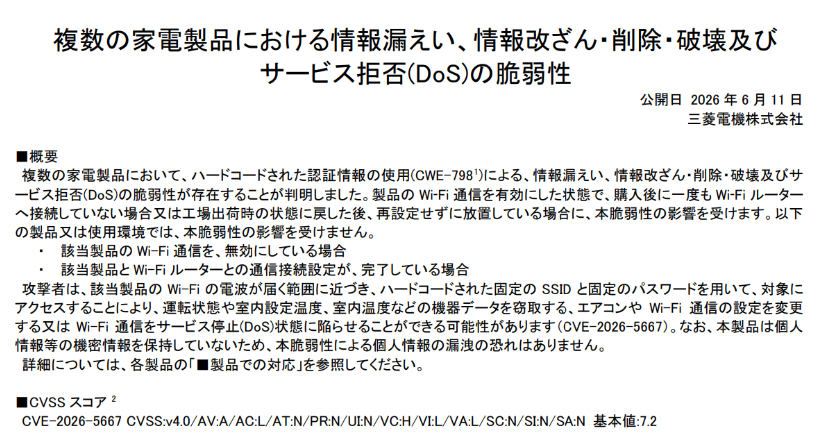
On June 11, Mitsubishi Electric announced that a wide range of its Wi-Fi-enabled home appliances—including air conditioners, refrigerators, water heaters, IH cooking heaters, and rice cookers—contain a security 脆弱性 (zeijakusei), or vulnerability.
The company is urging users to take action.
What Happened?
According to Mitsubishi Electric, the issue affects products such as the popular 霧ヶ峰 (Kirigamine) air conditioner series, along with several other household appliances equipped with Wi-Fi functionality.
The cause of the problem lies in the devices’ Wi-Fi feature. A fixed SSID (essu essu aidi, Wi-Fi network name) and password were ハードコード (haadokoodo)—embedded directly into the software.
Because of this, if an attacker is within wireless range and the device is left in a certain state, unauthorized access becomes possible.
The company explains that attackers could:
- Steal operation status or room temperature data
- Illegally change air conditioner settings
- Trigger a DoS (di oo esu) attack, stopping Wi-Fi communication
In Japanese, the explanation uses the phrase:
不正にアクセスすれば、〜を引き起こす可能性がある Fusei ni akusesu sureba, ~ o hikiokosu kanōsei ga aru “If accessed illegally, there is a possibility of causing ~”
That 可能性がある (kanōsei ga aru) structure is very common in news reports when describing risk.
Who Is Affected?
Not all users are at risk. The vulnerability applies only under specific conditions:
- The Wi-Fi function is still enabled
- The device has never been connected to a Wi-Fiルータ (wai-fai ruuta, Wi-Fi router)
- Or the device was reset to factory settings and left unconfigured
In this state, the fixed SSID and password remain active, allowing a nearby attacker to connect.
Importantly, the company states that these devices do not store personal or confidential information, so there is no risk of sensitive data leakage.
What Should Users Do?
Mitsubishi Electric recommends the following steps:
- Connect each device to a Wi-Fi router.
- Close the access point that the product automatically opens.
- Update the adapter software using each appliance’s dedicated app.
By updating the software, the vulnerability can be fixed.
If you do not have a Wi-Fi router, you can avoid the issue by disabling the Wi-Fi function entirely:
Wi-Fi機能を無効にする Wi-Fi kinō o mukō ni suru “Disable the Wi-Fi function”
For detailed instructions, the company provides guidance in a PDF document.
The countermeasure software for air conditioners sold in Japan is already 公開済み (kōkai zumi, already released). However:
- Some updates will be released in the future
- Some older models will not receive a fix
For those older models, users must either connect them to a Wi-Fi router or disable the Wi-Fi feature.
Cultural Context: Smart Homes in Japan
Japan has embraced connected home appliances, especially air conditioners. The 霧ヶ峰 (Kirigamine) brand is well-known domestically, and many households rely on remote control via smartphone apps—particularly during hot, humid summers.
However, this news reflects a broader issue in the tech world: as more everyday devices become internet-connected, cybersecurity risks increase. Even appliances like rice cookers and water heaters can become part of a network vulnerability.
Japanese news reports often use formal, technical phrasing to describe such risks, which makes this a great learning opportunity.
Learn Japanese from This Article
Vocabulary
| Japanese | Romaji | Meaning |
|---|---|---|
| 脆弱性 | zeijakusei | vulnerability (security weakness) |
| ハードコード | haadokoodo | hard-coded (embedded directly) |
| SSID | essu essu aidi | Wi-Fi network name |
| Wi-Fiルータ | wai-fai ruuta | Wi-Fi router |
| 無効にする | mukō ni suru | to disable |
| 公開済み | kōkai zumi | already released |
| DoS | di oo esu | Denial of Service attack |
Notice how many of these are written in katakana. Japanese frequently adapts global tech vocabulary this way.
Grammar Spotlight
1️⃣ 〜たため
Meaning: “because…” (formal written explanation)
From the article:
固定のSSIDとパスワードがハードコードされていたため、 Kotei no SSID to pasuwaado ga haadokoodo sarete ita tame, “Because a fixed SSID and password were hard-coded…”
Structure: Verb (past) + ため
Example sentences:
設定を変更したため、不具合が発生しました。 Settei o henkō shita tame, fuguai ga hassei shimashita. Because the settings were changed, a malfunction occurred.
接続していなかったため、問題が起きました。 Setsuzoku shite inakatta tame, mondai ga okimashita. Because it wasn’t connected, a problem happened.
This structure appears often in official announcements and news.
2️⃣ 〜可能性がある
Meaning: “there is a possibility that…”
Structure: Verb (dictionary form) + 可能性がある
Example:
- 不正アクセスされる可能性がある。 Fusei akusesu sareru kanōsei ga aru. There is a possibility of unauthorized access.
This expression is extremely common in Japanese risk reporting.
Useful Expression
対処を求める Taisho o motomeru “To call for action” or “urge a response”
You’ll often see this in news when companies or governments request that users or citizens take specific steps.
Continue Learning
📚 Working on your reading skills? Our Katakana Essentials: Adapting Global Words to Japanese lesson is a great next step.
📚 Curious about the Japanese used here? Our Basic Vocabulary Building: Embracing Words Without Latin Ties lesson covers this in depth.
Basic Vocabulary Building: Embracing Words Without Latin Ties
📚 Curious about the Japanese used here? Our Reading and Writing in Japanese II: Hiragana and Katakana lesson covers this in depth.
これからもよろしくお願いします。 Kore kara mo yoroshiku onegaishimasu.