
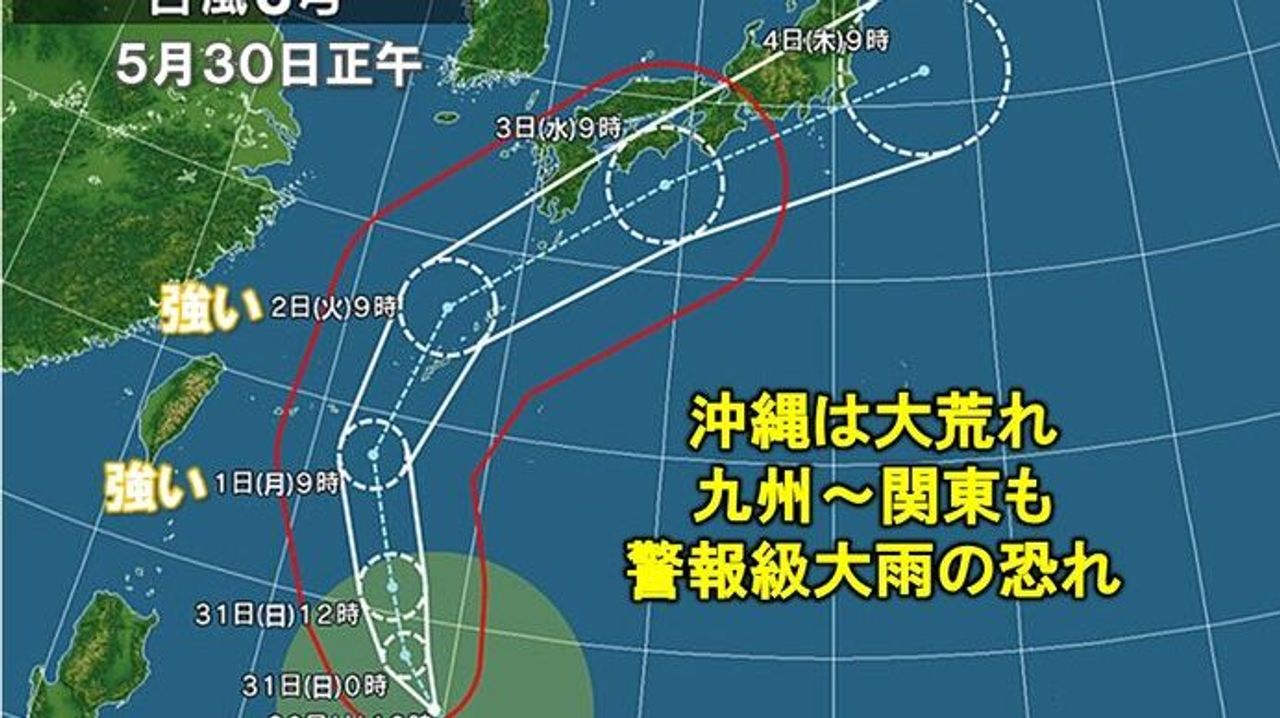
Typhoon No. 6 is expected to approach Okinawa and Amami with strong intensity from June 1 (Monday) to June 2 (Tuesday), bringing powerful winds and dangerous seas.
According to the report, the typhoon will move toward the region while maintaining significant 勢力 (seiryoku), or strength. It is forecast to enter the 暴風域 (bōfūiki), the storm zone with violent winds, as it 接近する (sekkin suru), or approaches, Okinawa and Amami.
Severe Conditions Expected in Okinawa and Amami
Residents in Okinawa and Amami are being warned of:
- 猛烈な風 (violent winds)
- 猛烈なしけ (extremely rough seas)
- 警報級の大雨 (keihō-kyū no ōame) — warning-level heavy rain
- 高潮 (takashio) — storm surges
The phrase 警報級 (keihō-kyū) means “on the level of a weather warning.” In Japan, weather agencies issue different stages of alerts, and a warning-level event signals serious danger.
The report also states that there is an 恐れがある (osore ga aru) — a risk or possibility — of storm surges and heavy rainfall. This expression is commonly used in Japanese news to indicate potential danger without stating it as a certainty.
Typhoon May Spread Its Impact Across Japan
After passing Okinawa and Amami, the typhoon is expected to approach western and eastern Japan as well.
At the same time, a 前線 (zensen), or weather front, is forecast to 活発化する (kappatsuka suru) — become more active or intensify. When a typhoon interacts with a seasonal front in Japan, rainfall can become even heavier.
Because of this combination, areas from Kyushu to the Kanto region and even the Pacific side of Tohoku may experience 警報級の大雨 (keihō-kyū no ōame), or warning-level rainfall.
Cultural Context: Why Typhoon Reports Matter in Japan
Typhoons are a regular part of Japan’s weather pattern, especially from early summer into autumn. Regions such as Okinawa and Amami, located in the southern part of the country, are often the first to experience approaching storms.
Japanese news reports tend to be precise and cautious. Instead of dramatic language, they frequently use structured expressions like:
- 〜にかけて (~ni kakete) — “from… to…” (spanning a period)
- 〜恐れがある (~osore ga aru) — “there is a risk that…”
Understanding these patterns will help you read real Japanese weather reports with confidence.
Learn Japanese from This Article
Key Vocabulary
| Japanese | Romaji | Meaning |
|---|---|---|
| 暴風域 | bōfūiki | storm zone (area with strong winds) |
| 接近する | sekkin suru | to approach |
| 勢力 | seiryoku | strength; intensity (of a typhoon) |
| 警報級 | keihō-kyū | warning-level |
| 高潮 | takashio | storm surge |
| 前線 | zensen | weather front |
| 活発化する | kappatsuka suru | to become active; to intensify |
Grammar Spotlight
1. 〜にかけて
Meaning: From (time/place) to (time/place); spanning
Example from the article: 6月1日から2日にかけて Rokugatsu tsuitachi kara futsuka ni kakete “From June 1 to June 2”
You can also use it for places:
- 九州から関東にかけて大雨が降る。 Kyūshū kara Kantō ni kakete ōame ga furu. Heavy rain will fall from Kyushu to Kanto.
This structure emphasizes a continuous stretch across time or area.
2. 〜恐れがある
Meaning: There is a risk/possibility that
高潮の恐れがある。 Takashio no osore ga aru. There is a risk of storm surge.
警報級の大雨となる恐れがあります。 Keihō-kyū no ōame to naru osore ga arimasu. There is a possibility of warning-level heavy rain.
This is a very common news expression. You’ll see it in weather, disaster, and public safety reports.
Useful Expression
- 強い勢力で接近する Tsuyoi seiryoku de sekkin suru “To approach with strong intensity”
This pattern — noun + で — often describes the condition or state in which something happens.
Continue Learning
Curious about the Japanese used here? Our Reading and Writing in Japanese II: Hiragana and Katakana lesson covers this in depth.
Working on your reading skills? Our Introduction to Kanji: Pictorial Foundations of Japanese Script lesson is a great next step.
Want to strengthen your overall vocabulary? Check out Basic Vocabulary Building: Embracing Words Without Latin Ties.
Typhoon reports may seem technical at first, but they’re actually excellent practice for real-world Japanese. The more you read expressions like 警報級 and 恐れがある, the more natural news-style Japanese will feel.
これからもよろしくお願いします。 Kore kara mo yoroshiku onegaishimasu.