
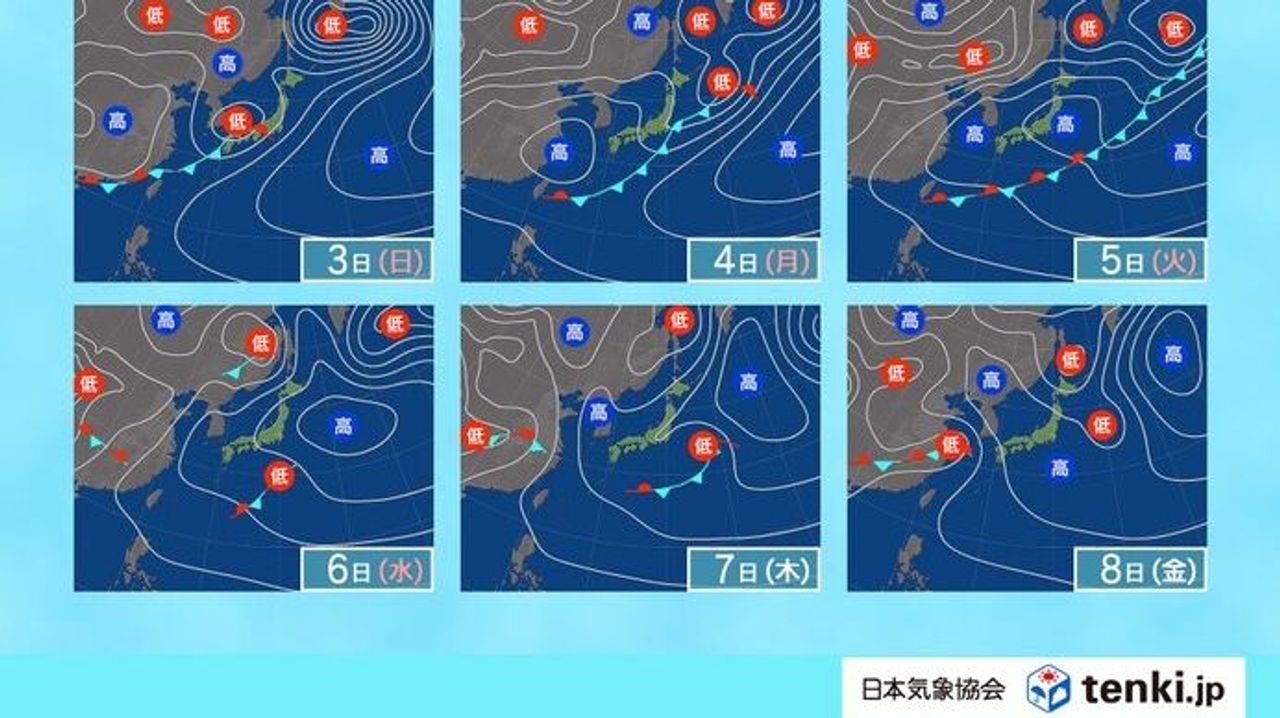
This year’s ゴールデンウィーク (gōruden wīku) will bring rapidly changing weather across Japan, with repeated periods of 荒天 (kōten), or stormy conditions, expected throughout the holiday.
According to the forecast, the weather will shift in short cycles, meaning sunny skies may not last long before being replaced by rain and strong winds.
Rapid Changes During Golden Week
On Saturday the 2nd, conditions will recover from Kyushu through the Kanto region. In other words, western and eastern parts of mainland Japan are expected to see improving weather.
However, in the Tohoku and Hokkaido regions, there is a risk of 暴風 (bōfū), or violent winds.
From Sunday the 3rd (Constitution Memorial Day) to Monday the 4th (Greenery Day), low atmospheric pressure systems and weather fronts will once again affect the country. Because of these 低気圧 (teikiatsu) and 前線 (zensen), rain and strong winds are expected nationwide.
In particular, from Kyushu to the Tokai region, there is an 恐れ (osore) — a risk — of 警報級 (keihō-kyū) heavy rain. The term keihō-kyū means rainfall serious enough to warrant an official weather warning.
Why This Matters: Golden Week in Japan
ゴールデンウィーク (gōruden wīku) is one of Japan’s most important holiday periods, made up of several national holidays clustered together in late April and early May.
Two holidays mentioned in the forecast are:
- 憲法記念日 (kenpō kinenbi) — Constitution Memorial Day (May 3)
- みどりの日 (midori no hi) — Greenery Day (May 4)
Many people travel, return to their hometowns, or enjoy outdoor activities during this time. That’s why forecasts about 荒天 (kōten) and 警報級 (keihō-kyū) rain are especially important. Bad weather during Golden Week can significantly affect travel and events.
Understanding how weather is reported in Japanese also gives you insight into how formal and precise public announcements are made in Japan.
Learn Japanese from This Article
Let’s break down key vocabulary and grammar you can use in real life.
Key Vocabulary
| Japanese | Romaji | Meaning |
|---|---|---|
| ゴールデンウィーク | gōruden wīku | Golden Week (series of national holidays) |
| 荒天 | kōten | stormy or severe weather |
| 暴風 | bōfū | violent wind, gale |
| 低気圧 | teikiatsu | low atmospheric pressure |
| 前線 | zensen | weather front |
| 警報級 | keihō-kyū | warning-level (serious enough for an official alert) |
| 恐れ | osore | risk, possibility (usually negative) |
| 回復する | kaifuku suru | to recover, improve (weather, health, etc.) |
| 影響 | eikyō | influence, effect |
Notice how many of these words use kanji that visually reflect meaning. For example:
- 風 in 暴風 means “wind.”
- 低 in 低気圧 means “low.”
If you're building your kanji knowledge, recognizing these components makes reading forecasts much easier.
Grammar Spotlight 1: 〜恐れがあります
Pattern: [Verb (plain form)] + 恐れがあります “There is a possibility/risk that…”
This expression is often used in formal announcements and news reports, especially for negative outcomes.
From the article:
- 警報級の大雨となる恐れがあります。 Keihō-kyū no ōame to naru osore ga arimasu. There is a possibility of warning-level heavy rain.
More examples:
事故が起こる恐れがあります。 Jiko ga okoru osore ga arimasu. There is a risk that an accident may occur.
電車が遅れる恐れがあります。 Densha ga okureru osore ga arimasu. There is a possibility that trains may be delayed.
This phrase sounds formal and is commonly used by officials and media.
Grammar Spotlight 2: 〜でしょう
Pattern: [Plain form] + でしょう “It will probably…” / “It is expected that…”
In weather forecasts, でしょう adds a sense of prediction or expectation.
From the article:
- 雨や風が強まるでしょう。 Ame ya kaze ga tsuyomaru deshō. Rain and wind will probably become stronger.
More examples:
明日は晴れるでしょう。 Ashita wa hareru deshō. It will probably be sunny tomorrow.
気温は下がるでしょう。 Kion wa sagaru deshō. The temperature will likely drop.
You’ll hear でしょう constantly in forecasts and formal speech.
Useful Expression
- 天気が回復します。 Tenki ga kaifuku shimasu. The weather will recover / improve.
This is a very common phrase in Japanese weather reports.
Continue Learning
Weather reports are a fantastic way to build real-world vocabulary.
- Ready to read more smoothly? Our lesson on Reading and Writing in Japanese II: Hiragana and Katakana will help you master these concepts.
- Working on your reading skills? Our Introduction to Kanji: Pictorial Foundations of Japanese Script lesson is a great next step.
- Curious about the Japanese used here? Our Basic Vocabulary Building: Embracing Words Without Latin Ties lesson covers this in depth.
Weather forecasts may seem simple at first glance, but they’re packed with useful grammar and formal expressions you’ll hear throughout Japan.
Keep reading real news, and you’ll steadily build the kind of Japanese that people in Japan actually use every day.
これからもよろしくお願いします。 Kore kara mo yoroshiku onegaishimasu.