
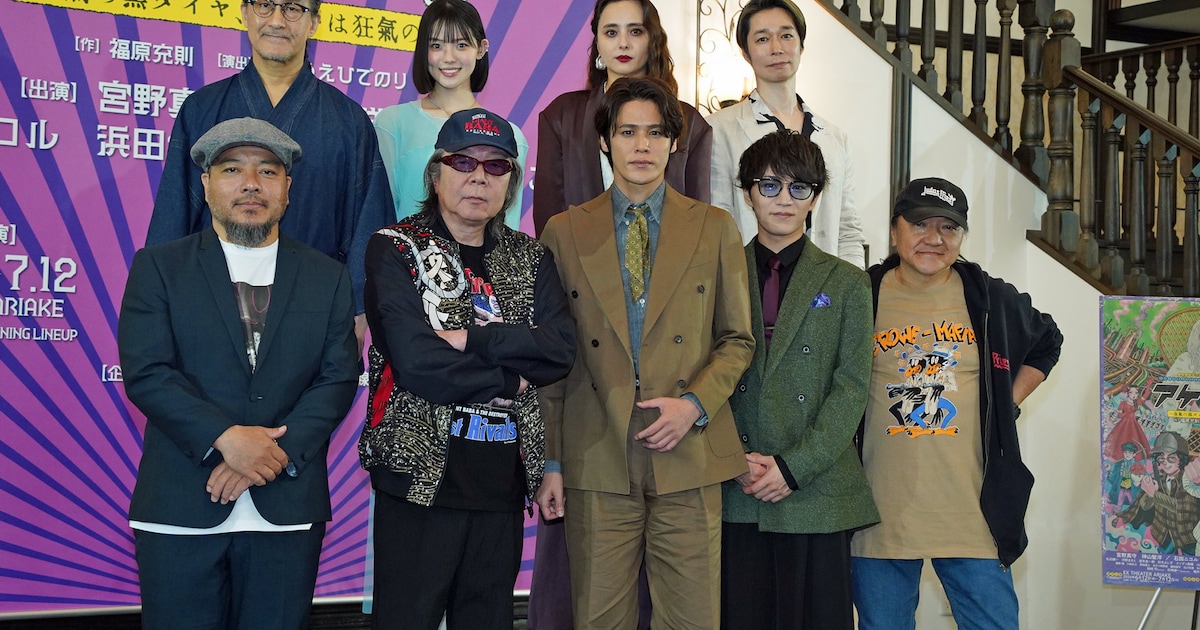
On April 14, a 製作発表 (seisaku happyō, production announcement) was held in Tokyo for a bold new stage production: 「アケチコ!~蒸気の黒ダイヤ、あるいは狂気の島~」. The show will open on April 25 at EX THEATER ARIAKE inside Tokyo Dream Park, marking the 46th anniversary performance of the legendary troupe 劇団☆新感線 (Gekidan Shinkansen).
And at the center of it all? Voice actor and performer 宮野真守 (Miyano Mamoru), taking on his first-ever 単独主演 (tandoku shuen)—a solo starring role.
A New Wind for Gekidan☆Shinkansen
This anniversary production features a brand-new script written by 福原充則 (Fukuhara Mitsunori), known for his socially conscious plays. It’s his first time writing for Gekidan☆Shinkansen.
Fukuhara revealed that director いのうえひでのり (Inoue Hidenori) has been watching his plays for 25 years. “I worked really hard on this,” Fukuhara said. “I’m a playwright who seriously writes about society—but no one has ever noticed.” Referring to current social conditions, he added that he hopes the serious themes in the script will unfold in a delightfully silly way on stage.
Director Inoue explained that after celebrating the troupe’s 45th anniversary last year, he wanted to create something completely different. Because EX THEATER ARIAKE is known for its excellent acoustics, they chose to produce a new installment in the “R” series—this time labeled “RSP” (Revue Steampunk)—featuring live music performed on stage.
Inoue described the work as a romantic yet frightening mystery set in the early Shōwa period. While Gekidan☆Shinkansen’s comedic “ネタもの” (joke-heavy productions) often leave audiences laughing without much lingering impact, he hinted that this time viewers might feel, “That was actually quite good,” along with a slightly unsettling aftertaste.
The Story: A Detective and a Mysterious Case
The play is set in Taishō 12 (1923) in M Prefecture, T City. Miyano plays the eccentric detective 明智小五郎—here reimagined as アケチコ五郎.
He meets 新田一耕助 (played by 神山智洋), a detective who grew up in Manila and returned to Japan. Together, they end up tackling a 怪事件 (kaijiken, mysterious case) involving a popular theater troupe called the Black Diamond Revue and the battle over its top star position.
Notice the phrase:
- 挑むことになる (idomu koto ni naru) – “end up challenging” / “come to take on”
This structure, 〜ことになる, suggests that events naturally develop in such a way that the characters find themselves facing the case.
Miyano Mamoru’s First Solo Lead
For Miyano, this is his first 単独主演 (tandoku shuen). He admitted feeling intense determination:
“I’m really fired up. Since I play a detective who intervenes in incidents, that slightly 胡散臭い (usanakusai, suspicious or shady) feeling is the キモ (kimo, key point).”
The word キモ is casual slang meaning “the essence” or “the crucial part.” You’ll often hear it in everyday conversation.
Miyano also said that because the play is full of swirling comedy scenes, he hopes the audience will laugh comfortably and still walk away with a meaningful message at the end.
When asked about being the sole lead, he responded poetically:
“I’m honored—but I’m not sure what a solo lead really is. I think this is the beginning of a journey to find out.”
That humility is very characteristic in Japanese press events. Even major stars often downplay their status.
A Cast Ready for Chaos
神山智洋 (Kamiyama Tomohiro), appearing with the troupe for the first time in 10 years, said his previous experience with them changed the way he approached acting. He expressed excitement about causing some on-stage 馬鹿騒ぎ (bakazawagi, wild and silly revelry).
His character is described as strongly justice-driven. However, he hinted that:
- 物語が進むにつれて (monogatari ga susumu ni tsurete) “As the story progresses…”
another side of his character will begin to emerge.
The grammar 〜につれて means “as something changes” or “in proportion to.” It’s useful when describing gradual developments.
Other cast members include:
- 石田ニコル (Ishida Nicole), intrigued by her character’s mysterious side
- 浜田信也 (Hamada Shinya), joining Gekidan☆Shinkansen for the first time
- 志田こはく (Shida Kohaku), playing a detective’s assistant
- 粟根まこと (Awane Makoto), promising a wide variety of songs backed by a live band
And then there’s 古田新太 (Furuta Arata), playing the wealthy and gender-ambiguous mysterious figure Andalusian Cougar. Though he hasn’t joined rehearsals yet due to another production, he joked that once he arrives, he’d like to cut the show down to two-thirds its length.
His dry humor drew laughter from the audience—another hallmark of Gekidan☆Shinkansen’s press events.
Cultural Context: Gekidan☆Shinkansen and “R” Series
Gekidan☆Shinkansen is famous for blending over-the-top action, elaborate staging, live music, and comedy. Their “R” series refers to revue-style productions—musical-heavy performances often featuring parody and spectacle.
The addition of “Steampunk” (スチームパンク) reflects Japan’s love of retro-futuristic aesthetics, especially settings inspired by the Taishō and early Shōwa eras. These periods often symbolize modernization, mystery, and dramatic cultural change—perfect for a detective story.
Learn Japanese from This Article
Key Vocabulary
| Japanese | Romaji | Meaning |
|---|---|---|
| 単独主演 | tandoku shuen | solo starring role |
| 製作発表 | seisaku happyō | production announcement |
| 怪事件 | kaijiken | mysterious case |
| 胡散臭い | usanakusai | suspicious; shady |
| キモ | kimo | key point; essence (casual) |
| 馬鹿騒ぎ | bakazawagi | wild, silly revelry |
| 感銘を受ける | kanmei o ukeru | to be deeply impressed |
You’ll notice a mix of kanji, hiragana, and katakana—just like real Japanese media.
Grammar Spotlight
1. 〜ことになる
Used when something “ends up” happening or is decided by circumstances.
Structure: Verb (dictionary form) + ことになる
Example from the story: 怪事件に挑むことになる。 Kaijiken ni idomu koto ni naru. “They end up taking on a mysterious case.”
More examples:
日本で働くことになりました。 Nihon de hataraku koto ni narimashita. “I ended up working in Japan.”
来月引っ越すことになります。 Raigetsu hikkosu koto ni narimasu. “It looks like I’ll be moving next month.”
2. 〜につれて
Used to show gradual change.
Structure: Verb (dictionary form) + につれて Noun + につれて
Example: 物語が進むにつれて、内なる一面が出てくる。 Monogatari ga susumu ni tsurete, uchinaru ichimen ga detekuru. “As the story progresses, another side emerges.”
More examples:
年を取るにつれて、考え方が変わる。 Toshi o toru ni tsurete, kangaekata ga kawaru. “As you get older, your way of thinking changes.”
練習するにつれて、上手になります。 Renshū suru ni tsurete, jōzu ni narimasu. “As you practice, you become better.”
Useful Expression
感銘を受ける (kanmei o ukeru) “To be deeply impressed.”
新しい挑戦に感銘を受けました。 Atarashii chōsen ni kanmei o ukemashita. “I was deeply impressed by the new challenge.”
This phrase is common in interviews and formal speech.
Continue Learning
📚 Working on your reading skills? Our Katakana Essentials: Adapting Global Words to Japanese lesson is a great next step.
📚 Working on your reading skills? Our Introduction to Kanji: Pictorial Foundations of Japanese Script lesson is a great next step.
Introduction to Kanji: Pictorial Foundations of Japanese Script
📚 Want to learn more about entertainment? Check out our lesson on Basic Vocabulary Building: Embracing Words Without Latin Ties.
Basic Vocabulary Building: Embracing Words Without Latin Ties
これからもよろしくお願いします。 Kore kara mo yoroshiku onegaishimasu.