
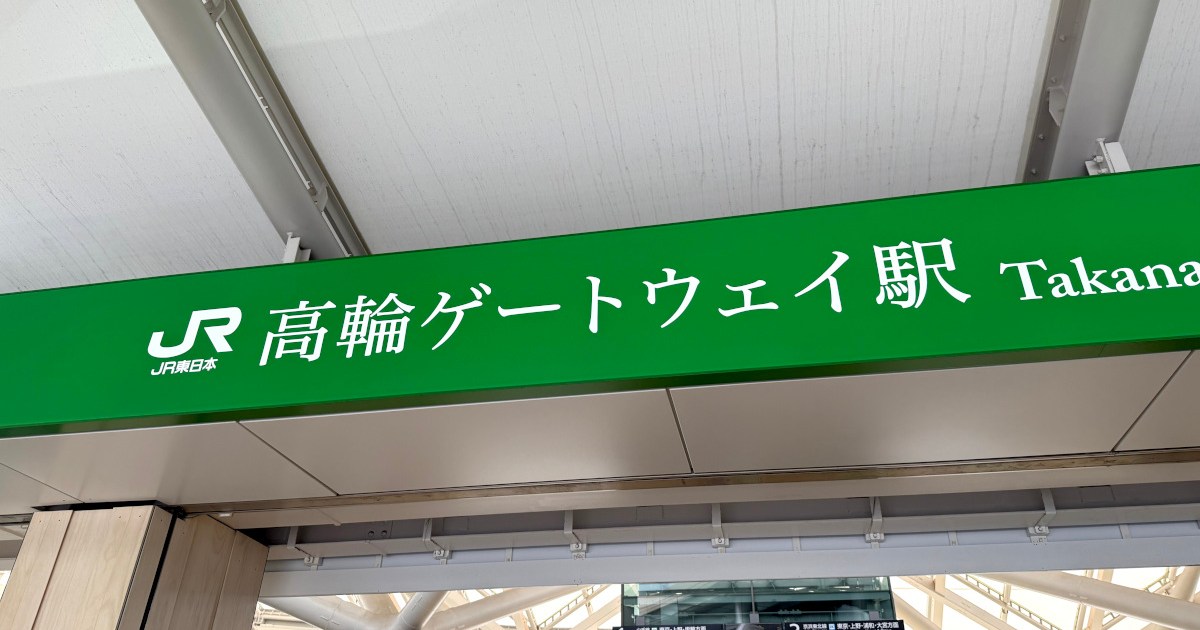
On March 28, 2026, the large-scale commercial facility 高輪ゲートウェイシティ (Takanawa Gateway City) held its grand opening. Directly connected—直結 (chokketsu)—to JR Takanawa Gateway Station, the site is a true 複合施設 (fukugō shisetsu), featuring shops, a hotel, offices, and exhibition spaces all in one place.
But less than two weeks after opening, reports began circulating: people were getting injured on a staircase inside the complex.
Reports of Accidents at the “Grand Staircase”
According to a Sankei Shimbun article dated April 10, at least two 怪我人 (keganin), or injured people, were confirmed at a staircase commonly known as the “Grand Staircase” (大階段, daikaidan).
The staircase is located between the north and south buildings of “Link Pillar 1,” about a one-minute walk from the JR station ticket gates. It’s one of the main pedestrian routes leading from the station toward the Takanawa area.
Accidents 相次ぐ (aitsugu)—happening one after another—at a brand-new facility raise an obvious question. Since the building just opened, deterioration can’t be the cause. So why would people get hurt on freshly completed stairs?
Visiting the Scene
The reporter went to see the staircase in person.
At first glance, nothing seemed unusual. “Could accidents really happen here?” was the honest first impression.
However, after walking down to the bottom of the structure, the reason became clearer.
The so-called “Grand Staircase” is not just a staircase. It’s an interwoven structure of stairs and benches.
Specifically:
- The actual stairs are on both sides.
- The central section is a series of benches.
- The benches are about the height of three steps.
It’s easy to imagine someone 誤認識 (goninshiki)—misrecognizing—the bench section as part of the stairs and stepping down incorrectly.
On top of that, the boundary between the stairs and the benches is visually subtle. If someone is only vaguely paying attention—perhaps while looking at their smartphone—the entire area might look like continuous steps.
Currently, the bench area has been marked 立ち入り禁止 (tachiiri kinshi), meaning “no entry,” with fences installed. This makes the boundary much clearer. Still, the reporter’s candid impression was: “It might be hard to understand at first glance.”
The design is stylish and clean. とはいえ (towa ie), even so, the risk of injury cannot be denied.
What Do Passersby Think?
The reporter also asked people nearby for their opinions.
A businessman in his 50s commented, “It’s dangerous for people who don’t know about it.” However, he hadn’t heard about the accidents and seemed surprised: “So that’s why they put up the fence?”
A father in his 30s, walking with his child, noted that the bench area is fairly high. “I can’t take my eyes off my child here,” he said. It may not be a space where children can safely play.
Overall, the reporter’s personal feeling was that it’s unfortunate. The facility itself is appealing, and operating—運用する (unyō suru)—the space as both stairs and benches is an interesting idea. However, if that’s the intention, clearer visual distinctions may need to be established. Leaving the area off-limits would be a waste.
For now, if you visit Takanawa Gateway City, it’s wise to pay special attention to the Grand Staircase.
Cultural Context: Design, Safety, and Public Space in Japan
Japan is often associated with safety and careful design. New public spaces especially are expected to function smoothly from day one. When accidents happen at a newly opened facility, it quickly becomes newsworthy.
At the same time, modern Japanese urban design frequently blends aesthetics with functionality. Spaces are often designed to serve multiple purposes—relaxation, transit, social gathering. In this case, the attempt to combine stairs and benches reflects that trend.
The challenge is balancing stylish design with intuitive safety. Even in a country known for order and attention to detail, human perception—especially in busy commuter areas—can lead to unexpected risks.
Learn Japanese from This Article
Let’s break down key vocabulary and grammar you can start using right away.
Key Vocabulary
| Japanese | Romaji | Meaning |
|---|---|---|
| 直結 | chokketsu | directly connected |
| 複合施設 | fukugō shisetsu | multi-purpose complex |
| 怪我人 | keganin | injured person |
| 相次ぐ | aitsugu | to happen one after another |
| 誤認識 | goninshiki | misrecognition |
| 立ち入り禁止 | tachiiri kinshi | no entry / off-limits |
| 運用する | unyō suru | to operate / manage |
Try making your own sentence with 相次ぐ (aitsugu), such as:
- 事故が相次いでいる。 Jiko ga aitsuide iru. “Accidents are happening one after another.”
Grammar Spotlight
〜のみならず〜
Meaning: Not only… but also…
Structure: Noun + のみならず + (noun/phrase)
Example:
- ショップのみならずホテルやオフィスもある。 Shoppu nomi narazu hoteru ya ofisu mo aru. “It has not only shops but also hotels and offices.”
This expression is slightly formal and often appears in news articles.
〜とはいえ
Meaning: Although / Even so / That said
Used to acknowledge something while presenting a contrasting point.
Example:
- 新しい施設とはいえ、事故は心配だ。 Atarashii shisetsu to wa ie, jiko wa shinpai da. “Although it’s a new facility, the accidents are concerning.”
You’ll often see this in opinion pieces or commentary.
Useful Expressions
初見だとわかりづらい。 Shoken da to wakarizurai. “It’s hard to understand at first glance.”
目を離せない。 Me o hanasenai. “I can’t take my eyes off (someone/something).”
Both are extremely natural phrases you’ll hear in daily life.
Continue Learning
📚 Want to understand the verb forms used here? Check out Masu Form: Mastering Polite Everyday Speech.
📚 Curious about the Japanese used here? Our Greetings and Self-Introductions: Authentic Entry Phrases lesson covers this in depth.
📚 Ready to dive deeper? Our lesson on Basic Vocabulary Building: Embracing Words Without Latin Ties will help you master these concepts.
Basic Vocabulary Building: Embracing Words Without Latin Ties
これからもよろしくお願いします。 Kore kara mo yoroshiku onegaishimasu.