
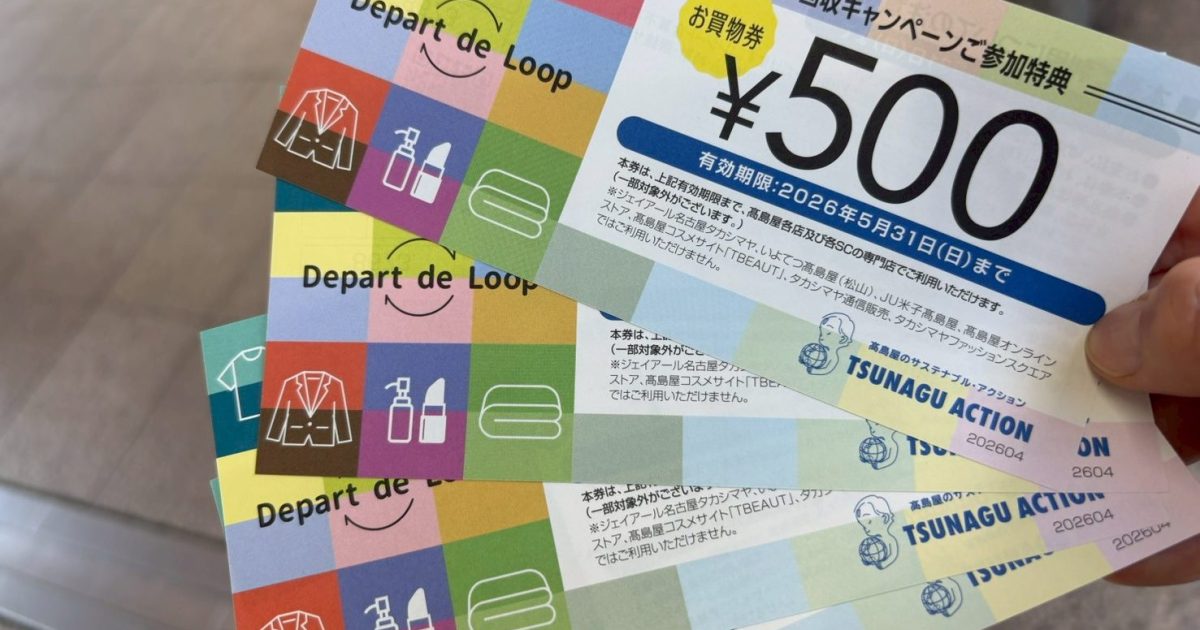
One item brought in, one 500-yen voucher given. Even clothes with lint balls or light stains are accepted—at least according to the official announcement. But would they really take them?
As spring arrives—and on some days, it already feels hot in Japan—it’s also time for 衣替え (koromogae), the seasonal change of clothing. Right on cue, Takashimaya has launched a recycling campaign called Depart de Loop(デパート デ ループ), where customers can bring in unwanted clothes, cosmetics, or tableware. For each item, you receive one 500-yen お買物券 (okaemonoken), or shopping voucher.
It sounds generous. But what about that sweater covered in 毛玉 (kedama, lint balls)? Or a jacket with visible stains? Would those really pass inspection?
Let’s take a closer look at what happened when someone tried it on the very first day.
What Is the “Depart de Loop” Campaign?
Takashimaya’s 回収 (kaishuu, collection) campaign is being held at 12 locations nationwide, though the dates vary by store.
Here are the key rules:
- 1 item = 1 voucher worth 500 yen
- Up to 9 items per person during the campaign
- No brand or store restrictions
- Clothes with holes, tears, or light stains are acceptable
- Items must be washed before bringing them in
- Empty cosmetic containers must be lightly rinsed
The phrase used in the announcement is:
1点につき500円分のお買物券が1枚もらえる Itten ni tsuki gohyaku-en bun no okaemonoken ga ichimai moraeru. “You can receive one 500-yen shopping voucher per item.”
Notice the grammar pattern 〜につき (ni tsuki), meaning “per” or “for each.” We’ll break this down more in the learning section.
Testing “Borderline” Clothes
During 衣替え (koromogae), the writer checked their closet and found some questionable items:
- A turtleneck covered in 毛玉 (kedama)
- A thin jacket with noticeable stains
- Children’s clothing marked with pen stains
These weren’t pristine. They clearly showed 使用感 (shiyoukan), meaning signs of wear or a “used” feeling.
Along with four clothing items, empty cosmetic bottles were also prepared (note: Muji runs its own separate recycling program).
The Drop-Off Experience in Nihonbashi
The writer visited Takashimaya’s Nihonbashi S.C., where the campaign had started earliest.
Rather than simply placing items in a collection box, the process was face-to-face. A staff member stood at a counter and personally checked each item, briefly unfolding and inspecting them one by one.
Despite the lint, stains, and visible wear, all four items were accepted without issue.
Success.
How the 2,000 Yen Voucher Actually Works
Four items meant:
- 500 yen × 4 vouchers
- Total: 2,000 yen in shopping vouchers
However, there’s an important condition:
One 500-yen voucher can be used per purchase of 5,000 yen (tax included).
So if you have four vouchers, you would need to spend over 20,000 yen to use all of them at once.
That makes this less of a “free money” situation and more of a discount system for those already planning department store shopping.
There are additional restrictions:
- Not usable for food or restaurants
- Some departments are 対象外 (taishougai, excluded)
- Valid until May 31, 2026
- Usable at participating Takashimaya stores
It’s generous—but not unlimited.
More Than Just a Voucher
The most interesting part might not be the vouchers at all.
Clothing made from 100% polyester may be chemically recycled into new polyester. These materials could eventually become Takashimaya original products or collaborative brand items.
That means your old sweater かもしれない (kamo shirenai, might possibly) reappear in the store one day as something entirely new.
The voucher is almost a 副産物 (fukusanbutsu), a by-product. The real value is having an easy alternative to simply throwing clothes away.
For items that aren’t clean enough to donate and not valuable enough to sell, this campaign fills a very Japanese niche: responsible disposal with a small reward.
Cultural Context: 衣替え and Seasonal Living
In Japan, 衣替え (koromogae) is more than closet cleaning. Traditionally, schools and companies officially switch uniforms twice a year—June and October. Even today, many households follow this rhythm.
This seasonal awareness connects to a broader Japanese mindset: respecting cycles, minimizing waste, and giving objects a second life whenever possible.
The phrase:
巡る巡るよ、衣類は巡るよ Meguru meguru yo, irui wa meguru yo. “Round and round, clothes keep circulating.”
captures this circular philosophy beautifully.
Learn Japanese from This Article
Vocabulary
| Japanese | Romaji | Meaning |
|---|---|---|
| 衣替え | koromogae | seasonal change of clothing |
| 回収 | kaishuu | collection, recycling collection |
| お買物券 | okaemonoken | shopping voucher |
| 毛玉 | kedama | lint ball, pilling |
| 使用感 | shiyoukan | signs of use |
| 対象外 | taishougai | excluded, not eligible |
| 副産物 | fukusanbutsu | by-product |
If you want to build confidence recognizing words like these, check out our Basic Vocabulary Building: Embracing Words Without Latin Ties.
Grammar Spotlight
1️⃣ 〜につき (ni tsuki) — “Per / For Each”
Structure: Noun + につき
Example from the campaign:
- 1点につき500円分のお買物券がもらえる。 Itten ni tsuki gohyaku-en bun no okaemonoken ga moraeru. “You receive a 500-yen voucher per item.”
More examples:
- お一人様9点まで受付可能です。1点につき1枚です。 O-hitori-sama kyūten made uketsuke kanou desu. Itten ni tsuki ichimai desu. “Up to 9 items per person. One voucher per item.”
This expression is common in formal notices and store announcements.
2️⃣ 〜かもしれない (kamo shirenai) — “Might / May”
Used to express possibility.
また店頭に並ぶかもしれない。 Mata tentō ni narabu kamo shirenai. “It might appear in stores again.”
結構お得かもしれない。 Kekkou otoku kamo shirenai. “It might be quite a good deal.”
In casual speech, you’ll often hear かも alone.
Want to understand how polite verb forms like もらえる and 受付可能です work? Check out Masu Form: Mastering Polite Everyday Speech.
Useful Expression
- 本当に? Hontou ni? “Really?”
A simple but powerful reaction phrase—perfect for situations just like this one.
Continue Learning
📚 Want to understand the verb forms used here? Check out Masu Form: Mastering Polite Everyday Speech.
📚 Curious about the Japanese used here? Our Greetings and Self-Introductions: Authentic Entry Phrases lesson covers this in depth.
📚 Curious about the Japanese used here? Our Basic Vocabulary Building: Embracing Words Without Latin Ties lesson covers this in depth.
Basic Vocabulary Building: Embracing Words Without Latin Ties
これからもよろしくお願いします。 Kore kara mo yoroshiku onegaishimasu.