
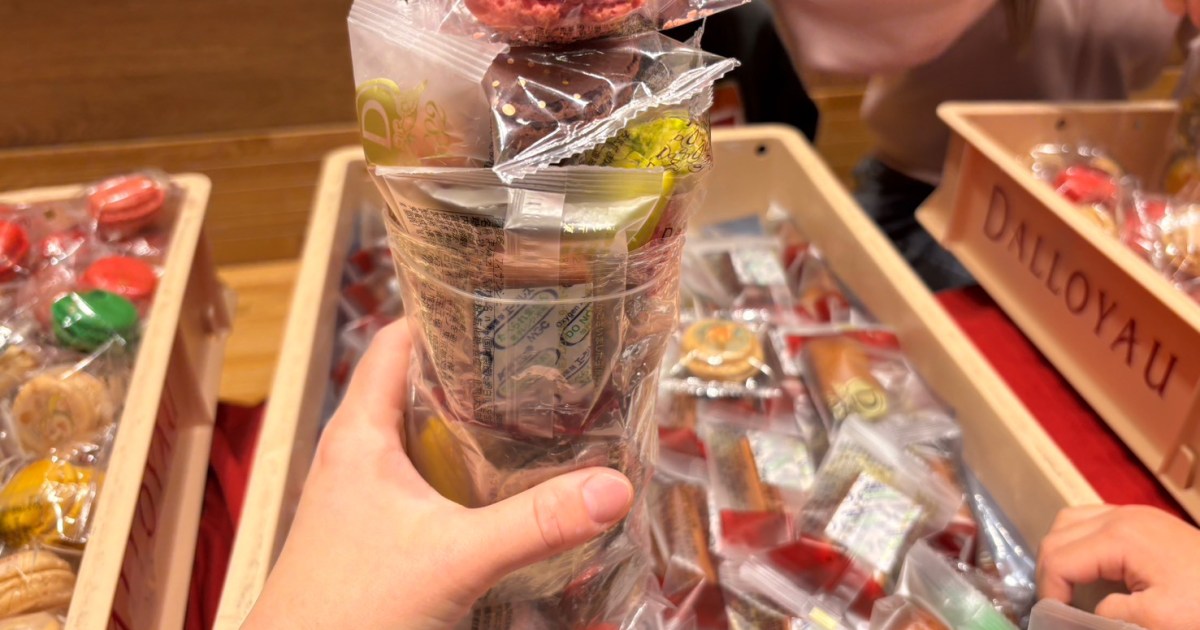
“Macaron all-you-can-pack.”
At first, even the writer of the original report said she could hardly believe her ears. Macarons are usually seen as delicate, high-end sweets—something you savor one by one. And yet here was an event where you could stuff as many as you wanted into a bag.
That event is called マカ放題 (maka houdai), a playful abbreviation of マカロン詰め放題 (makaron tsumehoudai)—an “all-you-can-pack” macaron challenge hosted by the French pastry brand Dalloyau.
The result? Harder than expected. More exciting than expected. And far more of a bargain than expected.
What Is マカ放題 (Maka Houdai)?
The key word here is 詰め放題 (tsumehoudai)—literally “pack-as-much-as-you-like.”
Participants are given a special bag and a 制限時間 (seigen jikan, time limit) of 10 minutes. Within that time, they can choose their favorite flavors and pack:
- As many as fit
- As many as can sit on top
- As many as can be stacked
Even better? The rules are surprisingly 太っ腹 (futtoppara, generous). The bag doesn’t even have to close.
But this isn’t just about getting sweets at a discount. According to the report, the event is also a sustainability effort. Slightly cracked macarons, slightly uneven shapes, or seasonal flavors that couldn’t be delivered to all stores are used—reducing food waste while still tasting delicious.
Event details—dates, price, contents—vary by store. In this case, the Shin-Misato branch had restarted the event in March 2026. A quick phone call led to a 予約 (yoyaku, reservation), and the writer secured a spot.
Participation fee: 1,620 yen (paid at 受付 (uketsuke, reception) before starting).
The Battle Begins Before the Timer
The event took place on a Saturday evening. Ten minutes before the start, participants checked in and paid.
As staff began lining up trays of macarons on the table, the atmosphere shifted. Quiet determination filled the room.
On this day, not only macarons but also financiers (small almond cakes) were included. Some even featured Doraemon-themed designs, raising the excitement before the clock had even started.
Participants were allowed to stretch their special plastic bags beforehand. Everyone was pulling and stretching, trying to increase capacity.
Then—rip.
The writer’s bag tore.
Fortunately, torn bags could be exchanged—even during the challenge. However, there was one strict rule: if your bag ripped with only 10 seconds left, you would have to exchange it for just eight macarons.
As she reached for another bag and started stretching again, a child next to her grabbed her arm and said:
“You should stop. It’ll rip again.”
Sometimes, children are the voice of reason.
10 Minutes of Intensity
Once the rules were explained, the 10-minute 制限時間 (seigen jikan) began.
All macarons were individually wrapped, with a bit of air inside the packaging—making them bulkier than expected. Packing efficiently was harder than it looked.
At first, she grabbed flavors she wanted. In the second half, she switched strategies based on advice from staff: build “walls” using financiers to create structure.
The room was quiet except for the rustling sound of plastic and the tension of the ticking clock.
Meanwhile, the children next to her kept worrying:
“You don’t have to be greedy!” “It’s already enough!”
Apparently, they were genuinely concerned about another bag disaster.
The Final Count: Was It Worth It?
After packing, participants had to hold the bag with both hands for five seconds. If it survived, success.
According to the writer, the “five seconds” felt closer to two. In hindsight, she wished she had added more.
The store’s all-time record? 33 pieces.
Her result:
- 12 macarons
- 4 financiers
- Total: 16 items
Not even close to 33—but still impressive.
Now let’s do the math.
Dalloyau macarons usually cost around 300 yen each. Even with a conservative estimate of 260 yen per item:
260 yen × 16 = 4,160 yen
With a participation fee of 1,620 yen, that’s over 2,500 yen saved—even by 丼勘定 (donburikanjou), meaning a rough calculation.
In other words, definitely お得 (otoku, a good bargain).
And importantly: despite being slightly imperfect items, they looked beautiful and tasted excellent. Favorites included a Doraemon dorayaki-style macaron and a chestnut flavor.
Even More Sweets: 70-Minute Buffet
The Shin-Misato store also offers a 70-minute sweets buffet for 3,300 yen (prices and details vary by location).
The buffet includes:
- 6 types of cake
- 10+ types of macarons
- Ice cream
- Popcorn
- Drinks
For a luxury brand, offering this many ways to enjoy their sweets feels surprisingly accessible.
One practical tip from the writer: the area around LaLaport Shin-Misato (where the store is located) gets heavily congested on weekends. She personally got stuck in traffic for over 30 minutes—so plan extra time.
Cultural Context: Why This Feels So Surprising
Macarons in Japan carry a strong image of being elegant, cute, and premium. They’re often individually boxed and carefully presented.
That’s why hearing マカロンといえば高級スイーツ (makaron to ieba koukyuu suītsu)—“speaking of macarons, they’re high-end sweets”—feels natural in Japanese.
An all-you-can-pack event flips that image. Yet at the same time, it reflects two important trends in Japan:
- Sustainability and reducing food waste
- Turning shopping into an experience or “event”
It’s not just about buying dessert—it’s about the challenge.
Learn Japanese from This Article
Key Vocabulary
| Japanese | Romaji | Meaning |
|---|---|---|
| 詰め放題 | tsumehoudai | all-you-can-pack event |
| 制限時間 | seigen jikan | time limit |
| 受付 | uketsuke | reception, check-in |
| 予約 | yoyaku | reservation |
| 太っ腹 | futtoppara | generous |
| お得 | otoku | good value, bargain |
| 丼勘定 | donburikanjou | rough calculation |
Grammar Spotlight
1️⃣ 〜といえば (Speaking of…)
Pattern: Noun + といえば
Used to introduce something strongly associated with the topic.
Example:
マカロンといえば、高級スイーツです。 Makaron to ieba, koukyuu suītsu desu. Speaking of macarons, they’re high-end sweets.
春といえば、桜ですね。 Haru to ieba, sakura desu ne. Speaking of spring, it’s cherry blossoms.
2️⃣ 〜だけ (As much as possible)
Often used as:
- 入るだけ (hairu dake) — as much as fits
- できるだけ (dekiru dake) — as much as possible
Examples:
袋に入るだけ入れてください。 Fukuro ni hairu dake irete kudasai. Please put in as much as fits in the bag.
できるだけ早く来てください。 Dekiru dake hayaku kite kudasai. Please come as soon as possible.
You’ll hear this structure constantly in daily Japanese.
Useful Expression
- かなりお得です。 Kanari otoku desu. It’s quite a bargain.
Notice the polite です form—if you want to master this essential style of everyday speech, see the lesson below.
Continue Learning
📚 Want to understand the verb forms used here? Check out Masu Form: Mastering Polite Everyday Speech.
📚 Curious about the Japanese used here? Our Greetings and Self-Introductions: Authentic Entry Phrases lesson covers this in depth.
📚 Curious about the Japanese used here? Our Basic Vocabulary Building: Embracing Words Without Latin Ties lesson covers this in depth.
Basic Vocabulary Building: Embracing Words Without Latin Ties
これからもよろしくお願いします。 Kore kara mo yoroshiku onegaishimasu.