
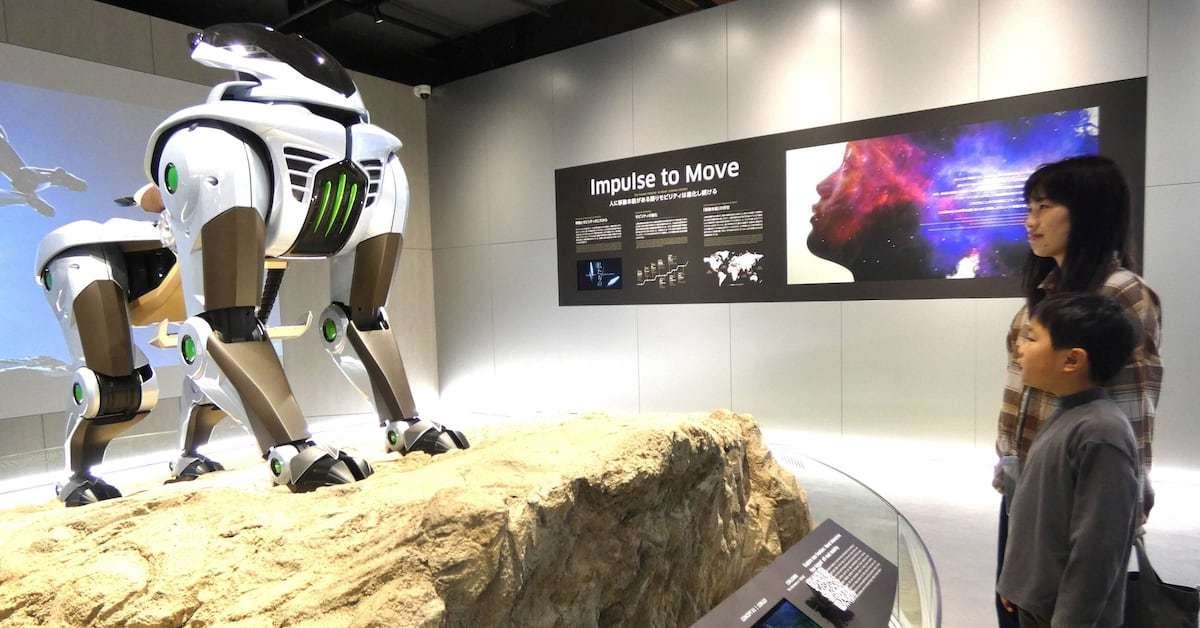
On April 2, Kawasaki Heavy Industries announced that it is now exhibiting a next-generation vehicle first unveiled at the 2025 Osaka-Kansai Expo at its museum, “Kawasaki World,” in Chuo Ward, Kobe.
The company says it hopes to pass on the Expo’s cutting-edge technology and excitement as a レガシー (regashii, legacy) to its hometown of Kobe.
A Rideable Four-Legged Robot: CORLEO
One of the most popular attractions at the Expo was CORLEO(コルレオ), an オフロードバイク (ofurōdo baiku, off-road motorcycle) that moves on four legs.
Unlike traditional motorcycles with two wheels, CORLEO is being developed to run on four mechanical legs. The goal is to create a new kind of モビリティ (mobiriti, mobility technology) that can handle rough environments.
According to Kawasaki, if the vehicle is completed, it will be able to maintain a comfortable ride even in mountainous areas or near water—places where tires struggle to operate.
Notice how futuristic that sounds. Instead of asking, “Can a road be built here?” the idea becomes, “Can the vehicle adapt to the land?”
A first-grade elementary school student from Kobe, 7-year-old Wataru Iwami, visited with his family and said with a smile, “I thought CORLEO was amazing. I want to ride it.”
Travel Without Ever Leaving Your Seat
Also on display is a full-scale model of the public transportation システム (shisutemu, system) called ALICE SYSTEM(アリスシステム).
This concept features a container-style private キャビン (kyabin, cabin) that can ドッキングする (dokkingu suru, dock or connect mechanically) with dedicated cars, trains, ships, and even airplanes.
If realized, passengers would be able to travel across land, sea, and air 一度も席を立つことなく—without ever leaving their seat.
A company representative commented: “未来の乗り物にはこういう選択肢もあるということを感じてもらえれば” “We hope people can feel that these kinds of options also exist for the vehicles of the future.”
The key word here is 選択肢 (sentakushi, option or choice). The company isn’t saying this is the only future. It’s presenting it as one possible path.
Cultural Context: Expo “Legacy” in Japan
World Expos are major events in Japan, often used to showcase technological innovation and national vision. The word レガシー (regashii, legacy) has become common in Japanese when discussing what remains after large international events.
Rather than letting these futuristic concepts disappear after Expo 2025, Kawasaki is continuing the exhibition in Kobe, connecting global innovation back to the local community.
You’ll notice something interesting as a Japanese learner: many of the key terms in this article—モビリティ, システム, キャビン, レガシー—are written in katakana. These are loanwords adapted into Japanese pronunciation.
Understanding katakana is essential for reading modern Japanese, especially in tech news.
Learn Japanese from This Article
Key Vocabulary
| Japanese | Romaji | Meaning |
|---|---|---|
| モビリティ | mobiriti | mobility; transportation technology |
| レガシー | regashii | legacy |
| オフロードバイク | ofurōdo baiku | off-road motorcycle |
| システム | shisutemu | system |
| キャビン | kyabin | cabin (private compartment) |
| ドッキングする | dokkingu suru | to dock; to connect mechanically |
| 選択肢 | sentakushi | option; choice |
Grammar Spotlight
1. 〜すれば (Conditional “if/when”)
This is the conditional form of する (suru, to do).
実現すれば、旅客は一度も席を立つことなく移動できる。 Jitsugen sureba, ryokaku wa ichido mo seki o tatsu koto naku idō dekiru. If it is realized, passengers will be able to travel without ever leaving their seat.
Structure:
- Verb (conditional 〜すれば form) + result
Example:
- 完成すれば、快適な乗り心地を維持できる。 Kansei sureba, kaiteki na norigokochi o iji dekiru. If it is completed, it can maintain a comfortable ride.
This pattern is very common in news and formal writing.
2. 〜ことなく (Without doing…)
一度も席を立つことなく Ichido mo seki o tatsu koto naku Without standing up even once
Structure:
- Verb (dictionary form) + ことなく
Example:
- 休むことなく働く。 Yasumu koto naku hataraku. To work without taking a break.
This expression sounds formal and often appears in written Japanese, especially in news articles.
Useful Expression
〜ということを感じてもらえれば ~ to iu koto o kanjite moraereba “We hope people can feel that…”
This is a polite way to express hope that someone will understand or experience something.
Continue Learning
📚 Working on your reading skills? Our Katakana Essentials: Adapting Global Words to Japanese lesson is a great next step.
📚 Ready to dive deeper? Our lesson on Basic Vocabulary Building: Embracing Words Without Latin Ties will help you master these concepts.
Basic Vocabulary Building: Embracing Words Without Latin Ties
📚 Ready to dive deeper? Our lesson on Reading and Writing in Japanese II: Hiragana and Katakana will help you master these concepts.
これからもよろしくお願いします。 Kore kara mo yoroshiku onegaishimasu.