
On March 31, 2026, the all-you-can-eat shabu-shabu chain Shabu-yo made a shocking announcement: it would suspend offering its popular pork belly due to a halt in Spanish pork imports.
For fans of thin, fatty slices of pork simmered in hot broth, this felt like the end of an era.
Pork Belly Suspended — Pork Loin Takes Its Place
Shabu-yo, known for its affordable 食べ放題 (tabehoudai, all-you-can-eat) courses, announced that スペイン産豚肉の輸入停止に伴い (Supein-san butaniku no yunyū teishi ni tomonai), or “due to the suspension of Spanish pork imports,” it would 提供を休止 (teikyō o kyūshi, suspend offering) pork belly.
In its place, the chain will 導入する (dōnyū suru, introduce) American pork loin.
On social media, pork belly lovers expressed their disappointment. But what was actually happening in stores?
One writer rushed to a Shabu-yo location just after noon to check. To his surprise, the lunch 豚バラコース (butabara kōsu, pork belly course) was still available on the touch-panel ordering system.
According to Shabu-yo, the timing of the menu change differs by location. In other words, some branches were still serving pork belly—for now.
Same Price, Different Meat
After the change, the price will remain the same. The former 豚バラコース (butabara kōsu) will simply be renamed the 豚ロースコース (buta rōsu kōsu, pork loin course).
Weekday lunch starts at 1,649 yen (tax included), and instead of the cheapest cut—pork belly—you’ll get unlimited pork loin.
From one perspective, this isn’t necessarily bad news. Since pork belly was the lowest-priced meat option, switching to loin at the same price could be seen as an upgrade. As the article suggests, it アップグレードと言えなくもない (appugurēdo to ienakumo nai)—“it’s not wrong to say it’s an upgrade.”
Pork Belly vs. Pork Shoulder Loin
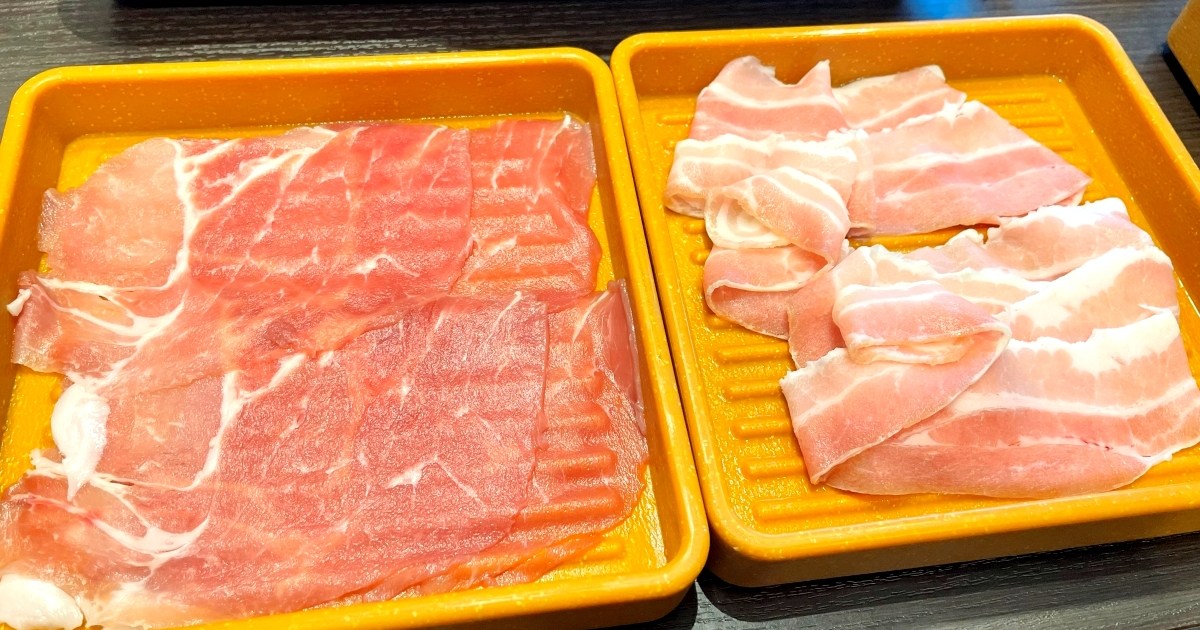
Since pork loin wasn’t yet available for order at that location, the writer chose the 豚コース (buta kōsu), which includes pork belly and pork shoulder loin, and decided to do a 食べ比べ (tabekurabe, tasting comparison).
Pork belly is famous for its rich fat. When dipped into the bubbling hot pot, its long, thin slices nearly fill the pot. The direct, savory flavor of the fat is its biggest charm.
Many customers say, “Shabu-yo is the place to go for pork belly.” It’s easy to understand why.
But after immediately trying pork shoulder loin, the writer had a realization:
“Maybe it’s the era of loin.”
He admits being in his 40s may influence his taste. If you plan to keep eating plate after plate, leaner meat might be better. Pork shoulder loin has more 赤身 (akami, lean red meat) and a stronger meat flavor. For all-you-can-eat dining, he believes it’s far more suitable than fatty pork belly.
A Sauce Makes a Comeback
There’s more.
Shabu-yo has also announced the 復活 (fukkatsu, comeback) of a popular dipping sauce: 紅生姜だれ (beni shōga dare, red pickled ginger sauce).
The refreshing quality of pork loin pairs unexpectedly well with the tangy acidity of red ginger. Alongside classic ポン酢 (ponzu) and ゴマだれ (goma dare, sesame sauce), it may become the “third sauce” option to try.
Bad News or Good News?
Shabu-yo describes its newly introduced pork loin as having a good balance of lean and fat, a tender texture, and a refined sweetness.
For pork belly fans, this may feel like a loss. But for loin lovers, it’s practically a 朗報 (rōhō, piece of good news).
The writer even promises to return once the menu fully switches over—ready to host his own “Loin Festival.”
Farewell, pork belly. Welcome, pork loin.
Cultural Context: Why Pork Cuts Matter in Japan
In Japanese hot pot culture, especially しゃぶしゃぶ (shabu-shabu), the cut of meat makes a huge difference.
- 豚バラ (butabara, pork belly) = fatty, rich, indulgent
- 豚ロース (buta rōsu, pork loin) = leaner, balanced
- 豚肩ロース (buta kata rōsu, pork shoulder loin) = flavorful, slightly fattier than loin
Because shabu-shabu involves cooking very thin slices quickly in broth, fat content directly affects texture and taste. In an all-you-can-eat setting, some diners prefer lighter cuts so they can eat more without feeling too heavy.
This subtle preference shift—especially among older diners—reflects broader Japanese food culture, where balance and longevity often outweigh pure indulgence.
Learn Japanese from This Article
Key Vocabulary
| Japanese | Romaji | Meaning |
|---|---|---|
| 食べ放題 | tabehoudai | all-you-can-eat |
| 提供を休止 | teikyō o kyūshi | to suspend offering |
| 導入する | dōnyū suru | to introduce (a product/system) |
| 食べ比べ | tabekurabe | tasting and comparing |
| 復活 | fukkatsu | comeback, revival |
| 赤身 | akami | lean red meat |
| 朗報 | rōhō | good news |
| 〜に伴い | ni tomonai | due to; accompanied by |
Grammar Spotlight
1. 〜に伴い (ni tomonai)
Meaning: “Due to…” / “Accompanied by…” A formal expression often used in news reports.
Structure: Noun + に伴い
Example from the article: スペイン産豚肉の輸入停止に伴い、豚バラの提供を休止。 Supein-san butaniku no yunyū teishi ni tomonai, butabara no teikyō o kyūshi. “Due to the suspension of Spanish pork imports, pork belly service was halted.”
You’ll frequently see this in formal announcements and business news.
2. 〜と言えなくもない (to ienakumo nai)
Meaning: “It’s not wrong to say…” / “One could say…”
This softens an opinion. Instead of strongly insisting, the speaker suggests something cautiously.
Structure: Verb (dictionary form) + と言えなくもない
Example: アップグレードと言えなくもない。 Appugurēdo to ienakumo nai. “It’s not wrong to say it’s an upgrade.”
Very natural in opinion writing.
Useful Expression
時代はロースだ。
Jidai wa rōsu da. “It’s the era of loin.”
This playful expression uses 時代は〜だ (jidai wa ~ da) to suggest something is the current trend or the future.
Example: これからは健康の時代だ。 Kore kara wa kenkō no jidai da. “From now on, it’s the age of health.”
Continue Learning
📚 Want to understand the verb forms used here? Check out Masu Form: Mastering Polite Everyday Speech.
📚 To understand more about lifestyle, explore our Greetings and Self-Introductions: Authentic Entry Phrases lesson.
📚 Ready to dive deeper? Our lesson on Basic Vocabulary Building: Embracing Words Without Latin Ties will help you master these concepts.
Basic Vocabulary Building: Embracing Words Without Latin Ties
これからもよろしくお願いします。 Kore kara mo yoroshiku onegaishimasu.