
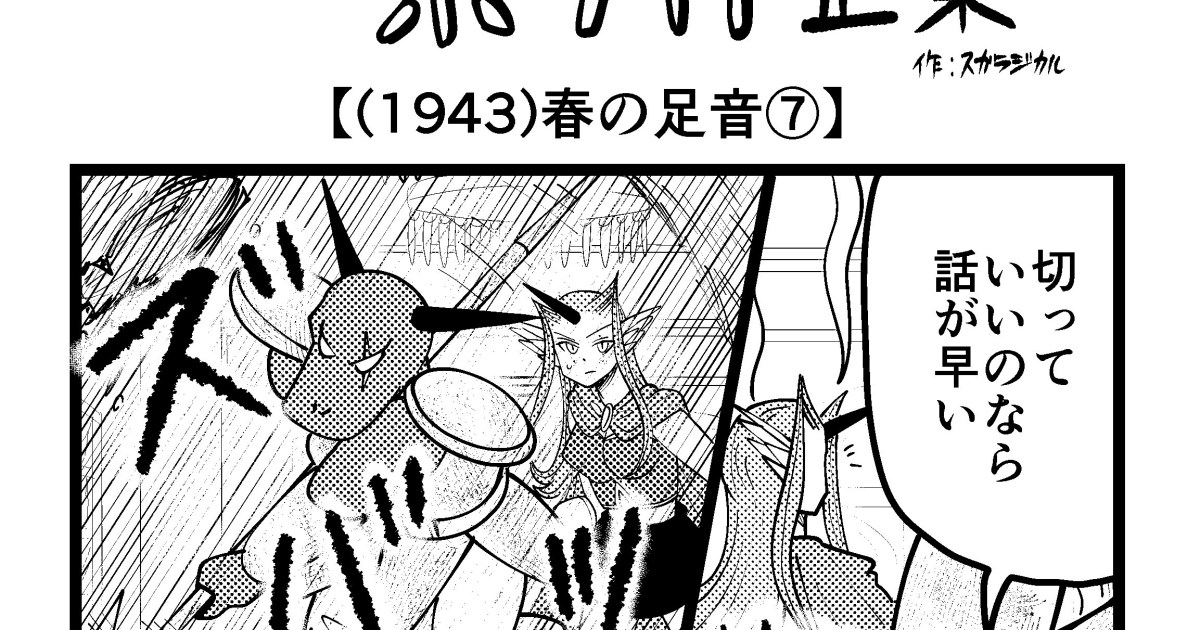
【4コマ】魔王軍はホワイト企業 1943話目「春の足音⑦」 was published on March 29, 2026, on Rocket News. The credit line is simple: 漫画:スガラジカル (manga: Sugarajikaru) — “Manga by Sugarajikaru.”
This entry is the 1943話目 (sen kyūhyaku yonjū san wa-me), meaning “Episode 1943,” of the long-running 4-panel comic series 魔王軍はホワイト企業 (Maō-gun wa howaito kigyō), or “The Demon King’s Army Is a White Company.” The subtitle this time is 「春の足音⑦」 (Haru no ashioto nana), “Footsteps of Spring (7).”
Readers are invited to navigate the series with links such as:
- « 前の話へ (mae no hanashi e) — “To the previous episode”
- 第1回から読む (dai ikkai kara yomu) — “Read from Episode 1”
- ▼キャラ一覧はこちら (kyara ichiran wa kochira) — “Character list is here”
Even in these short navigation phrases, there’s a lot of practical Japanese you’ll see again and again online.
A Snapshot of the Series Structure
This title tells us several important things about how Japanese web comics are organized.
First, 【4コマ】 (yon-koma) means “four-panel comic.” Traditional Japanese newspaper-style comics are often structured in four vertical panels. The format encourages quick pacing: setup, development, twist, and punchline.
Next, 第1943話目 uses the counter pattern 第〜回 / 第〜話 (dai ~ kai / dai ~ wa) to number episodes. This is how you say “the ~th time” or “the ~th episode” in Japanese.
Finally, 春の足音 (haru no ashioto) literally means “the footsteps of spring.” The phrase uses the grammar pattern NのN (noun + の + noun), which often works like “A of B” or “B’s A.” Here, it’s “spring’s footsteps,” a poetic way to describe signs that spring is approaching.
The small ⑦ shows this is part seven of a sub-arc.
How Navigation Language Teaches Real Japanese
Web manga pages are full of everyday interface expressions. Let’s break down a few from this page.
前の話へ (mae no hanashi e)
- 前 (mae) — before; previous
- 話 (hanashi) — story; episode
- へ (e) — direction marker (“to”)
Together: “To the previous episode.”
Notice the NのN structure again: 前の話 — “the previous story.”
第1回から読む (dai ikkai kara yomu)
- 第1回 (dai ikkai) — the first episode
- から (kara) — from
- 読む (yomu) — to read
This means “Read from Episode 1.”
Here, 〜から marks the starting point. You’ll use this constantly in daily life:
- 9時から始まります。 (ku-ji kara hajimarimasu.) “It starts from 9 o’clock.”
キャラ一覧はこちら (kyara ichiran wa kochira)
- 一覧 (ichiran) — list; overview
- こちら (kochira) — this way; here (polite)
This politely directs you: “The character list is here.”
Japanese websites often use こちら instead of a direct “here” to sound softer and more customer-friendly.
Cultural Context: Why So Many Episodes?
Seeing 1943話目 might surprise you. Long-running serialized content is common in Japan, especially in manga culture. Whether in print magazines or online platforms, series can continue for years.
Numbering each installment with 第〜話 keeps everything organized and makes it easy for readers to jump:
- Back to 前の話 (previous episode)
- All the way to 第1回から (from the very first episode)
This structured numbering system reflects how Japanese media carefully tracks installments — something you’ll also see in TV dramas and novels.
Learn Japanese from This Article
Vocabulary
| Japanese | Romaji | Meaning |
|---|---|---|
| 漫画 | manga | comic; manga |
| 前 | mae | before; previous; front |
| 話 | hanashi | story; episode; talk |
| 第〜回 | dai~kai | the ~th time/episode |
| 読む | yomu | to read |
| 一覧 | ichiran | list; overview |
| こちら | kochira | this way; here (polite) |
| 春 | haru | spring |
| 足音 | ashioto | sound of footsteps |
Grammar Spotlight
1) 〜から (Starting Point)
Structure: N + から + Verb
Used to show where something begins (time, place, sequence).
Examples:
第1回から読む。 Dai ikkai kara yomu. “Read from Episode 1.”
月曜日から学校が始まります。 Getsuyōbi kara gakkō ga hajimarimasu. “School starts from Monday.”
Think of から as clearly marking the starting line.
2) NのN (Noun Modification)
Structure: N1 + の + N2
This connects two nouns. It can show possession, description, or relationship.
Examples:
前の話 Mae no hanashi “The previous episode”
春の足音 Haru no ashioto “Spring’s footsteps” / “Footsteps of spring”
The particle の is one of the most important connectors in Japanese. Mastering it will instantly improve your reading ability.
Useful Expressions from Web Pages
- こちら (kochira) — A polite way to say “here”
- 〜はこちら — “~ is here” (customer-friendly tone)
- 第〜話 (dai ~ wa) — “Episode ~”
- 〜話目 (~ wa-me) — “The ~th episode” (emphasizing order)
You’ll see these constantly on Japanese websites, streaming services, and online stores.
Continue Learning
Want to understand the verb forms used here? Check out Masu Form: Mastering Polite Everyday Speech.
Ready to dive deeper? Our lesson on Basic Vocabulary Building: Embracing Words Without Latin Ties will help you master these concepts.
Curious about the Japanese used here? Our Greetings and Self-Introductions: Authentic Entry Phrases lesson covers this in depth.
Even a short manga listing page can teach you real, practical Japanese — from counters like 第1943話目 to essential connectors like の and から. Keep noticing these small phrases, and your reading skills will grow naturally, just like following a series from 第1回から.
これからもよろしくお願いします。 Kore kara mo yoroshiku onegaishimasu.