
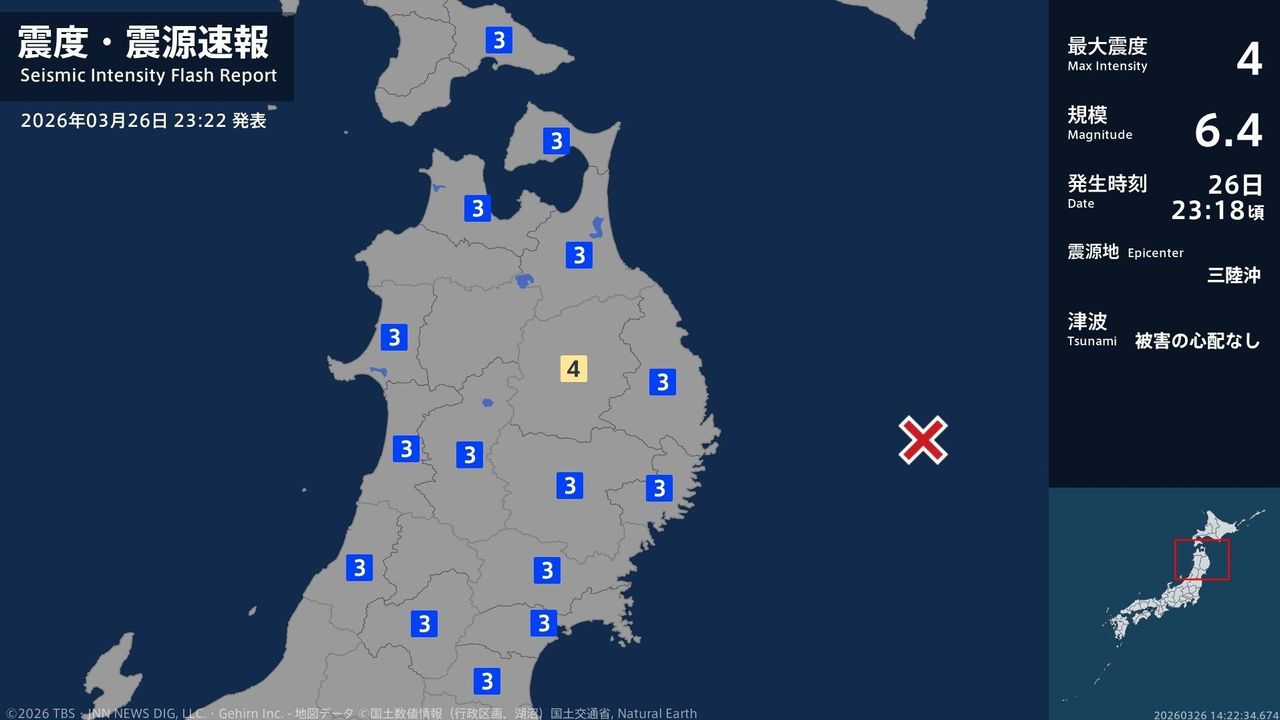
On March 26 at 午後11時18分ごろ (gogo juuichi-ji juuhappun goro), around 11:18 P.M., a somewhat strong earthquake struck 岩手県で (Iwate-ken de), Iwate Prefecture, recording a maximum seismic intensity of 4.
A Late-Night Earthquake in Iwate
According to reports, on the night of the 26th, a やや強い地震 (yaya tsuyoi jishin)—a somewhat strong earthquake—occurred in Iwate Prefecture.
The earthquake reached a 最大震度4 (saidai shindo yon), meaning the greatest seismic intensity observed was level 4 on Japan’s scale. The shaking was officially 観測する (kansoku suru), or measured, at this level.
The key details reported were:
- Date: March 26
- Time: Around 11:18 P.M.
- Location: Iwate Prefecture
- Maximum seismic intensity: 4
Even in short news bulletins like this, Japanese reports are very precise about time, place, and measurement.
Understanding Earthquakes in Japan
Japan uses a unique system called 震度 (shindo), or seismic intensity, to describe how strongly the ground shakes at a specific location. This is different from magnitude, which measures the total energy of an earthquake.
When news reports say 最大震度 (saidai shindo), they mean “the maximum seismic intensity observed” in affected areas.
A level 4 on the Japanese scale is noticeable and can feel strong, but it is not among the most severe levels. The wording やや強い (yaya tsuyoi) literally means “somewhat strong” or “rather strong,” softening the description slightly.
Because earthquakes are common in Japan, news reports are typically concise and factual, focusing on measurable data such as time, place, and 観測する (kansoku suru) results.
Learn Japanese from This Article
Let’s break down the key vocabulary and grammar used in this short but information-packed report.
Vocabulary
| Japanese | Romaji | Meaning |
|---|---|---|
| 午後 | gogo | P.M.; afternoon/evening |
| 震度 | shindo | seismic intensity (Japanese scale) |
| 観測する | kansoku suru | to observe; to measure |
| 最大 | saidai | maximum; greatest |
| やや | yaya | somewhat; rather; slightly |
| 強い | tsuyoi | strong |
| 岩手県 | Iwate-ken | Iwate Prefecture |
Notice how these words combine to form compact news expressions like:
- 最大震度4 (saidai shindo yon) — maximum seismic intensity 4
- やや強い地震 (yaya tsuyoi jishin) — a somewhat strong earthquake
Japanese news writing often stacks nouns together without extra words, which is why reading practice is so important.
Grammar Spotlight
1. 〜ごろ (around, about a time)
Used after a specific time to mean “around” or “about.”
Structure: Time + ごろ
Example from the article:
- 午後11時18分ごろ (gogo juuichi-ji juuhappun goro) Around 11:18 P.M.
More examples:
3時ごろ帰ります。 San-ji goro kaerimasu. I’ll go home around 3 o’clock.
朝7時ごろ起きます。 Asa shichi-ji goro okimasu. I wake up around 7 a.m.
2. Nで (location of an event)
The particle で marks where an action or event happens.
Structure: Place + で
Example from the article:
- 岩手県で地震がありました。 Iwate-ken de jishin ga arimashita. An earthquake occurred in Iwate Prefecture.
More examples:
東京で会議があります。 Tōkyō de kaigi ga arimasu. There is a meeting in Tokyo.
学校で勉強します。 Gakkō de benkyō shimasu. I study at school.
Understanding で is essential because Japanese news constantly specifies where events happen.
Useful Expressions from News Reports
地震がありました。 Jishin ga arimashita. There was an earthquake.
最大震度〜を観測しました。 Saidai shindo ~ o kansoku shimashita. A maximum seismic intensity of ~ was observed.
These patterns appear frequently in Japanese news, especially in reports about natural events.
Continue Learning
To strengthen your reading skills and understand news reports more confidently:
- To understand more about general, explore our Reading and Writing in Japanese II: Hiragana and Katakana lesson.
- Working on your reading skills? Our Introduction to Kanji: Pictorial Foundations of Japanese Script lesson is a great next step.
- Want to learn more about general? Check out our lesson on Basic Vocabulary Building: Embracing Words Without Latin Ties.
By reading short, real news reports like this, you’re training yourself to recognize patterns, particles, and vocabulary exactly as they’re used in Japan.
これからもよろしくお願いします。 Kore kara mo yoroshiku onegaishimasu.