
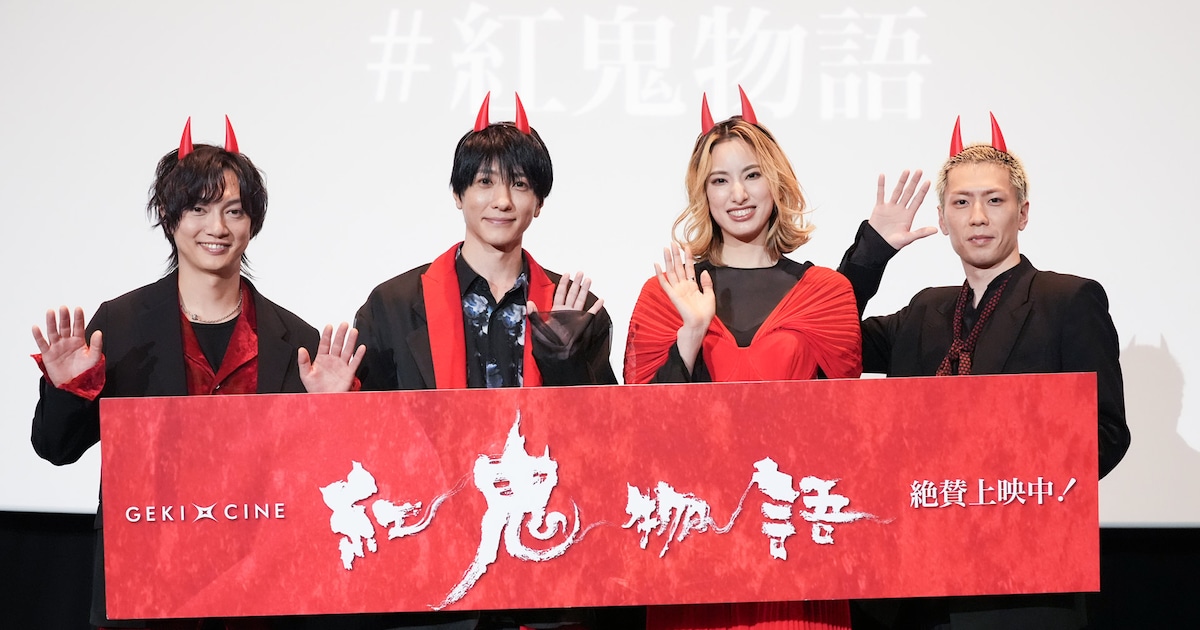
On March 21, a special screening with a live broadcast of the stage greeting for 「《ゲキ×シネ》紅鬼物語」 (Geki×Cine Akaoni Monogatari) was held in Tokyo—and streamed to movie theaters across Japan.
The film is the cinematic version of the 2025 stage production performed in Osaka and Tokyo from May to July last year. Now transformed into ゲキ×シネ (Geki×Cine), a high-quality filmed edition of a stage play, the story returns to audiences in a new format.
A Story of Demons and Human Hearts
Originally 上演 (jouen, staged) as part of Gekidan☆Shinkansen’s 45th anniversary performances, Akaoni Monogatari tells the story of a man named Minamoto no Aoi. One day, a being believed to be a demon abducts his wife, Beniko, and daughter, Fuji. Ten years later, he finally finds a clue and heads to the demons’ dwelling—only to discover a sorrowful chain of fate connected to their separation a decade earlier.
At the Tokyo screening venue, Shinjuku Wald 9, cast members Yuzuka Rei, Saotome Yūki, Kyan Yutaka, and Suzuki Hiroki 登壇 (toudan, appeared on stage) for a 舞台挨拶 (butai aisatsu, stage greeting). The event was shown nationwide via 生中継 (namachuukei, live broadcast).
Yuzuka Rei: “What Is a Demon?”
Yuzuka Rei, who plays Beniko, spoke about her strong desire to make the character’s 殺陣 (tate, choreographed stage combat) convincing and meaningful.
She expressed gratitude to co-stars Saotome and Suzuki, as well as the action team, saying:
“I was so happy to be able to perform so many fight scenes in such a wonderful environment.”
Reflecting on the story’s deeper meaning, she added:
“I’m grateful that Akaoni Monogatari has been reborn as Geki×Cine. What is a demon? Is it something inside people? Is it society? Or is it something within ourselves? I personally learned many things from this work. I would be happy if it reaches everyone as a piece that makes you feel something.”
Her comment highlights one of the play’s central questions: the “demon” may not simply be a monster—but a reflection of human emotion or social forces.
Saotome Yūki: The Power of Film
Saotome Yūki, who plays the demon Tochinoki, noted that this marked his sixth appearance with the troupe—but his first time participating in a Geki×Cine stage greeting.
He used the expression:
「6度目にして、ようやく初めてゲキ×シネの舞台挨拶に参加できて嬉しく思っております」 Rokudome ni shite, youyaku hajimete Geki×Cine no butai aisatsu ni sanka dekite ureshiku omotte orimasu. “Only on my sixth time have I finally been able to participate in a Geki×Cine stage greeting, and I’m very happy.”
He also shared an important perspective:
“I believe stage performances are best seen live. But with Shinkansen’s Geki×Cine, you can see tears, sweat, and fine details you can only catch here. Whether you saw it live or not, this filmed version offers something unique.”
Behind the Scenes: Camaraderie and Direction
Kyan Yutaka, playing Sakagami Kinnosuke, described Saotome as 頼りになる (tayori ni naru, dependable). He joked that in previous productions Saotome seemed ツンケンする (tsunken suru, aloof or prickly), but this time he was kind—joining morning practice sessions for fight choreography and offering detailed advice.
Meanwhile, Suzuki Hiroki, returning to the troupe after eight years, reflected on director Inoue Hidenori’s strict eye for comedy scenes. Since the title includes the word 「物語」 (monogatari, story), he encouraged audiences to watch it in theaters and talk about it with others, hoping it will become a truly beloved work.
Special Screenings and Exhibition
Until April 12, a costume exhibition is being held at Hibiya Chanter in Tokyo. Costumes worn by Yuzuka and Suzuki, stage props, and signed boards from the main cast are on display.
Some screenings also feature “カンゲキ上映” (kangeki jouei), where audience members are allowed to give 拍手 (hakushu, applause) and clap along. These special screenings include an exclusive pre-show video message from Yuzuka.
Cultural Context: What Is Geki×Cine?
ゲキ×シネ (Geki×Cine) is a uniquely Japanese format that blends theater and cinema. Instead of a simple recording, productions are filmed with cinematic camera work and editing, allowing viewers to experience close-ups and details impossible to see from a theater seat.
For Japanese audiences, this format has become a powerful way to preserve large-scale stage productions and share them nationwide.
Learn Japanese from This Article
Vocabulary
| Japanese | Romaji | Meaning |
|---|---|---|
| 舞台挨拶 | butai aisatsu | stage greeting; cast appearance at screening |
| 生中継 | namachuukei | live broadcast |
| 上演 | jouen | stage performance; to stage a play |
| 登壇 | toudan | to appear on stage |
| 殺陣 | tate | choreographed stage combat |
| 頼りになる | tayori ni naru | dependable; reliable |
| ツンケンする | tsunken suru | to act aloof or prickly |
| 拍手 | hakushu | applause |
Grammar Spotlight
1. 〜にして
Meaning: “only after…,” “at the point of…,” often emphasizing that something finally happened.
Example from the article:
- 6度目にして、ようやく初めて参加できた。 Rokudome ni shite, youyaku hajimete sanka dekita. “Only on the sixth time was I finally able to participate.”
Structure: Number + 度目にして
It highlights that something took many attempts before succeeding.
2. 〜ような気がする
Meaning: “I feel like…” / “I have the sense that…”
Example:
- 鬼は人の中にあるもののような気がする。 Oni wa hito no naka ni aru mono no you na ki ga suru. “I feel like demons exist within people.”
Structure: Plain form + ような気がする
Used to express a personal, soft opinion rather than a strong assertion.
Useful Expressions
ぜひご覧ください。 Zehi goran kudasai. “Please be sure to watch.”
〜として届いていたら嬉しいです。 … to shite todoite itara ureshii desu. “I’d be happy if it reaches you as…”
久しぶりに〜する。 Hisashiburi ni … suru. “To do something for the first time in a long while.”
Continue Learning
- Working on your reading skills? Our Introduction to Kanji: Pictorial Foundations of Japanese Script lesson is a great next step.
- Curious about the Japanese used here? Our Basic Vocabulary Building: Embracing Words Without Latin Ties lesson covers this in depth.
- Want help with loanwords like ゲキ×シネ? Our Katakana Essentials: Adapting Global Words to Japanese lesson will strengthen your reading skills.
Through stories like Akaoni Monogatari, you don’t just learn vocabulary—you encounter the emotional and philosophical layers of Japanese storytelling.
これからもよろしくお願いします。 Kore kara mo yoroshiku onegaishimasu.