
A 21-second song clip on TBS earned 2,420 yen in total royalties. That’s the real number a Japanese musician recently revealed—complete with his official 明細 (meisai, detailed statement)—after his lyrics were used on television.
For many people, TV exposure sounds like a fast track to 不労所得 (furou shotoku, passive income). But is it really?
From Streaming to Television: Is TV a Gold Mine?
The writer, Nakazawa, is active in several bands and distributes music through サブスク(サービス) (sabusuku (saabisu), subscription services) like Spotify. He notes that streaming income is often described as “a drop in the bucket.” Many musicians already know this reality.
But television? That feels different.
There’s a common image that even one broadcast could bring in a large amount of 印税 (inzai, royalties). Maybe not instant wealth—but surely a decent payout, don’t you think? That’s the expectation many people have.
So Nakazawa decided to publicly share the 著作権使用料 (chosakuken shiyouryou, copyright usage fee) breakdown from when a song he wrote lyrics for was used on TBS.
How Did His Song End Up on TV?
The 経緯 (keii, background circumstances) is surprisingly simple.
He himself appeared on a TBS golden-time program. During his introduction—“Nakazawa-san, who is also a musician”—a song he had written lyrics for was played briefly in the background.
So this wasn’t passive income at all. He was physically there, working.
That’s an important point. True 不労所得 (furou shotoku) usually requires massive commercial success. If you’re not a hit artist, you still have to put in the work. In his own words, there’s no secret “Oshi no Ko”-style insider life hack here.
How Are TV Royalties Calculated?
Previously, Nakazawa had contacted JASRAC (Japan’s main copyright management organization) to understand how TV royalties are calculated.
The system works by assigning points based on factors such as:
- Number of broadcasts
- Length of time the song is used
- Purpose (main theme or background music)
- The broadcaster’s 規模 (kibo, scale/size)
Interestingly, the time slot (late night vs. golden time) doesn’t matter.
In his case:
- Number of broadcasts: 1
- Length: 21 seconds
- Usage: BGM (background music)
- Broadcaster: TBS (a major commercial network)
As background music used only once, it was considered a relatively weak case in terms of points—but TBS is one of the largest networks, which helps.
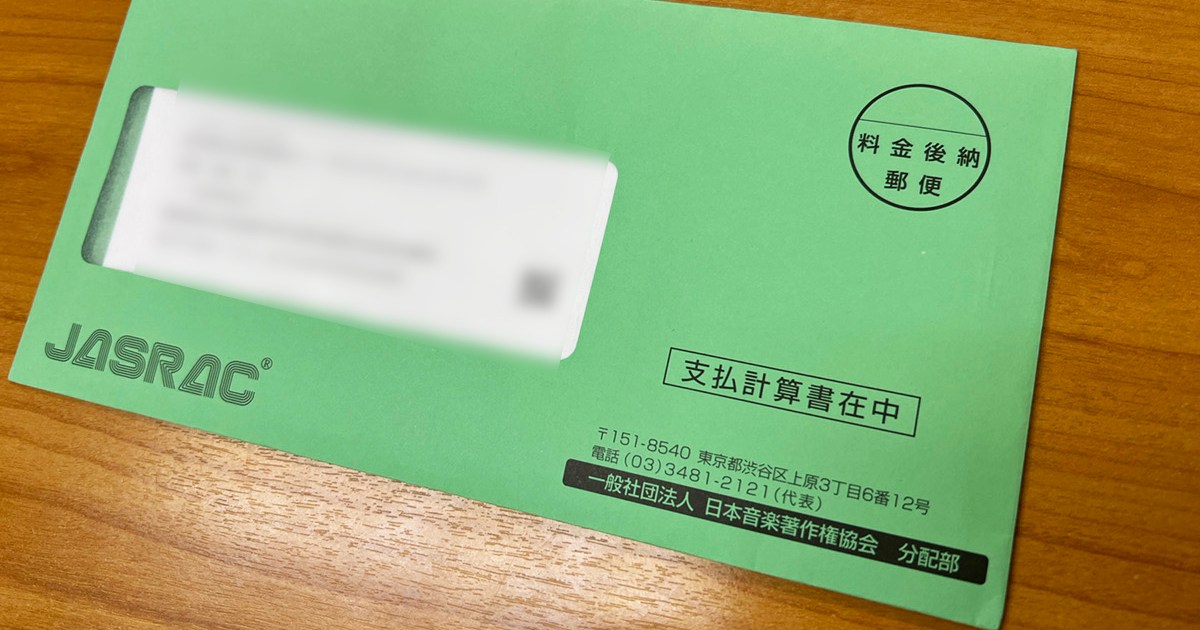
For television, payments are finalized about six months after the broadcast. So when the statement finally arrived, he opened the envelope dramatically.
Inside were three documents, including the detailed payment breakdown.
The Actual Numbers
The statement listed two relevant categories:
- KB131 民放テレビ・レコード放送 (commercial TV record broadcast)
- KN130 放送用録音・民放テレビ (recording for broadcast use, commercial TV)
According to JASRAC’s system, TV broadcasts generally involve recorded music, which means the reproduction right is also included.
So there are effectively two payments:
- One for the broadcast itself
- One for the reproduction (copying for broadcast)
Here’s what he received:
- Broadcast fee: 2,226 yen
- Reproduction fee: 194 yen
Total: 2,420 yen.
His reaction? “That’s so little!”
Is 2,420 Yen Really That Small?
At first glance, it feels disappointing. The fantasy of TV riches disappears instantly.
But let’s look at it calmly.
It was just 21 seconds. And he only wrote the lyrics—not the composition or arrangement. From that perspective, 2,420 yen might not be so bad.
In Japanese, this kind of explanatory realization often uses the grammar pattern 〜わけだ (wake da): “So that’s how it works.” / “That means…”
テレビは大金が入ると思っていたけど、21秒で2420円なわけだ。 terebi wa taikin ga hairu to omotte ita kedo, nijuuichi-byou de nisen yonhyaku nijuu en na wake da. “I thought TV would bring in big money, but it turns out it’s 2,420 yen for 21 seconds.”
He also reflects with a softer opinion using 〜ではないだろうか (de wa nai darou ka), meaning “isn’t it…?” or “don’t you think?”
21秒で2420円なら、多いとも言えるのではないだろうか。 nijuuichi-byou de nisen yonhyaku nijuu en nara, ooi to mo ieru no de wa nai darou ka. “For 21 seconds and 2,420 yen, couldn’t you say that’s actually quite a lot?”
Still, one thing is clear: he did not become rich.
Cultural Context: JASRAC and Japanese Royalties
In Japan, JASRAC manages music copyright licensing and distributes royalties to rights holders. When music is used on TV, the broadcaster reports usage, and payments are calculated based on a point system.
Unlike some countries where contracts may vary widely, Japan’s centralized management system creates a standardized structure. However, as this example shows, standard doesn’t necessarily mean huge.
The dream of 不労所得 remains a steep path—険しき道なり (a difficult road indeed).
Learn Japanese from This Article
Key Vocabulary
| Japanese | Romaji | Meaning |
|---|---|---|
| サブスク(サービス) | sabusuku (saabisu) | subscription (service) |
| 著作権使用料 | chosakuken shiyouryou | copyright usage fee, royalty |
| 印税 | inzai | royalties (books, music, etc.) |
| 不労所得 | furou shotoku | passive income |
| 明細 | meisai | detailed statement, breakdown |
| 経緯 | keii | background, circumstances |
| 規模 | kibo | scale, size |
Grammar Spotlight
1. 〜わけだ
Meaning: That means…, no wonder…, so…
Used to explain a conclusion based on information.
Structure: Plain form + わけだ
Example: テレビ局の規模が大きい。だから金額も高くなるわけだ。 terebi-kyoku no kibo ga ookii. dakara kingaku mo takaku naru wake da. “The TV station is large. That’s why the payment becomes higher.”
2. 〜ではないだろうか
Meaning: Isn’t it…?, Don’t you think…?, I suppose…
A softer, more reflective way to express opinion.
Structure: Plain form + のではないだろうか
Example: これは意外と現実的な金額なのではないだろうか。 kore wa igai to genjitsuteki na kingaku na no de wa nai darou ka. “Isn’t this actually a fairly realistic amount?”
Useful Expression
種目別使用料 shumokubetsu shiyouryou “Usage fee by category” — useful when reading official statements or contracts.
Continue Learning
Understanding numbers like 2,420 yen and 21 seconds in Japanese contexts is essential. Ready to dive deeper? Our lesson on Numbers and Counters: Contextual Counting Systems will help you master these concepts.
TV exposure sounds glamorous. The reality, at least in this case, is far more modest—but also more transparent than you might expect. And sometimes, seeing the real numbers is the best language lesson of all.
これからもよろしくお願いします。 Kore kara mo yoroshiku onegaishimasu.