
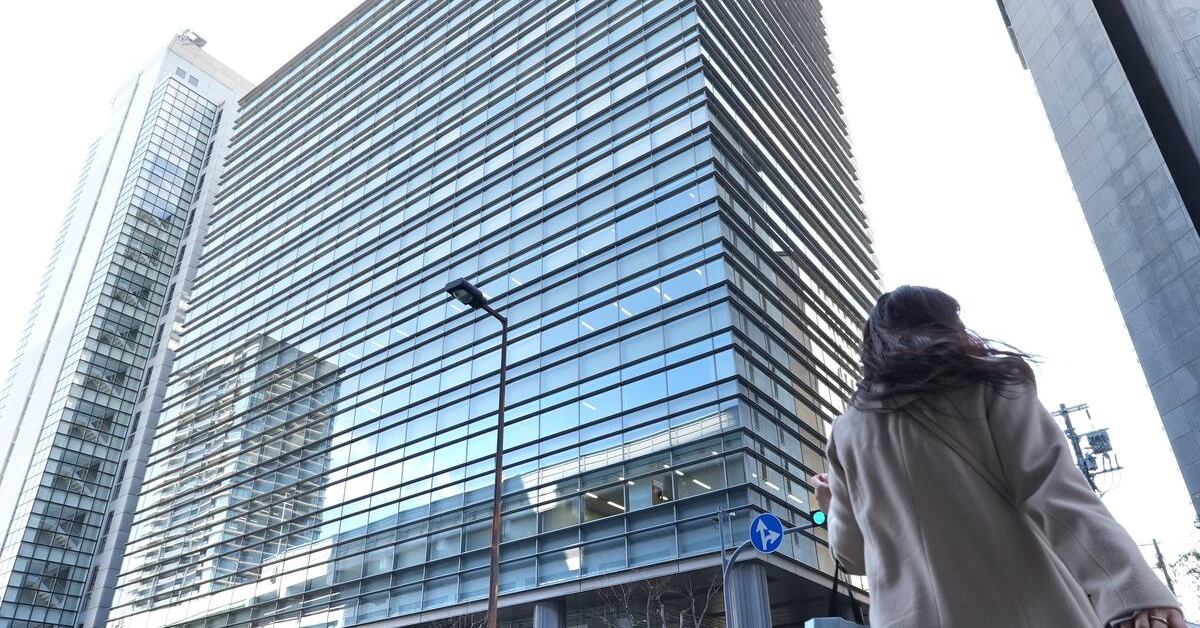
On March 16, Sharp began operations at its new headquarters in Osaka’s Chūō Ward, marking its first return to Osaka City in about ten years. The move brings the company’s main functions back from its former base at the Sakai factory—once a symbol of its LCD business.
A Decade After Moving Out
Sharp had relocated its headquarters in 2016 from Abeno Ward in Osaka City to Sakai City as part of its management restructuring. Now, nearly ten years later, the company has returned to Osaka City.
The new headquarters building, which Sharp is leasing, houses major administrative departments such as human resources, legal affairs, public relations, and accounting. About 800 employees will work in a space totaling approximately 9,500 square meters. Employee relocations are expected to be completed within this month.
The entrance of the new headquarters also features a bronze statue of Sharp’s founder, Hayakawa Tokuji—a symbolic reminder of the company’s origins as it enters a new phase.
Why Move Back Now?
There are two main reasons behind the relocation.
First, the move follows the sale of the Sakai factory. The Sakai plant had long represented Sharp’s LCD panel production, but the company stopped panel production there in August 2024. Afterward, it sold both the panel factory and the headquarters building.
Second, the relocation is described as part of the company’s policy of “investing in people.” The new office is located near Sakaisuji-Hommachi Station on the Osaka Metro Chūō Line, in a highly convenient central area. By returning to a more accessible urban location, Sharp aims to strengthen recruitment and employee development.
Behind these decisions lies a difficult period. Sharp recorded net losses for two consecutive fiscal years, 2022 and 2023, largely due to the slump in its display business. The headquarters move signals another step in its broader management recovery efforts.
Cultural Context: Osaka and Corporate Identity
Osaka has long been one of 日本 (nihon)’s major commercial centers. For a historic Osaka-based company like Sharp, location carries symbolic weight. Returning to central Osaka is not only a logistical decision—it also represents reconnecting with the city’s business community.
In Japanese ニュース (nyuusu), corporate headquarters relocations are often framed as signals of strategic change. Moving back to a city center can imply renewed ambition, a focus on talent acquisition, and a fresh start after restructuring.
The statue of founder Hayakawa Tokuji at the entrance reinforces this sense of continuity: even as strategies change, the company emphasizes its roots.
Learn Japanese from This Article
Let’s look at useful vocabulary and expressions taken directly from this story.
Key Vocabulary
| Japanese | Romaji | Meaning |
|---|---|---|
| 本社 | honsha | headquarters |
| 移転 | iten | relocation, move |
| 管理部門 | kanri bumon | administrative department |
| 人への投資 | hito e no tōshi | investment in people |
| 最終赤字 | saishū akaji | net loss |
| 生産を停止する | seisan o teishi suru | to stop production |
| 売却する | baikyaku suru | to sell (assets, property) |
Notice how many of these words are common in business ニュース (nyuusu). Learning them will help you read Japanese economic and tech reporting more confidently.
Grammar Spotlight: 〜に伴う (…ni tomonau)
One key expression from the article is:
〜に伴う (…ni tomonau) — “accompanying,” “due to,” or “as a result of”
Example from the text:
- 堺工場の売却に伴う対応 Sakai kōjō no baikyaku ni tomonau taiō “Measures accompanying the sale of the Sakai factory”
More examples:
組織変更に伴う人事異動 Soshiki henkō ni tomonau jinji idō “Personnel changes accompanying organizational reform”
価格改定に伴うお知らせ Kakaku kaitei ni tomonau oshirase “Notice regarding price revisions”
This structure is commonly used in formal writing and business contexts. When you see 〜に伴う, think: “This happens as a result of that.”
Useful Expression: 〜以来 (…irai)
Another important phrase:
〜以来 (…irai) — “since (a certain time in the past)”
From the article:
- 2016年に…移して以来、約10年ぶり “Since moving in 2016, it has been about ten years.”
Example:
- 日本に来て以来、ずっと大阪に住んでいます。 Nihon ni kite irai, zutto Ōsaka ni sunde imasu. “Since coming to Japan, I’ve been living in Osaka.”
This expression is extremely useful for talking about ongoing situations that started in the past.
Continue Learning
📚 Working on your reading skills? Our Katakana Essentials: Adapting Global Words to Japanese lesson is a great next step.
📚 Curious about the Japanese used here? Our Basic Vocabulary Building: Embracing Words Without Latin Ties lesson covers this in depth.
Basic Vocabulary Building: Embracing Words Without Latin Ties
📚 Curious about the Japanese used here? Our Reading and Writing in Japanese II: Hiragana and Katakana lesson covers this in depth.
これからもよろしくお願いします。 Kore kara mo yoroshiku onegaishimasu.