
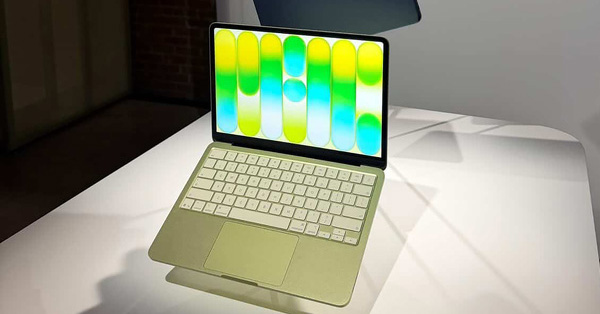
On March 4 (local time), Apple announced and showcased the new MacBook Neo at its Apple Experience event in New York’s Terminal Warehouse. The biggest surprise? It’s priced from ¥99,800, making it one of the most affordable new Macs in recent years.
Let’s take a closer look at what Apple revealed—and learn some authentic Japanese tech vocabulary along the way.
A Mac Equipped with the A18 Pro Chip
The MacBook Neo is the first Mac equipped with Apple’s iPhone chip, the A18 Pro. In Japanese product descriptions, you’ll often see:
- A18 Proを搭載したMacBook Neo A18 Pro o tōsai shita MacBook Neo “MacBook Neo equipped with the A18 Pro”
The verb 搭載する(とうさいする) (tōsai suru) means “to equip with” or “to mount.” It’s commonly used in tech news for devices that include specific features or components.
Display and Design
The MacBook Neo features a 13-inch Liquid Retina ディスプレイ (disupurei — display) with:
- 2408 × 1506 resolution (219ppi)
- 500 nits brightness
- sRGB color space
- Support for 1 billion colors
However, it is 非対応(ひたいおう) (hitaiō) — “not compatible with” — for P3 wide color and TrueTone.
This contrast between 〜に対応する (ni taiō suru, “to support”) and 〜に非対応 (ni hitaiō, “not support”) appears constantly in Japanese tech writing.
The body is made from アルミニウム (aruminiumu — aluminum), using 90% recycled material. The Apple logo is precisely engraved during the CNC cutting process, and instead of a mirror-polished finish, it’s treated differently during the anodizing stage to adjust color and reflectivity.
Available colors:
- Silver
- Blush
- Citrus
- Indigo
The weight is 1.23kg—the same as the MacBook Air (13-inch, M5, 2026).
Fanless and Silent
The MacBook Neo has a ファンレス (fanresu) design—meaning no cooling fan. Even during operation, it remains completely silent.
It also includes:
- Dual microphone array with beamforming
- 1080p FaceTime HD camera
However, Desk View and Center Frame camera features are 非対応 (hitaiō).
Keyboard, Storage, and Touch ID
The keyboard follows the JIS layout with 12 full-height function keys. A US keyboard is available as an option. The keycaps match each body color—but there is no keyboard backlight.
Here’s where things get interesting: the keyboard differs depending on ストレージ (sutorēji — storage) size.
| Model | Specs | Price |
|---|---|---|
| 8GB / 256GB | Magic Keyboard | ¥99,800 |
| 8GB / 512GB | Magic Keyboard with Touch ID | ¥114,800 |
Only the 512GB model includes Touch ID, allowing users to unlock the device, sign in to websites and apps, and download apps with a fingerprint.
Ports and Connectivity
On the left side, there are two USB-C ポート (pōto — ports):
- One supports DisplayPort and USB 3 (up to 10Gb/s)
- One supports USB 2 (up to 480Mb/s)
Both can be used for charging. The USB 3 port supports one external 4K/60Hz display.
Other features:
- 3.5mm headphone jack (positioned near the palm rest)
- Side-firing speakers supporting Spatial Audio and Dolby Atmos
- Wi-Fi 6E (802.11ax)
- Bluetooth 6
The bottom panel uses eight pentalobe screws.
Battery life is rated at:
- 16 hours for video streaming
- 11 hours for wireless web use
- 36.5Wh internal battery
A 20W USB-C power adapter and 1.5m USB-C cable are included.
Apple’s Message
John Ternus, Apple’s Senior Vice President of Hardware Engineering, introduced the MacBook Neo as:
“A Mac that delivers the magic of Mac at a groundbreaking price.”
He emphasized that it was designed from the ground up to be more accessible, featuring durable aluminum design, vivid display, Apple Silicon performance, all-day battery life, high-quality camera and microphones, Magic Keyboard, Multi-Touch trackpad, and the intuitive power of macOS.
Pre-orders began March 4, with release scheduled for March 11.
Cultural Context: Why Under ¥100,000 Matters
In Japan, the 10万円(じゅうまんえん) (jūman-en, 100,000 yen) mark carries psychological weight. Products priced below it are often perceived as significantly more affordable.
The phrase used in the title:
- 10万円切り(じゅうまんえんぎり) jūman-en giri “Under 100,000 yen”
The verb 切る(きる) (kiru) literally means “to cut,” but in pricing, it means “to break below.”
This expression appears frequently in Japanese business and tech news.
Learn Japanese from This Article
Vocabulary
| Japanese | Romaji | Meaning |
|---|---|---|
| 搭載(とうさい) | tōsai | to equip with |
| 非対応(ひたいおう) | hitaiō | not supported |
| ディスプレイ | disupurei | display |
| ファンレス | fanresu | fanless |
| ポート | pōto | port |
| ストレージ | sutorēji | storage |
| アルミニウム | aruminiumu | aluminum |
| 切る(きる) | kiru | to cut; to go below (a price) |
Grammar Spotlight
1️⃣ 〜を搭載したN
Meaning: “A noun equipped with ~”
Structure: [Feature] + を搭載した + [Noun]
Example:
A18 Proを搭載したMacBook A18 Pro o tōsai shita MacBook A MacBook equipped with the A18 Pro
最新チップを搭載したモデルです。 Saishin chippu o tōsai shita moderu desu. It’s a model equipped with the latest chip.
This structure is extremely common in Japanese product descriptions.
2️⃣ 〜に対応する/〜に非対応
Structure: [Feature] + に対応する → supports ~ [Feature] + に非対応 → does not support ~
Examples:
4K出力に対応するポートです。 4K shutsuryoku ni taiō suru pōto desu. It’s a port that supports 4K output.
TrueToneに非対応です。 TrueTone ni hitaiō desu. It does not support TrueTone.
You’ll see this everywhere in Japanese tech reviews.
Useful Expression
- 予約受付を開始しました。 Yoyaku uketsuke o kaishi shimashita. Reservations have started.
Notice how Japanese often avoids mentioning the subject (who started it). Context tells us it’s Apple.
Continue Learning
Want to learn more about how Japanese handles dates and time expressions like “3月4日より予約受付を開始”? Check out our lesson on Time and Dates: Tense-Free Expressions
Affordable pricing, recycled aluminum design, and a fanless silent body—MacBook Neo introduces a new way of describing laptops in Japanese tech media. By paying attention to expressions like 搭載 and 非対応, you’re not just reading tech news—you’re learning how Japanese products are presented in Japan itself.
これからもよろしくお願いします。 Kore kara mo yoroshiku onegaishimasu.