
Meta Description (150–acters): Apple unveils the iPhone 17e at the same ¥99,800 price, doubling storage to 256GB and adding MagSafe support for the first time.
On March 2, Apple announced the new iPhone 17e, an entry model that keeps the same starting price of 99,800 yen—while doubling the base storage to 256GB.
For many people in Japan, that combination of “same price, more storage” is the headline. Let’s take a closer look at what changed, what stayed the same, and what Japanese you can learn from this tech news.
iPhone 17e: Same Price, Double the Storage
Apple introduced the iPhone 17e as the エントリーモデル (entori moderu, entry-level model) in the iPhone 17 family.
The starting price remains 9万9800円 (99,800 yen), just like the previous generation. However, the minimum ストレージ (sutoreji, storage) has doubled to 256GB. There is also a 512GB model priced at 134,800 yen.
Pre-orders begin on March 4, and sales start on March 11.
In Japan, pricing stability is often seen as a strong selling point, especially as smartphones continue to become more expensive. Keeping the same price while increasing storage sends a clear message about value.
Design and Display: Familiar but Updated
The design follows the previous iPhone 16e, updating the chip and モデム (modemu, modem) while keeping the overall look.
It features a 6.1-inch Super Retina XDR (OLED) ディスプレイ (disupurei, display). The front cover uses “Ceramic Shield 2,” which is shared across the iPhone 17 family.
Compared to the previous generation, it offers:
- Three times the scratch resistance
- Anti-reflective coating
- IP68 water and dust resistance
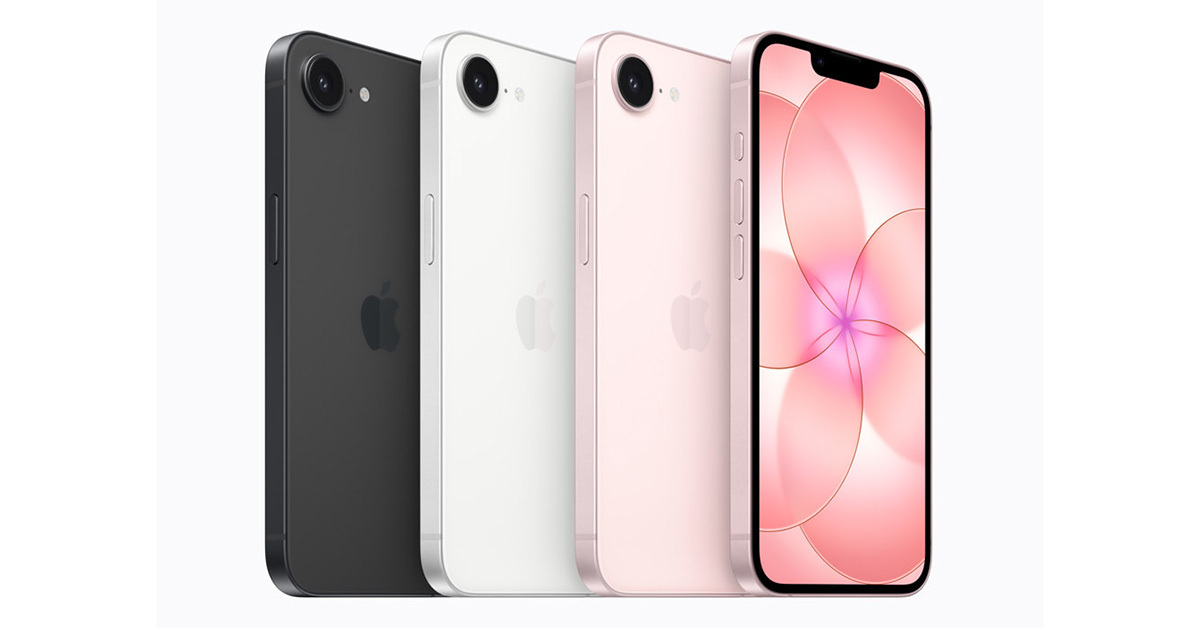
The body is made of aluminum and comes in three colors: black, white, and soft pink.
The phrase used in the article to describe this is:
前モデルを引き継ぎつつ、チップやモデムなどをアップデート。 Zen moderu o hikitsugi tsutsu, chippu ya modemu nado o appudēto. “While inheriting the previous model’s design, it updates the chip and modem.”
We’ll break down 〜つつ later in the grammar section.
A19 Chip and Faster AI Processing
The iPhone 17e runs on Apple’s latest A19 chip, with:
- 6-core CPU
- 4-core GPU
- 16-core Neural Engine
The GPU includes Neural Accelerators, allowing faster AI model inference than the previous generation. It also サポートしている (sapōto shite iru, supports) hardware-accelerated ray tracing.
Notice how Japanese tech writing often uses サポートする for “to support” a feature—this is extremely common in product descriptions.
New C1X Modem and Satellite Features
The iPhone 17e includes Apple’s in-house designed C1X modem. Compared to the C1 in the 16e, communication speeds are doubled.
It also supports デュアルeSIM (dyuaru i-shimu, dual eSIM).
In addition, it can communicate directly with satellites. This enables:
- Emergency SOS via satellite
- Messaging via satellite
- “Find My” via satellite
The article uses the phrase:
衛星との直接通信にも対応している。 Eisei to no chokusetsu tsūshin ni mo taiō shite iru. “It also supports direct communication with satellites.”
The grammar 〜に対応している is key here—we’ll look at it below.
Camera and Charging: MagSafe Finally Arrives
The camera is a single 48-megapixel lens, supporting 2x crop zoom. For video, it supports 4K Dolby Vision at up to 60fps.
One of the biggest changes is wireless charging.
The iPhone 16e only supported Qi charging (up to 7.5W). The iPhone 17e now supports Qi2 (up to 15W) and, for the first time in this model line, MagSafe.
That means MagSafe chargers, cases, and wallets can attach magnetically.
With a 20W or higher USB-C power adapter, the phone can charge to about 50% in approximately 30 minutes.
iOS 26 and Apple Intelligence (Beta)
The iPhone 17e runs iOS 26.
Apple Intelligence is バンドル (bandoru, bundled) in beta form. Features available in Japanese include:
- Live Translation
- Call Screening
- Visual Intelligence (searching information directly from what’s displayed on screen)
The word バンドル is often used in Japanese tech writing to mean “included together as a package.”
Cultural Context: How Japanese Tech News Reads
Japanese tech articles tend to be:
- Highly specification-focused
- Structured around price and features
- Written in a concise, formal style
You’ll often see loanwords like:
- ディスプレイ
- モデム
- サポート
- バンドル
Modern Japanese tech language blends native grammar with English-based vocabulary written in katakana. Learning to read these smoothly is a big step toward real-world Japanese literacy.
Learn Japanese from This Article
Key Vocabulary
| Japanese | Romaji | Meaning |
|---|---|---|
| エントリーモデル | entori moderu | entry-level model |
| ストレージ | sutoreji | storage |
| ディスプレイ | disupurei | display |
| モデム | modemu | modem |
| デュアルeSIM | dyuaru i-shimu | dual eSIM |
| サポートする | sapōto suru | to support (a feature) |
| バンドル | bandoru | bundled, included together |
| 〜に対応している | 〜ni taiō shite iru | to support / be compatible with |
Grammar Spotlight
1️⃣ 〜つつ
Meaning: “While doing A, also doing B” (formal written style)
Structure: Verb (stem) + つつ
Example from the article:
前モデルを引き継ぎつつ、アップデート。 Zen moderu o hikitsugi tsutsu, appudēto. “While inheriting the previous model, it updates (features).”
More examples:
働きつつ、日本語を勉強しています。 Hataraki tsutsu, nihongo o benkyō shite imasu. “I’m studying Japanese while working.”
伝統を守りつつ、新しい技術を取り入れる。 Dentō o mamori tsutsu, atarashii gijutsu o toriireru. “While preserving tradition, (we) adopt new technology.”
You’ll see this structure often in news and formal writing.
2️⃣ 〜に対応している
Meaning: “To support” or “to be compatible with”
Structure: Noun + に対応している
Examples:
Qi2に対応している。 Qi2 ni taiō shite iru. “It supports Qi2.”
日本語に対応しているアプリです。 Nihongo ni taiō shite iru apuri desu. “It’s an app that supports Japanese.”
This is one of the most common expressions in product descriptions in Japan.
Useful Expression
予約受付を開始する Yoyaku uketsuke o kaishi suru “to begin accepting pre-orders”
You’ll see this phrase in almost every Japanese product launch article.
Continue Learning
Curious about the structured, formal Japanese used in tech news introductions? Check out: Writing Practice: Crafting Initial Paragraphs
Tech articles like this are a goldmine for learning modern Japanese—especially if you want to read real-world news the way it’s written in Japan.
これからもよろしくお願いします。 Kore kara mo yoroshiku onegaishimasu.