
“Let’s pray we can see it.”
That was the guide’s quiet comment as the sea lay completely blue and calm. Even though “first drift ice sighting” had been announced more than a week earlier, the ocean off Abashiri showed no sign of ice. The sky was clear. Waves rolled in like any ordinary winter day. It turns out that seeing 流氷 (ryūhyō, drift ice) is far rarer—and far more fragile—than many people imagine.
Chasing Drift Ice in Eastern Hokkaido
Drift ice tourism in eastern Hokkaido is one of those experiences you can only have in winter. The writer of the original report had been inspired by the manga Golden Kamuy, whose climax features a dramatic escape across drift ice. Since the ice that forms in Russia’s Amur River drifts down through the Sea of Okhotsk to eastern Hokkaido, they reasoned (a bit boldly!) that it was “the same ice”—and headed to Abashiri.
The assumption? “As long as you make a 予約 (yoyaku, reservation) for the boat, anyone can see it.”
That assumption quickly began to crumble.
The Surprising Rarity of 流氷 (ryūhyō)
Many people think of drift ice as a simple seasonal phenomenon: winter comes, and ice appears. But that’s not quite true.
Yes, drift ice reaches eastern Hokkaido in winter. But because it floats on the sea, wind can push it closer to shore—or far away. You might see it one hour, and the next hour it could be completely gone. It’s incredibly fluid.
On the other hand, if the harbor fills entirely with ice, even an icebreaker cannot 出港 (shukkō, depart from port). In other words, the conditions have to be just right:
- Enough ice to see
- Not so much ice that the ship can’t move
- Close enough for a round-trip sightseeing route
It does not mean that winter automatically guarantees a perfect view. In Japanese, we could say:
冬だからといって、毎日流氷が見られるわけではない。 Fuyu dakara to itte, mainichi ryūhyō ga mirareru wake de wa nai. “Just because it’s winter doesn’t mean you can see drift ice every day.”
That pattern—〜わけではない—is extremely common in Japanese, and you’ll see it again later in our grammar section.
Sometimes the first cruise of the day sees drift ice, but the second doesn’t. Without it, the Sea of Okhotsk is simply a very cold ocean. Tension builds quickly.
Boarding the Icebreaker “Aurora”
The Abashiri Drift Ice Sightseeing Icebreaker “Aurora” is a 450-passenger 観光船 (kankōsen, sightseeing boat). Tickets cost around 5,000–6,000 yen for about 60 minutes.
This is the winter 目玉 (medama, highlight; main attraction) of Abashiri tourism, so reservations are essential. Even with a reservation, the ship can be 満船 (mansen, fully booked), and seating is first-come, first-served. Arriving early is highly recommended.
Unlike another famous drift ice boat in Monbetsu, which uses drill-like screws to crush ice, the Aurora breaks ice using its own weight—like Japan’s Antarctic research vessel Shirase.
When the ship departed right on time, the sea was still blue. No ice in sight.
Half the 60-minute journey passed before thin, translucent ice appeared, covering the surface like cracked skin. Not beautiful—at least not yet.
Then suddenly, the ship reached the drift ice zone.
A World Transformed into Ice
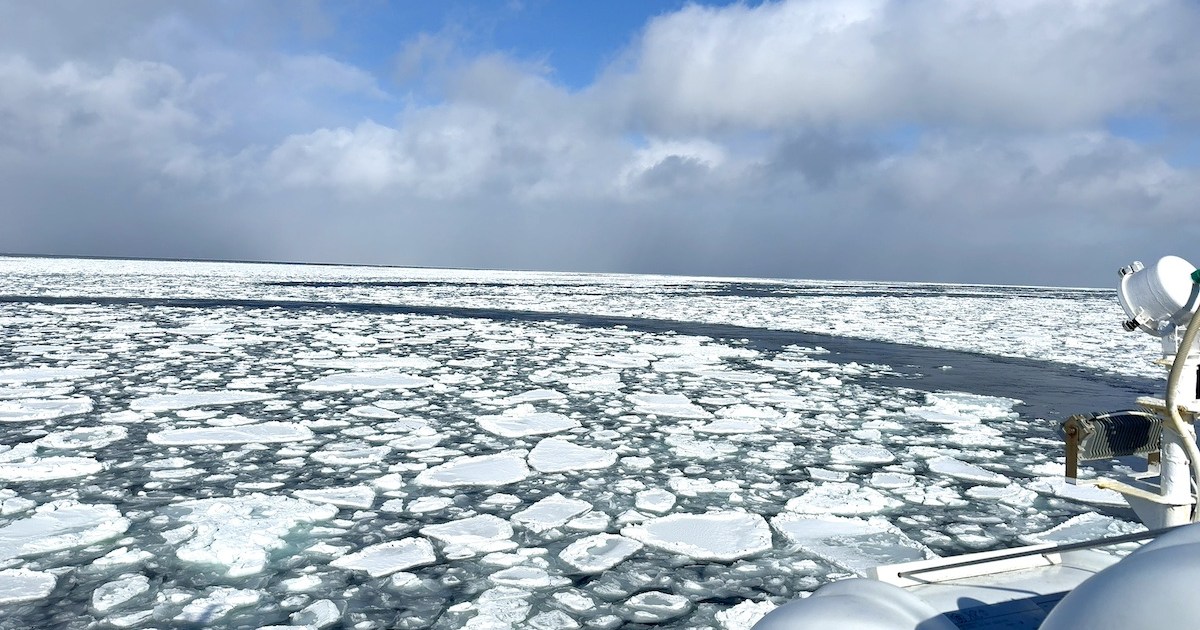
The ice wasn’t thick enough to walk on, like in the manga. But solid chunks stretched across the sea. As the Aurora moved deeper into the ice field, everything turned pale blue.
Where there had been open water, a flat, land-like surface spread out. It felt like a fleeting snowfield—changing shape moment by moment, existing only for a short time. Sunlight streamed through clouds, making the ice sparkle.
White-tailed eagles or Steller’s sea eagles rested on the ice.
Further north, where ice grows larger and thicker, collisions between ice sheets can create hills and ridges—almost like mountains. Nature’s power is astonishing.
Despite being an icebreaker, the ship made surprisingly little noise. Rather than violently smashing ice, it felt as though the boat gently pushed through drifting chunks.
Outside on the deck, the wind was painfully cold. Even with full 防寒 (bōkan, protection against the cold), you couldn’t stay in one place long. Passengers would briefly warm themselves in the shadow of the funnel before stepping out again.
When the ship turned back toward the harbor, a path remained carved through the ice—soon to disappear. Every moment felt temporary. The same view would never exist again.
It was described as a miracle-like hour.
How Long Will This View Remain?
The Aurora operates until the end of March and shares real-time updates: “Drift ice present,” “No drift ice,” or “Under confirmation.”
According to reports mentioned in the article, the area and duration of drift ice along Hokkaido’s coast have decreased to nearly half of what they were 100 years ago, possibly due to global warming. Glaciers in Alaska are also retreating year by year.
Even local residents of the next generation may not be able to see this sight.
The experience was so beautiful it felt almost divine—yet at the same time, it raised quiet concerns about the planet’s future.
Cultural Context: Why Drift Ice Matters in Japan
Drift ice is unique in Japan because Hokkaido is the southernmost place in the Northern Hemisphere where it regularly appears. That makes it both rare and deeply symbolic of Hokkaido’s harsh, powerful nature.
Eastern Hokkaido is known for its rugged climate and history. The mention of Golden Kamuy reflects how drift ice has entered pop culture as a dramatic, almost mythical setting.
In a country often associated with cherry blossoms and mild scenery, drift ice reminds us that Japan’s natural environment is far more diverse—and extreme—than many realize.
Learn Japanese from This Article
Key Vocabulary
| Japanese | Romaji | Meaning |
|---|---|---|
| 流氷 | ryūhyō | drift ice |
| 観光船 | kankōsen | sightseeing boat |
| 予約 | yoyaku | reservation |
| 出港 | shukkō | departure from port |
| 満船 | mansen | fully booked / full ship |
| 防寒 | bōkan | protection against the cold |
| 目玉 | medama | highlight; main attraction |
Try making your own sentence: > 流氷観光は冬の北海道の目玉です。 > Ryūhyō kankō wa fuyu no Hokkaidō no medama desu. > “Drift ice sightseeing is Hokkaido’s winter highlight.”
Grammar Spotlight
1️⃣ 〜わけではない
Meaning: “It does not mean that…” / “Not necessarily…”
Structure: [Verb / い-adjective / な-adjective + な / Noun + だ] + わけではない
Example from this theme:
冬だからといって、毎日見られるわけではない。 Fuyu dakara to itte, mainichi mirareru wake de wa nai. “Just because it’s winter doesn’t mean you can see it every day.”
This is a very natural way Japanese speakers soften statements or correct assumptions.
2️⃣ 〜ほど〜ない
Meaning: “Not as… as…”
Structure: A は B ほど + negative form
Example:
思ったほど寒くない。 Omotta hodo samukunai. “It’s not as cold as I expected.”
You could also say:
漫画ほど厚い氷ではない。 Manga hodo atsui kōri de wa nai. “The ice isn’t as thick as in the manga.”
Useful Expressions
見られることを祈りましょう。 Mirareru koto o inorimashō. “Let’s pray we can see it.”
あとちょっと。 Ato chotto. “Just a little more.”
なんて神々しい。 Nante kōgōshii. “How divine!”
Notice the polite verb ending 〜ます in announcements and explanations. Want to understand those forms better? See the lesson below.
Continue Learning
📚 Want to understand the verb forms used here? Check out Masu Form: Mastering Polite Everyday Speech.
📚 To understand more about lifestyle, explore our Greetings and Self-Introductions: Authentic Entry Phrases lesson.
📚 Want to learn more about lifestyle? Check out our lesson on Basic Vocabulary Building: Embracing Words Without Latin Ties.
Basic Vocabulary Building: Embracing Words Without Latin Ties
これからもよろしくお願いします。 Kore kara mo yoroshiku onegaishimasu.