
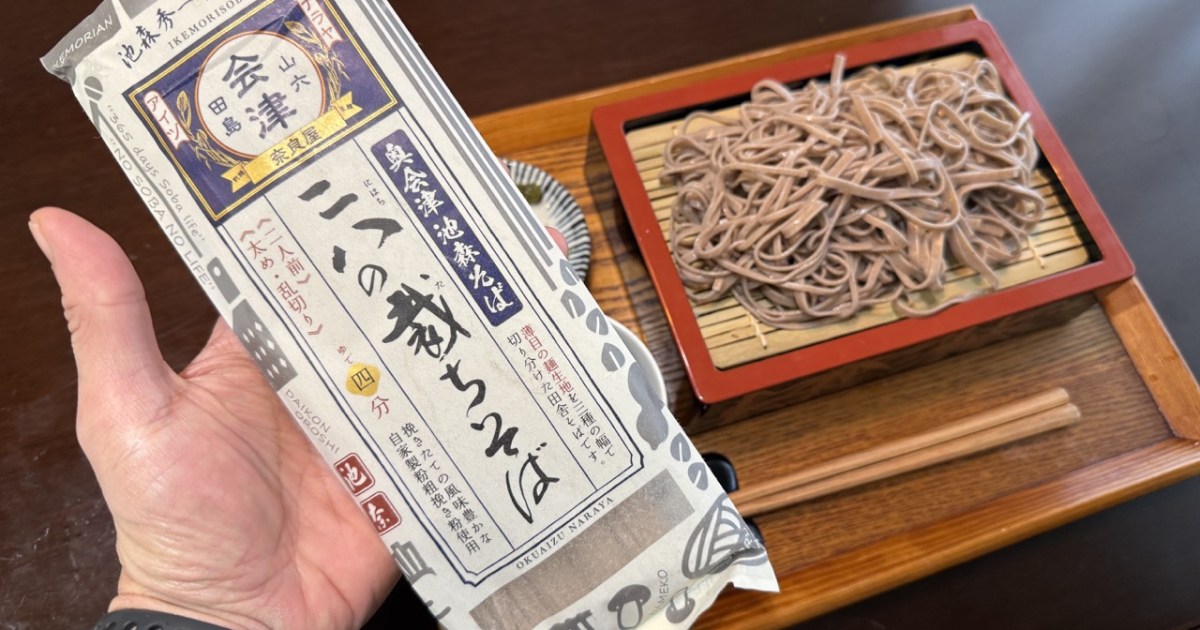
Seiyu, a major supermarket chain, recently came 傘下(さんか) (sanka)—under the umbrella—of the Kyushu-based retail giant Trial. With that change came a quiet but powerful transformation: the soba shelf in one local store was partially 一新(いっしん) (isshin), completely renewed.
Half the products stayed. Half were replaced.
And among the newcomers sat something unexpected: the “Ikemori Series.”
A Supermarket Surprise
The “Ikemori Series” is a line of dried soba noodles 監修(かんしゅう) (kanshū)—supervised and produced in collaboration—with Ikemori Hidekazu, a member of the music group DEEN and a man famously devoted to soba.
One particular product now sits regularly on the shelf:
池森秀一 x 奈良屋 奥会津・池森そば 二八の裁ちそば Ikemori Hidekazu x Naraya Okuaizu Ikemori Soba – Nihachi no Tachi Soba
On the package, two red seal-style stamps appear side by side: 池 (Ike) and 奈 (Nara).
For the writer—a self-proclaimed dried soba critic—this was personal. He had long loved Naraya, a Fukushima-based maker known as a “treasure of Fukushima.” He even knew about this collaboration. He had heard it was “extremely delicious.”
But he refused to seek it out.
Why? Because this series is built on 偶然(ぐうぜん) (gūzen)—chance encounters. The motto of his “Home Soba Wanderings” is to discover soba naturally, not chase it down. Perhaps, he admits, he was also trying to 目を逸らす(めをそらす) (me o sorasu)—to look away—from the fact that his beloved Naraya had teamed up with another man.
Then one day, there it was. Right in front of him.
He decided not to run.
Cooking It Like a Pro
The preparation was simple:
- Boil in a large pot for 4 minutes
- Rinse and chill in cold or ice water
- Serve
And the taste?
“Frustratingly good,” he writes. “Exquisite.”
This soba is 乱切り(らんぎり)—irregularly cut—combining three noodle widths: 1.9mm, 2.4mm, and 3.5mm. The thickest, flat 3.5mm strands stand out with a bold presence and playful texture.
The texture alone is entertaining. But after enjoying the chew and the 喉越し(のどごし) (nodogoshi)—that smooth sensation as the noodles slide down your throat—the true soba flavor lingers on the tongue at the very end.
Chilling the noodles in ice water tightens them, giving them a firm bite and a feeling of restaurant-quality soba.
At that moment, the distinction between “home soba” and “eating-out soba” disappears.
“This is already shop soba,” he declares. “And not just any shop—an excellent one.”
One serving (227 yen) feels too small. He could easily eat two.
In the end, he surrenders.
It’s delicious. And that’s enough.
A Cultural Shift on the Soba Shelf
Even now, announcements play in Seiyu stores saying the company has joined the Trial Group. Seiyu is still Seiyu—but its 品揃え(しなぞろえ) (shinazoroe), its product lineup, is steadily changing.
Among those changes, the overhaul of the soba shelf feels revolutionary.
Without traveling to Fukushima. Without visiting an antenna shop that specializes in regional goods.
You can now buy “Ikemori x Naraya” at your neighborhood Seiyu.
The supermarket, in a sense, has become a soba restaurant.
In Japan, regional foods carry deep emotional weight. Local noodle makers like Naraya represent not just flavor, but place and pride. Seeing them appear in everyday supermarkets reflects both corporate consolidation and wider access to regional culture.
For soba lovers, that’s no small event.
Learn Japanese from This Article
Key Vocabulary
| Japanese | Romaji | Meaning |
|---|---|---|
| 傘下 | sanka | under the umbrella (of a company) |
| 一新 | isshin | complete renewal, overhaul |
| 監修 | kanshū | supervision, produced under supervision |
| 偶然 | gūzen | coincidence, by chance |
| 目を逸らす | me o sorasu | to look away, avoid facing |
| 喉越し | nodogoshi | smoothness when swallowing |
| 品揃え | shinazoroe | product lineup, assortment |
Try making your own sentence with 偶然 (gūzen): 偶然、西友で見つけました。 Gūzen, Seiyū de mitsukemashita. “I found it at Seiyu by chance.”
Notice the polite past verb 見つけました (mitsukemashita). This is the masu form—essential for everyday Japanese.
Grammar Spotlight
1️⃣ 〜こそ (Strong Emphasis)
Structure: Noun + こそ
Used to emphasize that something is exactly what matters.
Example inspired by the article’s spirit:
偶然こそが大切です。 Gūzen koso ga taisetsu desu. “Chance is precisely what’s important.”
This pattern adds emotional intensity—very common in essays and speeches.
2️⃣ 〜ずとも (Even Without Doing…)
A formal/written version of 〜なくても.
Verb (negative stem) + ずとも
Example from the article’s idea:
福島に行かずとも買えます。 Fukushima ni ikazu tomo kaemasu. “You can buy it even without going to Fukushima.”
This form appears often in written Japanese, making it great for reading practice.
Useful Expressions
まいりました。 Mairimashita. “I surrender.” / “You got me.” A humble, slightly dramatic way to admit defeat—often used playfully.
ペロリと食べる。 Perori to taberu. “To eat something in no time.”
Continue Learning
📚 Want to understand the verb forms used here? Check out Masu Form: Mastering Polite Everyday Speech.
📚 Curious about the Japanese used here? Our Greetings and Self-Introductions: Authentic Entry Phrases lesson covers this in depth.
📚 Want to learn more about lifestyle? Check out our lesson on Basic Vocabulary Building: Embracing Words Without Latin Ties.
Basic Vocabulary Building: Embracing Words Without Latin Ties
これからもよろしくお願いします。 Kore kara mo yoroshiku onegaishimasu.