
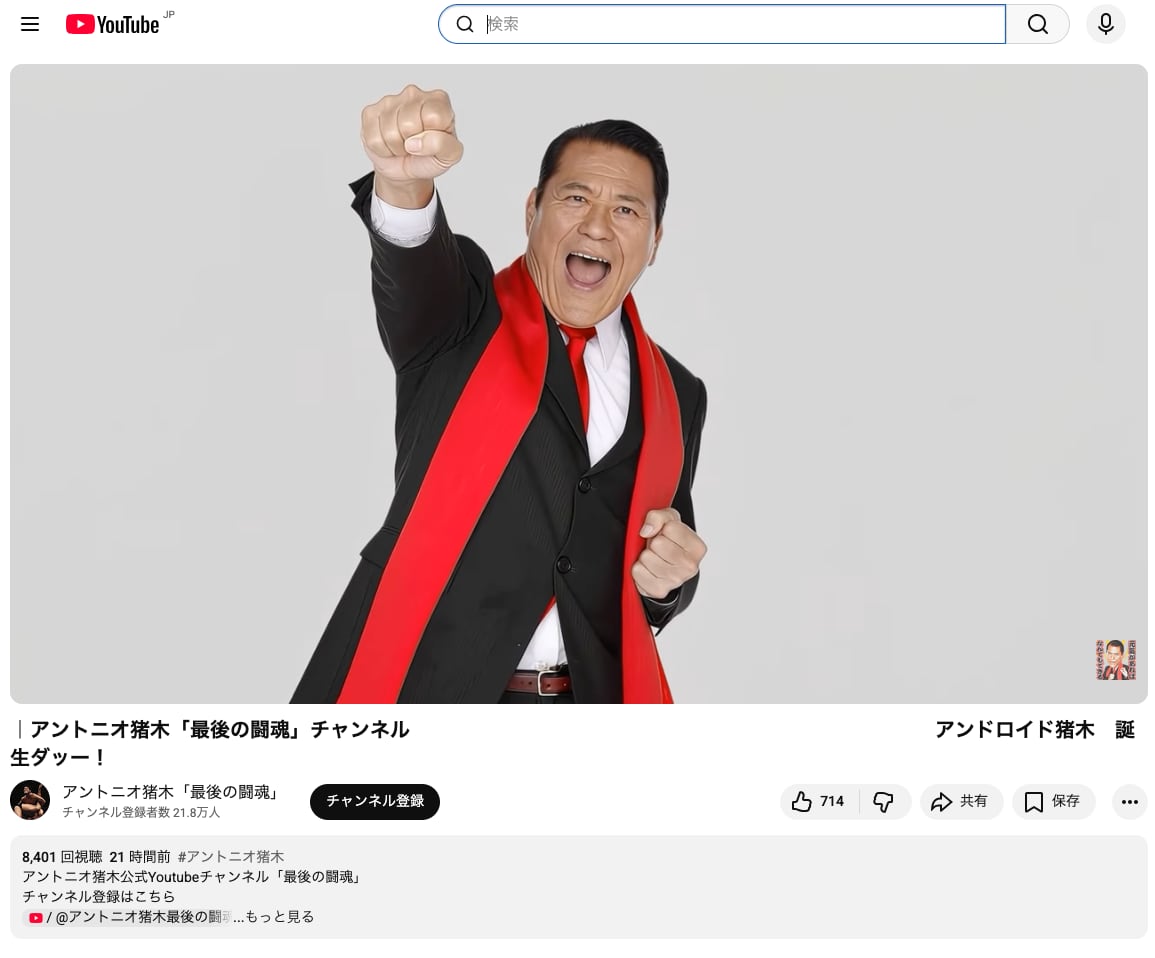
On February 19, Inoki Genki Factory announced the launch of the 「AI猪木」 (AI Inoki) and 「アンドロイド猪木」 (andoroido Inoki) projects—an ambitious plan to recreate legendary pro wrestler Antonio Inoki using advanced AI and humanoid robotics.
The company, which manages licenses related to the late Antonio Inoki, revealed that the project will be developed in collaboration with AVITA, led by renowned android researcher Hiroshi Ishiguro, and SMBC Value Creation of the SMBC Group. The goal? To complete the project by February 20, 2027—Inoki’s birthday.
Recreating a Legend Through Technology
The new プロジェクト (purojekuto – project) includes two major components:
- AI猪木 (AI Inoki): An AI-powered digital version of Inoki
- アンドロイド猪木 (andoroido Inoki): A physical ヒューマノイド (hyūmanoido – humanoid robot) version
A デモ映像 (demo eizō – demo video) of “AI Inoki” has already been released through the “Antonio Inoki ‘Last Fighting Spirit’” channel.
The development will be based on AVITA’s technology. AVITA is known for its work in android research and is led by Hiroshi Ishiguro, Professor Emeritus at Osaka University and a leading figure in humanoid robotics.
According to AVITA, this effort is not limited to simple エンターテインメント (entāteinmento – entertainment*). Instead, the company positions it as a socially meaningful initiative that includes:
- Passing on personality, philosophy, and memory
- Presenting a レガシー (regashī – legacy*) in a form that allows dialogue with future generations
The company also described it as one example of its work in the field of フィジカルAI (fijikaru AI), meaning AI that has a physical body.
Who Was Antonio Inoki?
Antonio Inoki debuted in 1960 and founded New Japan Pro-Wrestling in 1972. He became one of the most iconic figures in Japanese professional wrestling.
He was also famous for his catchphrases:
- 「元気ですかー!」 (Genki desu ka?) — “Are you feeling energetic?”
- 「1、2、3、ダァーッ!」 (Ichi, ni, san, dā!) — “One, two, three, yeah!”
These phrases are deeply associated with his public persona and fighting spirit (闘魂, tōkon).
Later in life, Inoki served two terms as a member of the House of Councillors (参議院議員, sangiin giin), showing that his influence extended beyond the wrestling ring into politics.
He passed away in October 2022 at the age of 79.
Cultural Context: Technology Meets Legacy
Japan has long been a leader in robotics, particularly in the development of humanoid robots. Professor Hiroshi Ishiguro, who leads AVITA, is internationally known for creating highly realistic androids.
What makes this アンドロイド (andoroido) project unique is its focus on inheritance—what AVITA calls the continuation of “personality, philosophy, and memory.”
Rather than preserving Inoki only through recordings or museums, the project aims to create a version capable of interaction. In Japanese culture, preserving a person’s レガシー (regashī)—especially someone seen as a national icon—carries strong emotional and social meaning.
The target completion date, February 20, 2027, is also symbolic because it is Inoki’s birthday. The project 2027年2月20日までの完成を目指す (2027-nen 2-gatsu 20-nichi made no kansei o mezasu)—it aims for completion by that date.
Learn Japanese from This Article
Technology news in Japan is full of katakana words. Let’s break down some key vocabulary and grammar.
Key Vocabulary
| Japanese | Romaji | Meaning |
|---|---|---|
| プロジェクト | purojekuto | project |
| デモ映像 | demo eizō | demo video |
| ヒューマノイド | hyūmanoido | humanoid |
| アンドロイド | andoroido | android; humanoid robot |
| フィジカルAI | fijikaru AI | physical AI |
| レガシー | regashī | legacy |
| エンターテインメント | entāteinmento | entertainment |
Notice how all of these are written in katakana. Japan often adapts global tech vocabulary directly into Japanese pronunciation.
Grammar Spotlight
1️⃣ 〜にとどまらず
Meaning: Not limited to; not only… but also…
From the article: 単なるエンターテインメントにとどまらず Tannaru entāteinmento ni todomarazu “Not limited to mere entertainment”
Structure: > Noun + にとどまらず
Examples:
日本国内にとどまらず、海外でも人気があります。 Nihon kokunai ni todomarazu, kaigai demo ninki ga arimasu. It’s popular not only in Japan but also overseas.
技術開発にとどまらず、教育にも活用されている。 Gijutsu kaihatsu ni todomarazu, kyōiku ni mo katsuyō sarete iru. It’s used not only for technological development but also in education.
2️⃣ 〜を目指す
Meaning: To aim for; to target
From the article: 完成を目指す Kansei o mezasu “To aim for completion”
Structure: > Noun + を目指す
Examples:
優勝を目指す。 Yūshō o mezasu. To aim for victory.
2027年の完成を目指しています。 2027-nen no kansei o mezashite imasu. They are aiming for completion in 2027.
This pattern is extremely common in news articles.
Useful Expression
元気ですか? (Genki desu ka?) “Are you feeling energetic?”
While it literally asks about health or energy, in Inoki’s case it became a powerful motivational phrase. Context changes meaning—something you’ll notice often in authentic Japanese.
Continue Learning
Working on your reading skills? Our Katakana Essentials: Adapting Global Words to Japanese lesson is a great next step.
To understand more about tech, explore our Basic Vocabulary Building: Embracing Words Without Latin Ties lesson.
To strengthen your foundation in scripts, check out Reading and Writing in Japanese II: Hiragana and Katakana.
The creation of AI猪木 and アンドロイド猪木 shows how Japan blends advanced robotics with cultural memory—using フィジカルAI not just to entertain, but to preserve a legacy in interactive form.
これからもよろしくお願いします。 Kore kara mo yoroshiku onegaishimasu.