
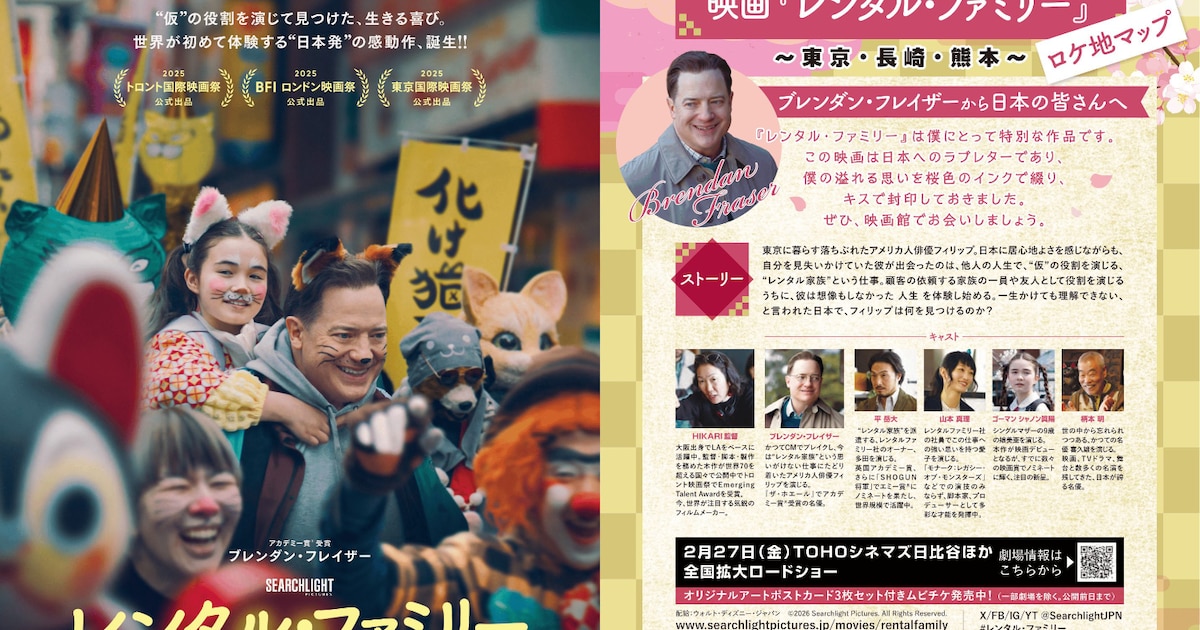
On February 19, 2026, a special location map for the film 「レンタル・ファミリー」 (Rental Family) was 公開された (koukai sareta — was released). The movie, starring Brendan Fraser and filmed entirely in Japan, is set to hit theaters nationwide on February 27.
For fans—and for Japanese learners—this map is more than a promotional tool. It’s a guided tour through real-life ロケ地 (rokechi, filming locations) across Tokyo, Nagasaki, and Kumamoto.
A Story of a “Rental” Life
「レンタル・ファミリー」 tells the story of Philip, a washed-up actor living in Tokyo. In Japanese, someone who has fallen from success is described as 落ちぶれた (ochibureta), from the verb 落ちぶれる (ochibureru), meaning “to fall from success.”
Philip takes on work as part of a “rental family” service, performing temporary roles in other people’s lives. Through this unusual job, he experiences parts of life he never imagined.
Brendan Fraser takes the 主演 (shuen, starring role) as Philip.
- Tadanobu Asano? (No—according to the source:) Tada, the company president who hires Philip, is played by 平岳大.
- Aiko, who works at the same company, is played by 山本真理.
- Veteran actor 柄本明 plays Kikuo, a leading Japanese actor in the story.
- Newcomer ゴーマン シャノン 眞陽 plays Mia, the young girl who spends time with Philip as his temporary “daughter.”
The film is directed by HIKARI, known for 37 Seconds.
When an actor “plays” a role in Japanese, the verb often used in formal contexts is 扮する (funsuru). For example:
- ブレンダン・フレイザーがフィリップに扮する。 Burendan Fureizā ga Firippu ni funsuru. Brendan Fraser plays Philip.
You’ll often see this phrasing in entertainment news.
A Love Letter to Japan
The special map doesn’t just list locations—it gathers detailed information about places that appear in the film.
Among them:
- 浅草(東京) (Asakusa, Tokyo), including the okonomiyaki 名店 (meiten, famous establishment) 染太郎 (Sometarō), a shop beloved by writer Sakaguchi Ango.
- 武蔵新田駅 near the Chinese noodle shop 中華麺舗 虎, a restaurant 親しまれている (shitashimarete iru, loved by locals).
- 島原鉄道(長崎) (Shimabara Railway, Nagasaki).
- 上田家住宅(熊本・天草) (Ueda Residence, Amakusa, Kumamoto).
The map also includes a message from Fraser 日本の観客に向けて (nihon no kankyaku ni mukete — toward Japanese audiences):
「『レンタル・ファミリー』は僕にとって特別な作品です。この映画は日本へのラブレターであり、僕の溢れる思いを桜色のインクで綴り、キスで封印しておきました。」 “Rental Family is a special work for me. This film is a love letter to Japan. I wrote my overflowing feelings in cherry-blossom-colored ink and sealed it with a kiss.”
The imagery of 桜色 (sakurairo, cherry blossom color) carries deep emotional weight in Japan, where cherry blossoms symbolize both beauty and the fleeting nature of life.
Celebrating Amakusa and Tokyo Filming Spots
Because part of the film was shot in Amakusa, Kumamoto, a collaboration poster has also been created with 雲仙天草国立公園 (Unzen-Amakusa National Park), which marks 70 years since the Amakusa area was designated as part of the park. The poster will be displayed in related locations throughout Kumamoto.
In Tokyo, the film will also be featured at the 「東京フィルムワンダーランド」 event on February 22 and 23 at Kabukicho Cine City Square. Organized by Tokyo Location Box—a comprehensive office supporting film and drama shoots—one of the four tents will spotlight 「レンタル・ファミリー」, introducing filming spots such as:
- 神楽坂 (Kagurazaka)
- 隅田川 (Sumida River)
- 麻布台ヒルズ (Azabudai Hills)
- 都電荒川線 (Toden Arakawa Line)
The movie opens nationwide on 2026年2月27日(金).
Cultural Context: What Is a “Rental Family”?
While the article doesn’t explain the concept in detail, Japan has had real services where people can hire actors to pose as family members for social situations. The idea of performing social roles connects deeply to Japanese cultural expectations around harmony, appearances, and belonging.
That makes the title 「レンタル・ファミリー」 especially layered. It’s written in katakana—レンタル (rentaru, rental)—a borrowed English word adapted into Japanese pronunciation. Understanding katakana is essential when reading entertainment news filled with global terms.
Learn Japanese from This Article
Key Vocabulary
| Japanese | Romaji | Meaning |
|---|---|---|
| ロケ地 | rokechi | filming location |
| 主演 | shuen | starring role; lead actor |
| 公開 | koukai | release; make public |
| 落ちぶれる | ochibureru | to fall from success |
| 扮する | funsuru | to play (a role); to act as |
| 名店 | meiten | famous establishment |
| 親しまれている | shitashimarete iru | loved/familiar to people |
Try reading this sentence from the article:
- 特別ロケーションマップが公開された。 Tokubetsu rokēshon mappu ga koukai sareta. A special location map was released.
Grammar Spotlight
1. 〜が公開された (Passive Form in News)
Pattern: > Noun + が公開された
This structure uses the passive form and is extremely common in Japanese news writing.
- ポスターが公開された。 Posutā ga koukai sareta. The poster was released.
- 予告編が公開された。 Yokokuhen ga koukai sareta. The trailer was released.
The passive form creates a neutral, objective tone—perfect for headlines.
2. 〜に向けて (Toward / Aimed At)
Pattern: > Target + に向けて
- 日本の観客に向けてメッセージが書かれた。 Nihon no kankyaku ni mukete messēji ga kakareta. A message was written toward Japanese audiences.
- 公開日に向けて準備する。 Koukaibi ni mukete junbi suru. Prepare toward the release date.
It expresses direction—physical or abstract.
Useful Expression
- 〜に扮する (ni funsuru) — to portray (a character) A formal, news-style way to say “play a role.”
Continue Learning
Working on your reading skills? Our Katakana Essentials: Adapting Global Words to Japanese lesson is a great next step.
Working on your reading skills? Our Introduction to Kanji: Pictorial Foundations of Japanese Script lesson is a great next step.
Want to learn more about entertainment? Check out our lesson on Basic Vocabulary Building: Embracing Words Without Latin Ties.
The more you read real news like this, the more natural these patterns—公開された, に向けて, 主演—will feel. Step by step, you’ll start reading Japanese the way it’s written for native audiences.
これからもよろしくお願いします。 Kore kara mo yoroshiku onegaishimasu.