
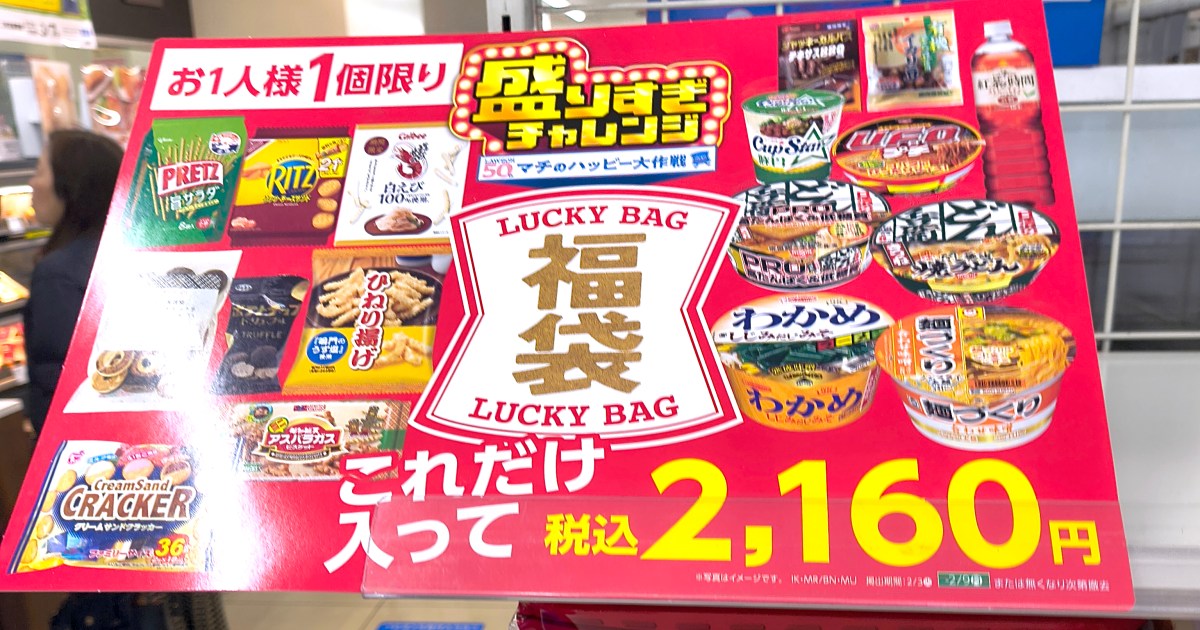
Lawson’s Surprise “Super-Stuffed Challenge Lucky Bag” Shocks Japan!
Imagine dropping everything—your half-eaten lunch, your work emails—just to sprint to the nearest convenience store because of a social media post. If you’ve ever wondered what could spark such urgency in Japan, let me introduce you to Lawson’s latest phenomenon: the 盛りすぎチャレンジ福袋 (morisugi charenji fukubukuro), or “Super-Stuffed Challenge Lucky Bag.” Released without warning on February 3, 2026, this bargain bag isn’t just a deal; it’s a cultural event that reveals the thrill of surprises and value in everyday Japanese life. Let’s dive into the story and uncover some authentic language lessons along the way!
The Unexpected Drop: Lawson’s Lucky Bag Surprise
On a seemingly ordinary morning, Lawson, one of Japan’s biggest コンビニ (konbini) chains, launched their 福袋 (fukubukuro)—a “lucky bag”—as part of their “Super-Stuffed Challenge” campaign. Priced at just 2,160 yen (tax included), this bag hit shelves at 7 a.m. with no prior announcement. 突如 (totsujo), meaning “suddenly,” it appeared, and just as quickly, it started disappearing. A writer from Rocket News barely managed to grab the last one at their local store, and their advice? If you spot one, don’t hesitate—it かもしれない (kamoshirenai), or “might,” be gone in minutes!
This isn’t just about snacks; it’s about the thrill of the hunt. With only limited 在庫 (zaiko), or “stock,” available, the urgency to snag one reflects how Japanese marketing often plays on scarcity to create buzz. For learners, this is a perfect snapshot of how language and culture intertwine in daily life.
What’s Inside? A Treasure Trove of Value
When the writer finally got their hands on the bag, they were stunned by its weight—around 3 kilograms (over 6.5 pounds)! Opening it revealed an incredible 品数 (hinsuu), or “number of items,” totaling 17 products. From classics like かっぱえびせん (kappa ebisen), a shrimp-flavored cracker, to instant noodles like どん兵衛 (donbei), and even drinks, the variety was staggering. After crunching the numbers, they found the total retail value was 4,059 yen, meaning a savings of 1,899 yen. That’s what makes this bag so お得 (otoku), or “a good deal,” and a must-buy if you’re lucky enough to find one during its 販売 (hanbai), or “sale.”
Cultural Context: The Magic of Fukubukuro and Konbini Culture
If you’re new to Japanese traditions, let’s unpack the concept of 福袋 (fukubukuro). Literally translating to “lucky bag,” these mystery bundles are a staple of New Year celebrations, where stores offer discounted goods with unknown contents. It’s a gamble, but the value typically exceeds the price, making it a beloved custom. While traditionally tied to January, Lawson’s surprise releases throughout the year—like this one—keep the excitement alive.
This also shines a light on Japan’s コンビニ (konbini) culture. Convenience stores aren’t just for quick bites; they’re hubs of innovation, seasonal treats, and limited-edition surprises. The idea of 盛りすぎ (morisugi), meaning “overstuffed” or “too much,” taps into a cultural appreciation for abundance. Getting more than you paid for? That’s a win worth chasing, and it’s a mindset you’ll encounter often in Japan.
Learn Japanese from This Article
This story isn’t just entertaining—it’s a goldmine for learning authentic Japanese as it’s used in real life. Let’s break down some key vocabulary and grammar points to help you navigate similar situations, whether you’re hunting for bargains or chatting about deals with friends.
Key Vocabulary
| Japanese | Romaji | Meaning |
|---|---|---|
| 福袋 | fukubukuro | lucky bag (mystery discount bag) |
| 突如 | totsujo | suddenly, all of a sudden |
| 販売 | hanbai | sale, selling |
| コンビニ | konbini | convenience store |
| お得 | otoku | good deal, profitable, worthwhile |
| 在庫 | zaiko | stock, inventory |
| 品数 | hinsuu | number of items, variety of goods |
Grammar Spotlight: 〜かもしれない (Might, Perhaps)
The pattern 〜かもしれない (kamoshirenai) is used to express possibility or uncertainty, much like “might” or “perhaps” in English. It’s perfect for situations where you’re not sure about an outcome, like whether a lucky bag is still in stock.
Structure: Verb (plain form) + かもしれない OR Noun + かもしれない
Examples:
- まだ福袋が残っているかもしれない。 (Mada fukubukuro ga nokotteiru kamoshirenai.) “There might still be some lucky bags left.”
- このコンビニに在庫があるかもしれない。 (Kono konbini ni zaiko ga aru kamoshirenai.) “This convenience store might have some in stock.”
- もう売り切れだかもしれない。 (Mou urikire da kamoshirenai.) “It might already be sold out.”
Use this when you’re speculating or giving a heads-up without certainty—a common way to communicate in Japanese without sounding overly assertive.
Grammar Spotlight: 〜たところ (As a Result of Doing ~, Upon Doing ~)
The pattern 〜たところ (ta tokoro) describes a situation or result immediately after doing something. It’s often used to set the scene or explain what happened right after an action, like opening a bag to see what’s inside.
Structure: Verb (た form) + ところ
Examples:
- 福袋を開けたところ、17点も入っていた。 (Fukubukuro o aketa tokoro, juunana-ten mo haitteita.) “Upon opening the lucky bag, there were 17 items inside.”
- コンビニに行ったところ、もう売り切れだった。 (Konbini ni itta tokoro, mou urikire datta.) “As a result of going to the convenience store, I found it was already sold out.”
- 値段を計算したところ、とてもお得だった。 (Nedan o keisan shita tokoro, totemo otoku datta.) “Upon calculating the price, it turned out to be a great deal.”
This pattern is handy for storytelling, as it connects actions to immediate outcomes, mirroring how the Rocket News writer described their experience.
Continue Learning
Want to dive deeper into Japanese language nuances? Check out these related lessons to build on what you’ve learned today:
- Time and Dates: Tense-Free Expressions: To understand more about time, explore our Time and Dates: Tense-Free Expressions lesson.
- Wa vs. Ga: Emphasizing Importance in Sentences: To understand more about は, explore our Wa vs. Ga: Emphasizing Importance in Sentences lesson.
- Ni, De, and E: Mapping Directions and Locations: Want to learn more about に? Check out our lesson on Ni, De, and E: Mapping Directions and Locations.
Closing Thoughts
Whether you’re dreaming of snagging your own 福袋 (fukubukuro) or just soaking in the excitement of Japanese daily life, stories like this remind us that language learning is about more than words—it’s about connecting with a culture full of surprises. Keep practicing, keep exploring, and who knows? You might find your own お得 (otoku) deal someday!
これからもよろしくお願いします。 Kore kara mo yoroshiku onegaishimasu.