
Nara National Research Institute for Cultural Properties in Nara City has launched a new project team—プロジェクトチーム (purojekuto chiimu)—to rethink how archaeological digs are done as Japan faces fewer workers, an aging population, and rising labor costs. The institute began the team this spring and started studying how to use next-generation methods such as 3D measurement and artificial intelligence—人工知能 (jinkou chinou)—for more efficient and advanced excavation surveys—発掘調査 (hakkutsu chousa).
The announcement came after director Makoto Motonaka spoke to reporters in June 2026 and said the institute faces staffing and financial challenges, while excavation work and cultural property preservation across Japan are at a turning point. According to ITmedia, the institute plans to establish these methods and share them nationwide, though it also expects a difficult question: how to combine digital tools with a field where experience still matters greatly.
New tools for sites that are hard to excavate
The Nara institute researches cultural properties in Japan and abroad. It is known for excavations at major historic sites including the Heijō Palace site in Nara City and the Fujiwara Palace site in Kashihara, Nara Prefecture, and for work decoding wooden tablets and studying architectural reconstruction.
At a dig site of about 1,000 square meters, the institute says it usually needs around three research staff and more than ten workers to dig the soil. Those workers are mainly sent by private companies under contract, and labor costs are now more than 1.5 times what they were a little over a decade ago. Kojiro Shiba, head of the Second Archaeology Research Room, said rising personnel costs have made it harder to dig than when budgets were less tight.
Local governments across Japan are also short on specialist staff for investigations. The Agency for Cultural Affairs says there were about 7,000 such workers a little over twenty years ago, but in recent years that number has fallen to about 5,500.
Ground radar, 3D records, and AI analysis
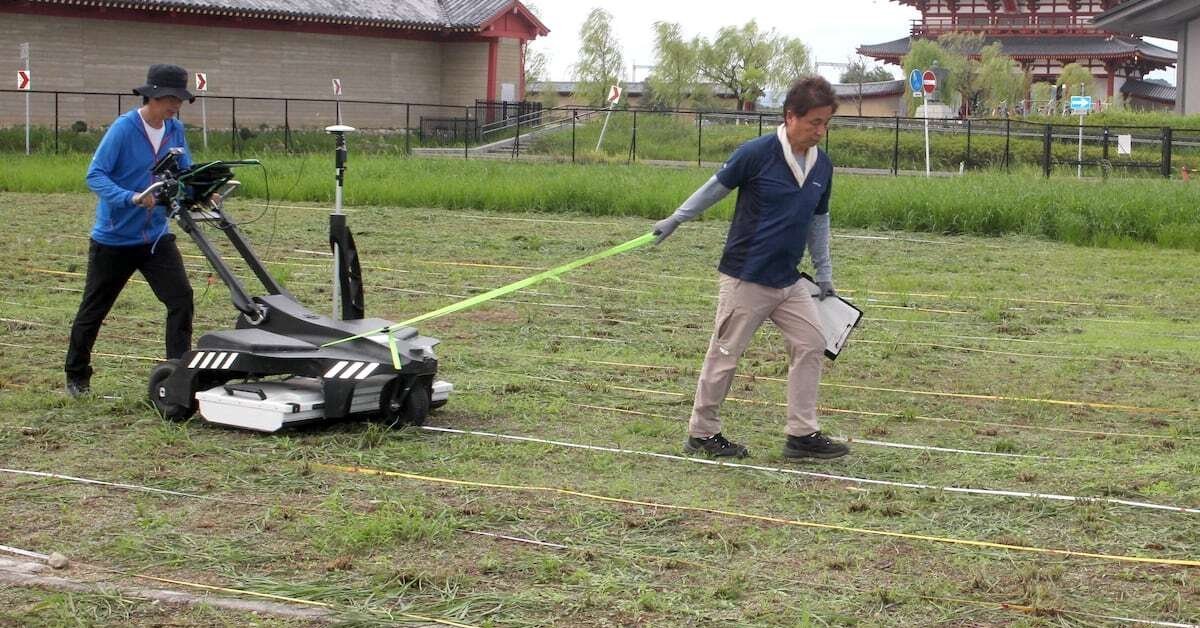
To respond, one of the three working groups—ワーキンググループ (waakingu guruupu)—inside the new team is developing new excavation methods. In September, researchers carried out ground-penetrating radar near a site where groups of wooden tablets connected to the Daijōsai rite of Emperor Shōmu’s succession had been unearthed. Radar surveys have spread mainly at sites such as kofun burial mounds, where many structures produce clear reactions, and Shiba said he hopes they can also become an option in places with fewer structures.
The institute is also pushing ahead with 3D conversion—3次元化 (sanjigenka)—of records for unearthed features and artifacts. In the past, archaeologists finished drawings of features such as postholes by hand. Now, 3D models made through photography and analysis are becoming more common, allowing highly accurate records to be shared.
Shiba said analog methods sometimes discard information, while 3D recording can preserve everything, including color and depth, and pass it on to future generations as it is. Hand-drawn feature maps require experience, but 3D measurement may make manualization—マニュアル化 (manyuaruka)—possible. The institute wants to organize methods from data collection to report writing and propose them to local governments nationwide. It also plans to study AI-based automatic recognition of soil information.
Still, the institute says effectiveness must be tested carefully. Shiba noted that while 3D records can draw out and visualize information without leaving anything behind, interpretation—such as deciding which posthole matches with another—does not come automatically. The question is not only efficiency, but what kind of record is appropriate for actual use.
A long way to go at Heijō Palace
At present, the progress—進捗 (shinchoku)—rate of excavation at the Heijō Palace site is about 40 percent, and many uninvestigated blank areas remain. Clarifying nearby sites such as the Tōin South site is also a challenge, so expectations for future research are high.
Akihiro Watanabe, a professor of ancient history at Nara University who is familiar with excavation surveys, said he hopes people and digital technology can work together well. At the same time, he stressed that the foundation of archaeology is still how humans see and express a site, and that techniques need to be handed down from person to person.
Learn Japanese from This Article
Vocabulary
| Japanese | Romaji | Meaning |
|---|---|---|
| 発掘調査 | hakkutsu chousa | archaeological excavation; excavation survey |
| 効率化 | kouritsuka | improving efficiency; streamlining |
| 人工知能 | jinkou chinou | artificial intelligence |
| プロジェクトチーム | purojekuto chiimu | project team |
| ワーキンググループ | waakingu guruupu | working group |
| 3次元化 | sanjigenka | 3D conversion; making something three-dimensional |
| マニュアル化 | manyuaruka | standardization into manuals; turning into a manualized process |
| 進捗 | shinchoku | progress; status of progress |
Grammar Spotlight
〜に向けた
Meaning: toward; aimed at; for the purpose of preparing for
From the article: 発掘調査の効率化や高度化のため3次元計測や人工知能(AI)をはじめとした次世代型の調査手法の活用に向けた検討を始めた。 Hakkutsu chousa no kouritsuka ya koudoka no tame sanjigen keisoku ya jinkou chinou (AI) o hajime to shita jisedaigata no chousa shuhou no katsuyou ni muketa kentou o hajimeta. They began examining the use of next-generation survey methods such as 3D measurement and AI toward making excavation surveys more efficient and advanced.
Example: 全国への提案に向けた準備が進んでいます。 Zenkoku e no teian ni muketa junbi ga susunde imasu. Preparations are moving forward toward proposals for the whole country.
Example: 新しい調査方法の確立に向けた研究が続いています。 Atarashii chousa houhou no kakuritsu ni muketa kenkyuu ga tsuzuite imasu. Research is continuing toward establishing new investigation methods.
〜を通じ
Meaning: through; by means of
From the article: 木簡の解読や建築の復元研究を通じ歴史の解明と文化財保護を担っている。 Mokkan no kaidoku ya kenchiku no fukugen kenkyuu o tsuuji rekishi no kaimei to bunkazai hogo o ninatte iru. It plays a role in clarifying history and protecting cultural properties through decoding wooden tablets and research on architectural reconstruction.
Example: 地中レーダー探査を通じ新しい情報を集める。 Chichuu reedaa tansaa o tsuuji atarashii jouhou o atsumeru. They gather new information through ground radar surveys.
Example: 3次元モデルを通じ記録を共有できる。 Sanjigen moderu o tsuuji kiroku o kyouyuu dekiru. Records can be shared through 3D models.
Useful Expressions
掘らずに確認する Horazu ni kakunin suru To confirm something without digging
曲がり角だ Magarikado da To be at a turning point
経験がモノをいう Keiken ga mono o iu Experience makes the difference
Continue Learning
- Potential Form: Abilities and Possibilities: Want to use 〜けた from this article yourself? Our Potential Form: Abilities and Possibilities lesson covers it.
- Vocabulary Through Kanji Compounds: Lego-Like Word Building: Want to use 進捗 from this article yourself? Our Vocabulary Through Kanji Compounds: Lego-Like Word Building lesson covers it.
これからもよろしくお願いします。 Kore kara mo yoroshiku onegaishimasu.