
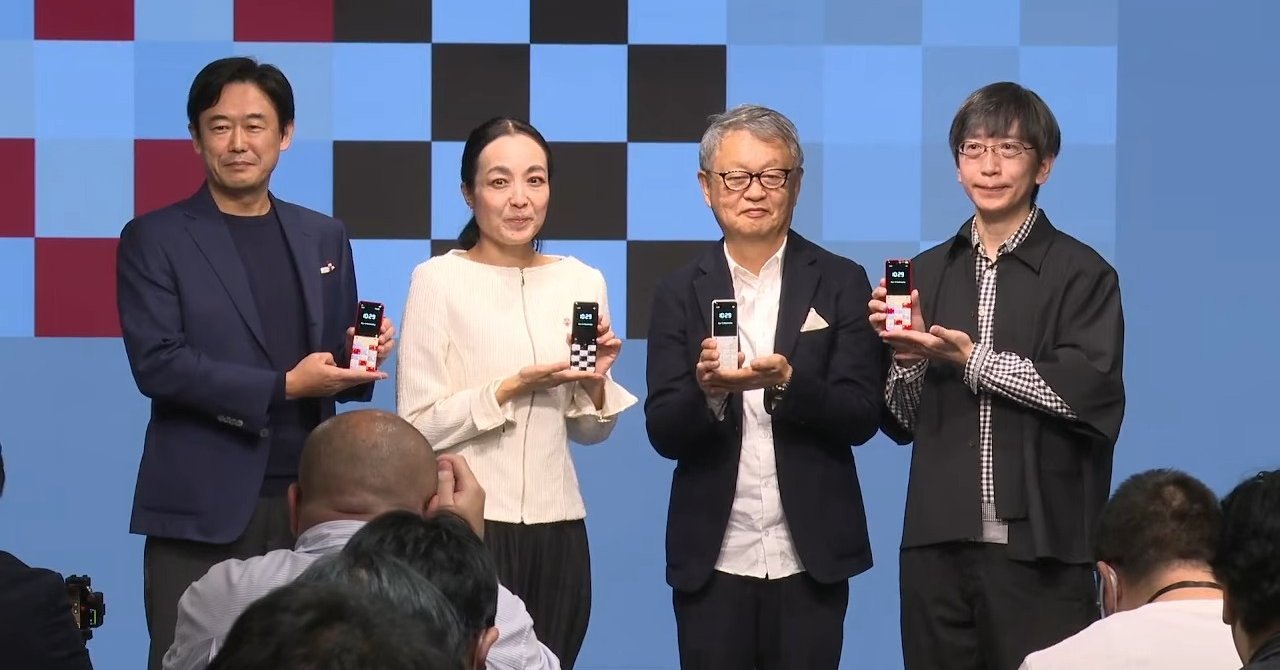
KDDI announced on November 18 that it will 発売 (hatsubai, launch for sale) the INFOBAR ZERO on December 25: a mobile phone that does not connect to the internet. The device focuses on voice calls and SMS, costs 32,780 yen including tax, and has been open for 予約 (yoyaku, pre-order) since 10 a.m. the same day.
That basic idea is what makes the phone unusual. At a time when smartphones are standard, KDDI is releasing a stripped-down model built around calls and messages, and presenting it as a different kind of phone experience. ITmedia covered the announcement in detail in its original report from ITmedia.
An INFOBAR return after about eight years
INFOBAR began in 2003 as part of KDDI’s “au Design project.” New models appeared later as both feature phones and smartphones, and INFOBAR ZERO is the first new model in about eight years since 2018’s INFOBAR xv.
Its main 機能 (kinou, features) are calls, SMS, a roughly 2-megapixel camera, contacts, calendar, alarm, music playback, and a calculator. It does not connect to the internet, so users cannot browse websites or use social media the way they would on a smartphone. Music has to be transferred from a smartphone or PC. The phone also brings back acrylic tile keys for the first time in 23 years since the original model.
INFOBAR ZERO also 対応する (taiou suru, supports) KDDI’s “Second Number” service, which lets users add a phone number for calls and SMS only. Combined with that service, a second number can be separated from a smartphone and used on the INFOBAR ZERO instead. It is also the first original model under SIMフリー (shimu furii, SIM-free) brand au Flex Style, so it can be used on networks other than au.
KDDI is aiming at younger users who want less digital life
KDDI says the main target is younger users. At the presentation, the company said that values around intentionally reducing digital use are spreading globally, especially among younger generations.
Still, Japan’s heavy use of LINE creates an obvious question. Reporters asked whether younger people, who often do not know each other’s phone numbers, would still need to carry a smartphone to use LINE, weakening the point of a デジタルデトックス (dejitaru detokkusu, digital detox). Tetsu Sunahara from KDDI’s brand management department answered that even he, as a member of the so-called “dankai junior” generation, now mainly uses LINE rather than voice calls or short messages.
Sunahara said he hopes people might accept short exchanges by call or SMS as a new kind of experience, something like haiku or tanka. Product designer Naoto Fukasawa, who handled the design, added that many people may only call one or two others anyway, and suggested a use closer to an old transceiver: keeping it in a pocket and staying connected to that one person.
The project started as an in-house “dumb phone” idea
Asked why about eight years had passed since the previous INFOBAR xv, Sunahara said the project did not begin as a plan to revive INFOBAR itself. Instead, there had been an internal push to develop a “dumb phone” with limited functions, and the team decided to make use of the au Design project’s assets. The project キックオフ (kikkuofu, kickoff) was on October 31 the year before, which KDDI calls “INFOBAR Day.”
Sunahara also explained the price. Even though parts including memory have become more expensive, the maker began procuring materials from the development start a year earlier, allowing INFOBAR ZERO to be priced below the INFOBAR xv, which had cost 51,840 yen including tax.
KDDI did not disclose a sales target, but Sunahara said expected sales are one digit lower than in the old days. As for the future, he said the company is not trying to target a large market from the start, but would like to continue if the device creates wider effects.
Learn Japanese from This Article
Vocabulary
| Japanese | Romaji | Meaning |
|---|---|---|
| 発売 | hatsubai | release; launch for sale |
| 予約 | yoyaku | reservation; pre-order |
| 機能 | kinou | function; feature |
| 特化 | tokka | specialization; focusing on one area |
| 対応する | taiou suru | to support; to be compatible with |
| SIMフリー | shimu furii | SIM-free; unlocked |
| デジタルデトックス | dejitaru detokkusu | digital detox |
| キックオフ | kikkuofu | kickoff; official start of a project |
Grammar Spotlight: 〜のではないか
This pattern expresses a possibility, expectation, or soft suggestion: “might it be that…?” or “isn’t it possible that…?”
Pattern: Verb / い-adjective / な-adjective + のではないか
From the article: さらに砂原氏は、通話やSMSによる短いやりとりを、俳句や短歌のような新しい体験として受け止めてもらえるのではないかと期待を寄せる。 Sara ni Sunahara-shi wa, tsuuwa ya esu emu esu ni yoru mijikai yaritori o, haiku ya tanka no you na atarashii taiken to shite uketomete moraeru no de wa nai ka to kitai o yosheru. Sunahara further expressed hope that people might accept short exchanges by calls or SMS as a new kind of experience, like haiku or tanka.
Example: 若い人には、この携帯のシンプルさが新鮮なのではないか。 Wakai hito ni wa, kono keitai no shinpuru-sa ga shinsen na no de wa nai ka. Might it be that younger people find this phone’s simplicity fresh?
Example: 電話番号だけでつながる関係も、便利なのではないか。 Denwa bangou dake de tsunagaru kankei mo, benri na no de wa nai ka. Isn’t it possible that relationships built just through phone numbers are convenient too?
Useful Expressions
インターネットにつながらない携帯 intaanetto ni tsunagaranai keitai a mobile phone that does not connect to the internet
通話とSMSに特化した端末 tsuuwa to esu emu esu ni tokka shita tanmatsu a device specialized in calls and SMS
電話番号を追加できる denwa bangou o tsuika dekiru can add a phone number
機能をそぎ落とした kinou o sogiotoshita stripped down in features
Continue Learning
- Nai Form: Negating Without Auxiliary Words: Want to use 〜ないか from this article yourself? Our Nai Form: Negating Without Auxiliary Words lesson covers it.
- Numbers and Counters: Contextual Counting Systems: Want to learn more about 数字? Check out our lesson on Numbers and Counters: Contextual Counting Systems.
これからもよろしくお願いします。 Kore kara mo yoroshiku onegaishimasu.