
A single touch on a smartphone, and the cooker begins adjusting heat and pressure on its own. A few minutes later, steam bursts out—and perfectly cooked German potatoes appear.
Is this a magic pot? Or just an expensive indulgence?
On April 11, 2026, Rocket News reviewed Panasonic’s latest automatic cooking pot, the ビストロ NF-AC1000-K (Bisutorō), rented through the company’s subscription service. The result? Dinner-making changed dramatically.
Smart Appliances Are Getting Smarter
Home 家電 (kaden, home appliances) are becoming increasingly intelligent. Automatic cookers—known in Japanese as オートクッカー(自動調理鍋) (ōto kukkā / jidō chōribanabe)—can calculate cooking times and handle heating on their own. It almost sounds like something out of Harry Potter, where Mrs. Weasley waves a wand and dinner cooks itself.
とはいえ (towa ie), even though automatic cookers are said to be highly practical now, they cost around 70,000 yen (about $450–500 USD). That makes 導入 (dōnyū, introduction/installation) a serious decision.
The writer admits thinking, “It sounds amazing, but it’s not for my household.”
Renting Instead of Buying
That’s where Panasonic’s subscription service, foodable(フーダブル) (Fūdaburu), comes in. For a 月額 (getsugaku, monthly fee) of 2,980 yen, users can rent the latest kitchen appliances.
A few key details:
- The product arrives brand new (not reused).
- Bonus food ingredients are included.
- There is a 最低利用期間 (saitei riyō kikan, minimum usage period) of 36 months.
- 中途解約 (chūto kaiyaku, cancellation before completion) costs 7,960 yen (tax included).
After the contract ends, customers can choose to buy, return, or continue renting.
In Japan, large appliances can be difficult and expensive to dispose of. The idea of “not owning” but renting long-term is becoming more appealing—similar to car leasing.
First Impressions: Big, Heavy, Powerful
The cooker is about 30 cm wide and weighs roughly 8 kg. The reviewer describes it as “quite large,” even bigger than a family-sized rice cooker.
The 同梱物 (dōkonbutsu, included items) are simple:
- Inner pot
- Rotating blade
- Steaming plate
That rotating blade is the key feature. It spins at the bottom of the pot, automatically stirring dishes like stir-fries. Unlike humans, it doesn’t get tired or distracted.
Most functions are controlled via smartphone app, though you still physically press the start button. Full functionality requires internet setup (2.4GHz only), which took some effort—but once connected, it worked smoothly.
Testing It Out: German Potatoes and Nikujaga
The first dish: ジャーマンポテト (Jāman poteto, German potatoes). Online reviews claimed potatoes turn out wonderfully fluffy.
The writer admits to being bad at cooking—relying on natto, fried eggs, and pork miso soup in an “infinite rotation.” So expectations were cautious.
After sending the recipe data from the smartphone, the cooker displayed the dish name and automatically adjusted heat and pressure. It felt futuristic—like a gadget from Doraemon, a famous Japanese robot cat character from manga.
When the dish finished, steam poured out.
Success.
The potatoes were golden brown on the outside and fluffy inside. No anxious poking with toothpicks to check if they were cooked through.
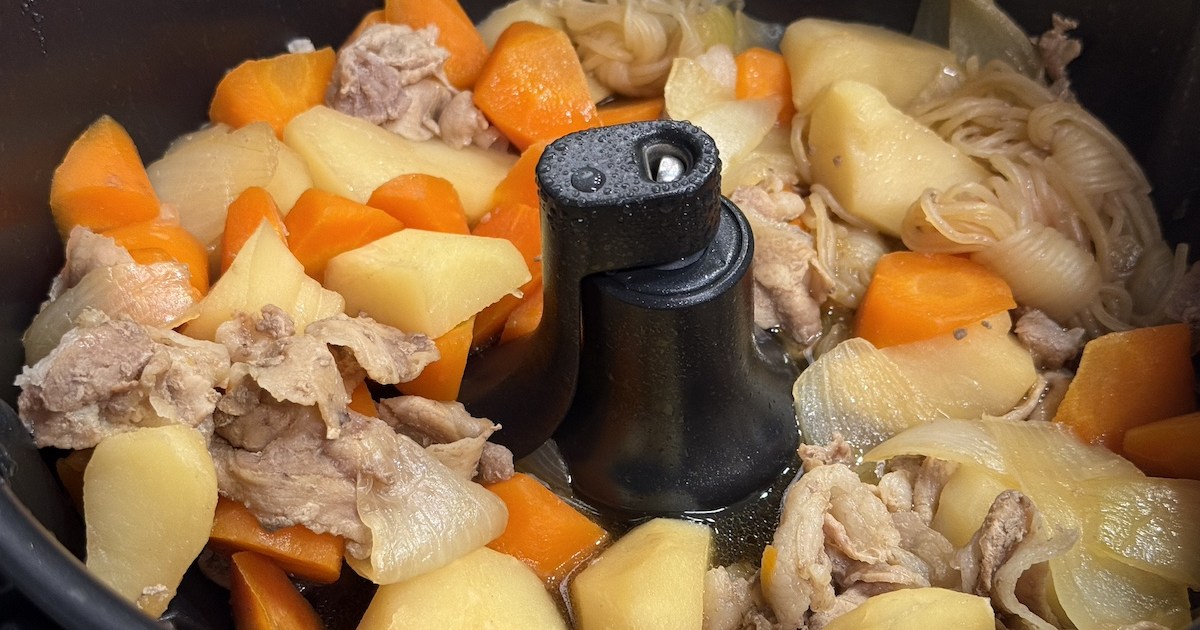
Next came 肉じゃが (nikujaga), a classic Japanese home-style dish of simmered meat and potatoes. It’s deceptively simple but hard to get right—flavors often fail to fully 染み込む (shimikomu, soak in).
Even with frozen meat and extra ingredients added, the result was deeply satisfying. The seasoning had soaked all the way through, and the vegetables were tender.
The app includes a memo function, allowing users to leave notes like “add more soy sauce next time.” You can even see other users’ notes—like a collective cooking wisdom database.
What Works—and What Doesn’t
The cooker excels at:
- Simmered dishes
- Flavor-rich stews
- Curries
- Dishes where seasoning needs to soak in
Vegetables release sweetness, making even medium-spicy curry taste mild. Thanks to pressure cooking, heat penetrates easily, and you can leave the pot unattended for long periods.
This is where おかげで (okage de, thanks to) becomes useful. 圧力のおかげで、野菜にしっかり火が通る。 Atsuryoku no okage de, yasai ni shikkari hi ga tōru. “Thanks to the pressure, the vegetables cook thoroughly.”
However, high-heat dishes like fried rice were disappointing. The rice became too soft and slightly sticky. Fried chicken also received mixed reviews—it’s not a replacement for a deep fryer.
Not Exactly a “Time-Saving” Appliance
Interestingly, the reviewer concludes that this isn’t really a typical “time-saving” device.
Heating times are similar to stovetop cooking:
- Stir-fried vegetables: 10 minutes
- German potatoes: 25 minutes
The large inner pot must be washed by hand (not dishwasher-safe), so total effort may not decrease dramatically.
But here’s the real benefit: for people who struggle with cooking, the hardest part—judging timing and doneness—is handled by the machine.
No more overcooked vegetables while waiting for meat to finish. No more hovering over the stove.
For this reviewer, that alone makes the monthly fee worthwhile—for now.
Cultural Context: Why Nikujaga Matters
肉じゃが (nikujaga) is often called the “king of home cooking” in Japan. It represents comfort food and family warmth. In Japanese pop culture, someone who makes good nikujaga is seen as caring and domestic.
So when a machine can consistently produce delicious nikujaga, that’s more than convenience—it touches on emotional and cultural values tied to home life.
Learn Japanese from This Article
Key Vocabulary
| Japanese | Romaji | Meaning |
|---|---|---|
| 家電 | kaden | home appliances |
| 導入 | dōnyū | introduction; installation |
| 月額 | getsugaku | monthly fee |
| 最低利用期間 | saitei riyō kikan | minimum usage period |
| 中途解約 | chūto kaiyaku | cancellation before contract completion |
| 同梱物 | dōkonbutsu | included items |
| 染み込む | shimikomu | to soak in; permeate |
Grammar Spotlight
1. 〜とはいえ (Although; Even though it is said that…)
Structure: [Statement] + とはいえ
Example from this story:
実用レベルになっているとはいえ、高価だ。 Jitsuyō reberu ni natte iru to wa ie, kōka da. “Although it has reached a practical level, it’s expensive.”
Use this when you want to acknowledge something but add a contrasting point.
2. 〜おかげで (Thanks to…)
Structure: [Reason] + おかげで + [Positive result]
圧力のおかげで、味がよく染み込む。 Atsuryoku no okage de, aji ga yoku shimikomu. “Thanks to the pressure, the flavor soaks in well.”
This expression implies a positive outcome.
Useful Expression
放置でいい (hōchi de ii) — “You can just leave it alone.”
スイッチを押したら、あとは放置でいい。 Suicchi o oshita ra, ato wa hōchi de ii. “Once you press the switch, you can just leave it.”
This casual phrase is common in everyday Japanese.
Continue Learning
Ready to dive deeper? Our lesson on Time and Dates: Tense-Free Expressions will help you master these concepts.
Would you rent a smart cooker like this, or would you rather master the frying pan yourself? Either way, every news story is a chance to build real-world Japanese.
これからもよろしくお願いします。 Kore kara mo yoroshiku onegaishimasu.