
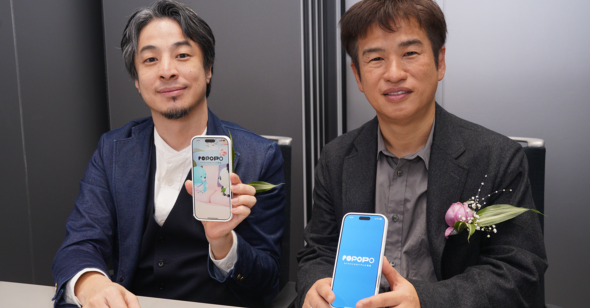
On March 18, a new app called “POPOPO” was announced with a bold promise: a “camera-free video call.” Instead of showing your real face, you appear as a 3D アバター (abatā, avatar) inside a virtual space—and talk as if you were in a movie.
Developed as a smartphone app, POPOPO allows users to have voice conversations in a VR-like space. When a call connects, each person’s avatar appears, automatically moving in sync with their voice. The camera switches angles on its own, creating a cinematic feeling—まるで映画の出演者かのような (maru de eiga no shutsuen-sha ka no you na)—as if you were a film actor sharing the same scene.
But VR and the メタバース (metabāsu, metaverse) are known as difficult fields. Major companies, including Meta in the United States, have invested heavily—only to suffer losses and 撤退 (tettai, withdrawal). So why enter this space now? Why is a Japanese company choosing to 参入する (san'nyuu suru, enter) such a challenging market?
To answer that, ITmedia interviewed three key figures: investor and director 川上量生 (Kawakamigo, known as “Kawango”), director 西村博之 (Nishimura Hiroyuki, known as “Hiroyuki”), and development lead MIRO (岩城進之介), the creator of the VRM avatar format.
Why Past VR Struggled
The roots of POPOPO go back to 2018. MIRO recalls that user growth for “Virtual Cast,” a VR service for head-mounted displays (HMDs), had stalled. Kawakami challenged him to think about a smartphone version.
At the time, Kawakami believed HMD-based VR would become a world of “バ美肉” (bamiku), short for バーチャル美少女受肉 (bācharu bishoujo juniku). The term refers to (often male) users embodying cute anime-style girl avatars in virtual spaces. While passionate fans exist, he felt this niche would never attract everyone—young and old alike.
So the question became: What would “VR for ordinary users” look like? Kawakami’s answer was simple—“It has to run on smartphones.”
The Key: “Comfortable” Camera Work
Designing VR for smartphones comes with a major limitation: screen size. If you show a full-body avatar on a small screen, it feels tiny and immersion disappears.
Their solution? Perfect the カメラワーク (kamerawāku, camera work).
In POPOPO, the camera automatically shifts between close-ups and wide shots, depending on the flow of conversation. According to Kawakami, the team spent the most time recreating “cuts that feel good to humans.” The goal was not just automation, but cinematic rhythm.
However, this “comfortable camera work” could not be achieved through 全自動 (zenjidou, fully automatic) systems alone. The team brought in film director 手塚眞 (Tezuka Makoto) to supervise. They prepared manual cuts equivalent to “one full theatrical film.” Kawakami proudly notes that combining auto-camera systems with human-crafted cuts is something that hasn’t really existed before.
In a March 18 livestream featuring Kawakami and musician Gackt, viewers could see how—even though they were in separate locations—it looked as if they were sharing the same space, like hosts of a TV program.
Simplicity Over Complexity
POPOPO launches with more than 400 “Holo Suits” in its ラインアップ (rain'appu, lineup). Users are expected to change avatars like fashion. Notably, director 庵野秀明 (Anno Hideaki) is involved in adjusting the avatar designs.
Yet beneath the style is radical simplicity.
Typical VR services require users to tap on floors to move closer to someone or use controllers for interaction. POPOPO eliminates this. Movement is automatic. There is no モーショントラッキング (mōshon torakkingu, motion tracking). Your avatar moves simply by speaking.
As Kawakami puts it, “It’s more convenient to just warp automatically.”
MIRO explains their philosophy clearly: users don’t want to move avatars with controllers—they just want to talk with friends. In response to that goal—そのゴールに対して (sono gōru ni taishite)—the team built a system where everything except conversation is automated.
Do We Even Need Avatars?
A natural question arises: if you just want to talk, why not use voice chat? If you want visuals, why not use regular video calls?
MIRO admits they debated this internally. “There were discussions about whether voice-only might be enough,” he says.
And yet, POPOPO exists—suggesting they believe avatars and cinematic space offer something more. (The second half of the article promises to explore that answer further.)
Cultural Context: Japan and Virtual Identity
Japan has long embraced virtual identity. From VTubers to anime-style profile icons, appearing as a character rather than your real face is culturally normalized. The idea of バ美肉 (bamiku) reflects Japan’s unique blend of anonymity, creativity, and performance.
At the same time, Japanese product design often prioritizes user comfort and emotional experience—what feels 気持ちいい (kimochi ii, pleasant). POPOPO’s focus on cinematic flow rather than technical complexity fits this philosophy.
Learn Japanese from This Article
Key Vocabulary
| Japanese | Romaji | Meaning |
|---|---|---|
| アバター | abatā | avatar |
| メタバース | metabāsu | metaverse |
| カメラワーク | kamerawāku | camera work |
| モーショントラッキング | mōshon torakkingu | motion tracking |
| 参入する | san'nyuu suru | to enter (a market) |
| 撤退 | tettai | withdrawal |
| 全自動 | zenjidou | fully automatic |
| ラインアップ | rain'appu | lineup |
Notice how many of these are written in katakana. Tech Japanese is full of loanwords. Recognizing them quickly will dramatically improve your reading speed.
Grammar Spotlight
1️⃣ 〜かのような — “as if…”
Used to describe something that feels like or resembles something else.
映画の出演者かのような雰囲気 eiga no shutsuen-sha ka no you na fun'iki An atmosphere as if you were a movie actor.
同じ空間にいるかのように見える。 onaji kuukan ni iru ka no you ni mieru It looks as if they are in the same space.
This pattern adds vivid imagery—perfect for storytelling.
2️⃣ 〜に対して — “in response to / toward”
Used when describing an action or attitude directed at something.
そのゴールに対して、アプリを設計した。 sono gōru ni taishite, apuri o sekkei shita They designed the app in response to that goal.
It’s common in business, debates, and interviews.
Useful Expression
気持ちいいカメラワーク kimochi ii kamerawāku Camera work that feels good (pleasant, satisfying).
In Japanese, 気持ちいい (kimochi ii) is widely used beyond physical comfort—it can describe sound, timing, visuals, even social interactions.
Continue Learning
- Working on your reading skills? Our Katakana Essentials: Adapting Global Words to Japanese lesson is a great next step.
- Curious about the Japanese used here? Our Basic Vocabulary Building: Embracing Words Without Latin Ties lesson covers this in depth.
- Want to strengthen your foundation? Check out Reading and Writing in Japanese II: Hiragana and Katakana.
A “camera-free video call” that feels like starring in your own film—POPOPO is betting that comfort, simplicity, and cinematic design can succeed where heavy VR hardware struggled. Whether it can avoid the fate of past メタバース (metabāsu) ventures remains to be seen—but linguistically and culturally, it offers fascinating insight into Japan’s evolving tech world.
これからもよろしくお願いします。 Kore kara mo yoroshiku onegaishimasu.