
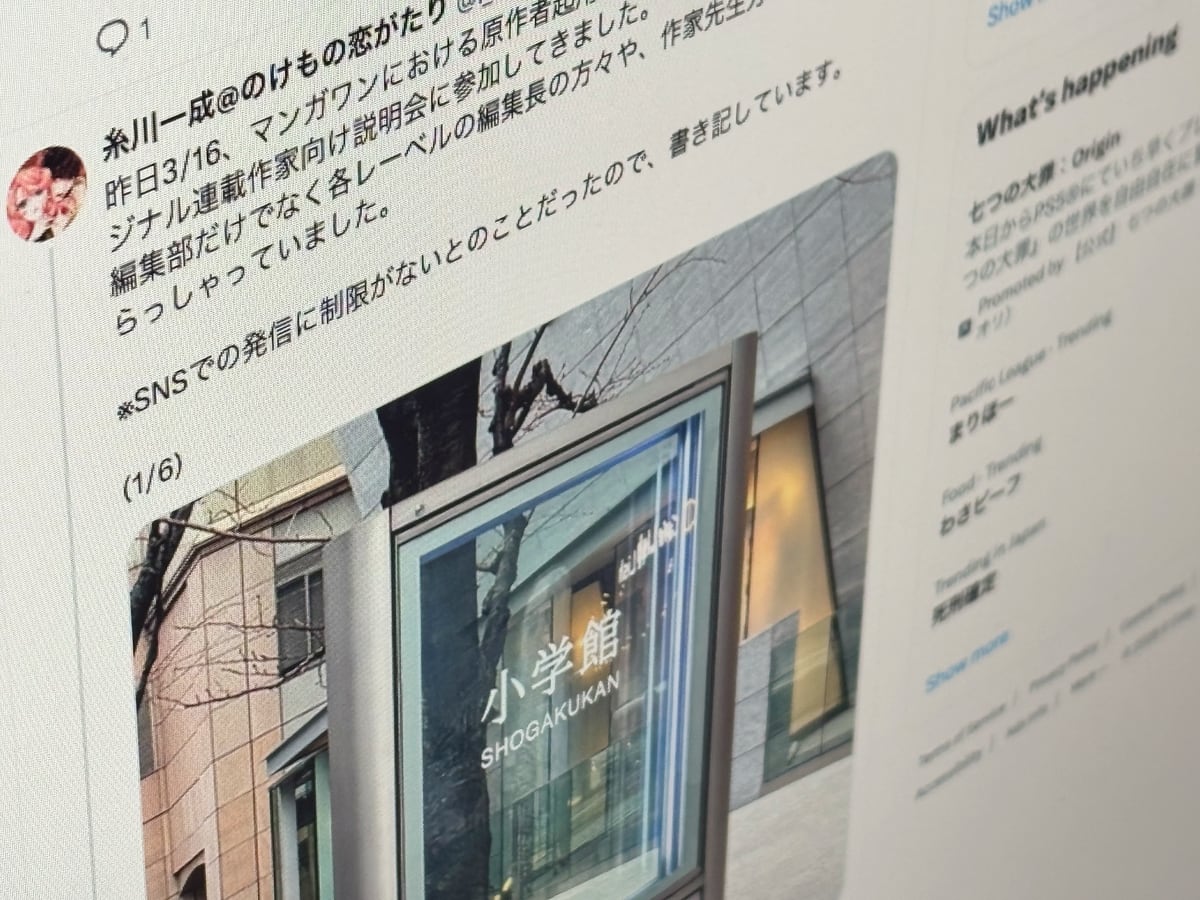
On March 16, Shogakukan held a briefing session for creators serialized on its manga distribution アプリ (apuri, app) “MangaONE” regarding a controversy over the appointment of an original author. More than 80 editors and manga artists gathered to hear about upcoming reforms, according to posts shared on SNS (esuenesu, social networking services) by manga creator 糸川一成 (Kazunari Itokawa).
Importantly, creators were not restricted from sharing information about the meeting on social media.
What Happened at the Briefing?
The session focused on the issue of selecting and appointing authors for serialization on MangaONE. According to Itokawa, the explanation from the editorial department felt somewhat like a “statement of intent” (所信表明), suggesting that while reforms were discussed, details and transparency may have been lacking. Attendees reportedly exchanged strong and critical opinions during the meeting.
One key point that stood out was a proposed policy change: when appointing writers, the publisher may require them to agree to the company’s コンプライアンス (konpuraiansu, compliance) 基準 (kijun, standards or criteria*).
In Japanese corporate culture, コンプライアンス refers not only to obeying laws and regulations, but also to adhering to corporate ethics and broader social norms. In recent years, many companies have strengthened compliance systems to reduce management リスク (risuku, risk), especially in response to scandals.
Why Compliance Is a Big Issue in Manga Publishing
Manga creators and original authors often work under pen names and may not publicly reveal their faces. This means that, structurally, even if a creator has had problems in the past, it can be relatively easy to “reincarnate” under a new name.
Itokawa pointed out that this structural issue lies at the root of the industry’s challenges. If problems are discovered after publication, collected volumes may become unsellable. In such cases:
- The publisher’s credibility is damaged.
- The author loses income.
- Fans are left disappointed.
He emphasized that opportunities for honest creators to publish their work—and readers’ ability to enjoy excellent stories—should not be hindered by an attitude of “as long as it’s interesting, a criminal record doesn’t matter.”
At the same time, Itokawa expressed cautious optimism, stating that this moment marks a clear turning point in the compliance awareness of editorial departments, Shogakukan, and the industry as a whole.
Further briefing sessions may be held as needed, and an official 声明 (seimei, statement) from MangaONE will be announced once it is finalized.
The Work at the Center of Attention
Itokawa is the creator of 「のけもの恋がたり~稀血の娘とあやかし狐~」 (Nokemono Koigatari: Kikechi no Musume to Ayakashi Gitsune), a love fantasy set in the Taisho era. The story follows an “outsider child” and a “half-spirit” (半妖) in a historical fantasy setting. The latest volume (Vol. 2) was just released on January 19.
While the article does not detail the original controversy itself, the focus is clearly on how publishers plan to prevent similar issues in the future.
Cultural Context: Compliance in Modern Japan
The word コンプライアンス (konpuraiansu) is written in katakana because it comes from English. In Japan, however, it has developed a particularly strong corporate nuance. Companies often create internal 基準 (kijun, standards) that go beyond what is legally required in order to protect reputation and avoid public backlash.
Public trust is extremely important in Japanese business culture. A single scandal can result in apologies, product recalls, canceled projects, or even resignations by executives. In creative industries like manga—where fans form deep emotional connections with works—ethical concerns can quickly become business concerns.
This explains why Shogakukan is emphasizing compliance not only as a legal matter, but as an industry-wide shift in values.
Learn Japanese from This Article
Let’s break down key vocabulary and grammar you can start using right away.
Key Vocabulary
| Japanese | Romaji | Meaning |
|---|---|---|
| アプリ | apuri | app (application) |
| SNS | esuenesu | social networking service |
| コンプライアンス | konpuraiansu | compliance (legal/ethical adherence) |
| 基準 | kijun | standard; criteria |
| リスク | risuku | risk |
| 声明 | seimei | official statement |
| 連載 | rensai | serialization (regular publication) |
| 編集部 | henshūbu | editorial department |
Notice how many of these words—especially アプリ, SNS, コンプライアンス, and リスク—are written in katakana. They are loanwords adapted into Japanese pronunciation.
Grammar Spotlight
1. 〜について
Meaning: about; regarding
This pattern is used constantly in news writing.
Structure: Noun + について
Example from this topic: 原作者起用問題について説明会を行った。 Gensakusha kiyō mondai ni tsuite setsumeikai o okonatta. “They held a briefing regarding the issue of appointing an original author.”
More examples:
日本文化について勉強しています。 Nihon bunka ni tsuite benkyō shite imasu. I’m studying about Japanese culture.
このニュースについてどう思いますか。 Kono nyūsu ni tsuite dō omoimasu ka? What do you think about this news?
2. 〜次第
Meaning: as soon as; once (something is decided)
Common in formal announcements.
Structure: Verb (ます-stem) + 次第
Example from the article context: 声明がまとまり次第、発表する。 Seimei ga matomari shidai, happyō suru. “We will announce it as soon as the statement is finalized.”
This expression feels official and is frequently used in company announcements and press releases.
Useful Expression
所信表明(しょしんひょうめい)
shoshin hyōmei — statement of intent
This term is often used in politics when a prime minister outlines policy goals. In this article, it suggests that the briefing focused more on intentions than concrete measures.
Continue Learning
Working on your reading skills? Our 👉 Katakana Essentials: Adapting Global Words to Japanese lesson is a great next step.
Ready to dive deeper? Our lesson on 👉 Basic Vocabulary Building: Embracing Words Without Latin Ties will help you master these concepts.
Want to strengthen your reading foundation? Check out 👉 Reading and Writing in Japanese II: Hiragana and Katakana.
Stories like this show how language, business culture, and ethics intersect in modern Japan. By learning words like コンプライアンス and grammar patterns like 〜次第, you're not just studying vocabulary—you’re gaining insight into how Japanese society communicates responsibility and trust.
これからもよろしくお願いします。 Kore kara mo yoroshiku onegaishimasu.