
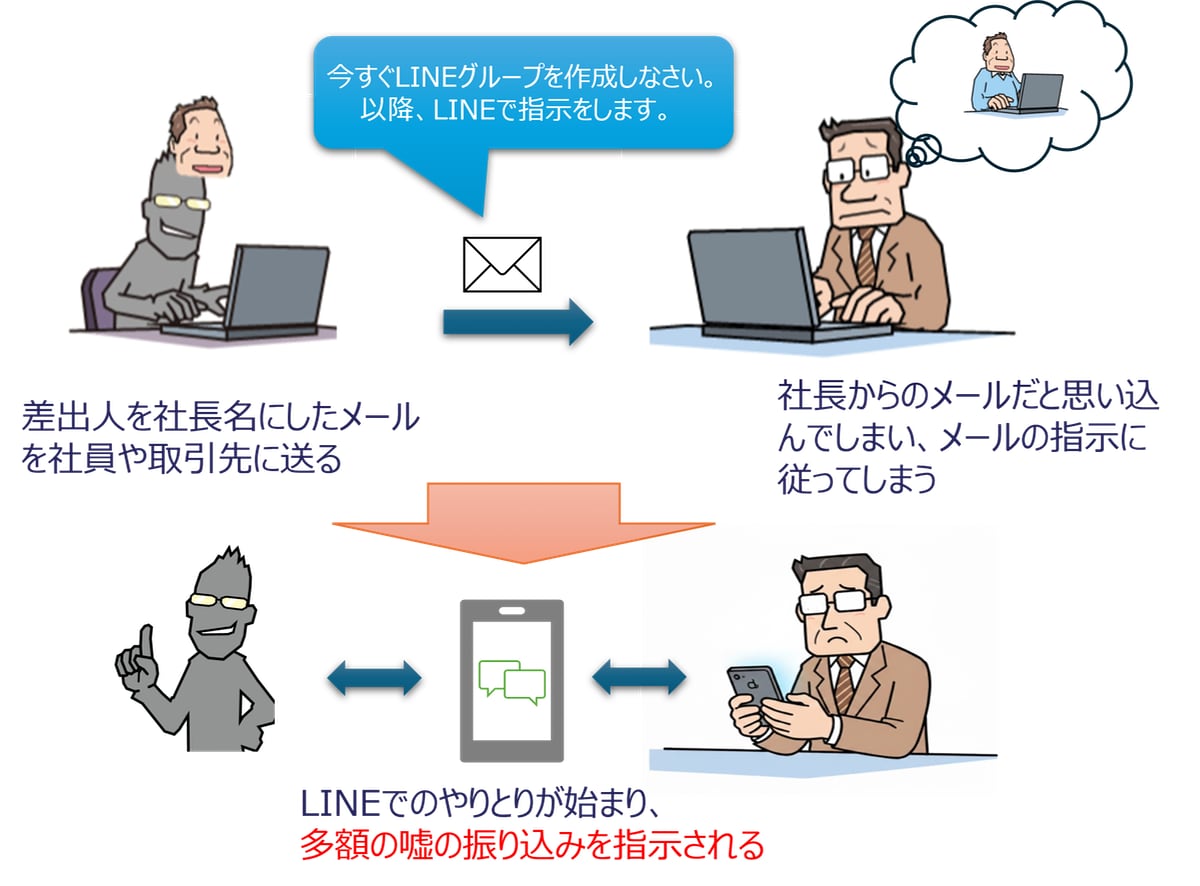
On March 12, Japan’s Information-technology Promotion Agency (IPA) issued a warning about a surge in scam emails impersonating real company presidents. According to the agency, consultations about this scheme have increased sharply since mid-December 2025.
This latest ニュース (nyuusu, news) highlights a growing cybersecurity threat affecting businesses across 日本 (nihon, Japan).
What Is the “Fake President” Scam?
The scam is a type of business email fraud. The sender pretends to be a company president or executive. The email instructs the recipient to:
- Create a LINE group
- Send back a QR code
If the employee follows these instructions, communication continues within the LINE group. There, the scammer pretends to conduct a legitimate business transaction and eventually demands a large bank transfer.
In other words, the initial email is just the first step. The real manipulation happens inside the LINE group, where the scammer pressures the employee into transferring a significant amount of money.
A Rapid Increase in Reports
Although the IPA has not confirmed actual financial losses through its consultation desk, it received 106 reports related to this method between December 16, 2025 and March 10, 2026.
Media reports have described cases where large sums were transferred. Japan’s National Police Agency also issued its own warning on February 13, signaling that authorities are taking the threat seriously.
Common Features of the Scam Emails
According to the IPA, these scam emails often share several characteristics:
- The sender’s name appears as the company president.
- The email address uses free services such as outlook.com or hotmail.com.
- The email is sent to a company mailing list.
- The subject line is simply the company’s name.
The agency believes scammers may be obtaining company information from publicly available sources or leaked data.
In some cases—though fewer in number—the emails include attachments designed to infect the recipient’s computer with malware.
IPA’s Advice: Ignore and Verify
The IPA strongly recommends:
- Ignoring and deleting suspicious emails.
- Consulting your company’s IT or system department if unsure.
- Confirming with the supposed sender (such as the president) through a different method, such as a phone call.
The agency warns that such scam emails are highly likely to continue targeting companies and organizations in the future. Vigilance is essential.
Cultural Context: Why Target the “President”?
In Japanese companies, the 社長 (shachō, company president) holds significant authority. Employees are culturally accustomed to responding quickly and respectfully to instructions from superiors.
Scammers exploit this structure. An urgent request from the “president” can feel difficult to question, especially if it appears to concern confidential business matters.
Understanding this cultural dynamic helps explain why this scam has gained traction. It’s not just a technical trick—it’s a psychological one rooted in workplace hierarchy.
Learn Japanese from This Article
Let’s break down useful vocabulary and expressions you can use right away.
Key Vocabulary
| Japanese | Romaji | Meaning |
|---|---|---|
| 情報処理推進機構 | jōhō shori suishin kikō | Information-technology Promotion Agency (IPA) |
| 詐欺メール | sagi mēru | scam email |
| 社長 | shachō | company president |
| 注意喚起 | chūi kanki | warning; alert |
| 振り込み | furikomi | bank transfer |
| 相談 | sōdan | consultation |
| 不審なメール | fushin na mēru | suspicious email |
| 削除する | sakujo suru | to delete |
Notice how many tech-related words use katakana, such as メール (mēru, email) and グループ (gurūpu, group). Katakana is commonly used in Japanese tech and business contexts.
Grammar Spotlight: ~をかたる
One important expression in this article is:
X をかたる
This means “to impersonate X” or “to pretend to be X.”
Pattern:
[Person/Organization] + をかたる
Examples:
社長をかたるメールが届いた。 Shachō o kataru mēru ga todoita. An email impersonating the president arrived.
警察をかたる詐欺に注意してください。 Keisatsu o kataru sagi ni chūi shite kudasai. Be careful of scams impersonating the police.
This structure is very common in crime-related ニュース (nyuusu) in 日本 (nihon), so it’s worth remembering.
Useful Expressions
注意喚起を行う chūi kanki o okonau to issue a warning
確認する kakunin suru to confirm
無視して削除する mushi shite sakujo suru to ignore and delete
These phrases are frequently used in cybersecurity announcements and official statements.
Continue Learning
Working on your reading skills? Our Katakana Essentials: Adapting Global Words to Japanese lesson is a great next step.
Curious about the Japanese used here? Our Basic Vocabulary Building: Embracing Words Without Latin Ties lesson covers this in depth.
To understand more about tech, explore our Reading and Writing in Japanese II: Hiragana and Katakana lesson.
Cybersecurity vocabulary is becoming more important every year. By reading real-world ニュース (nyuusu) like this, you’re learning Japanese the way people in 日本 (nihon) actually use it—through current events, official warnings, and everyday business language.
これからもよろしくお願いします。 Kore kara mo yoroshiku onegaishimasu.