
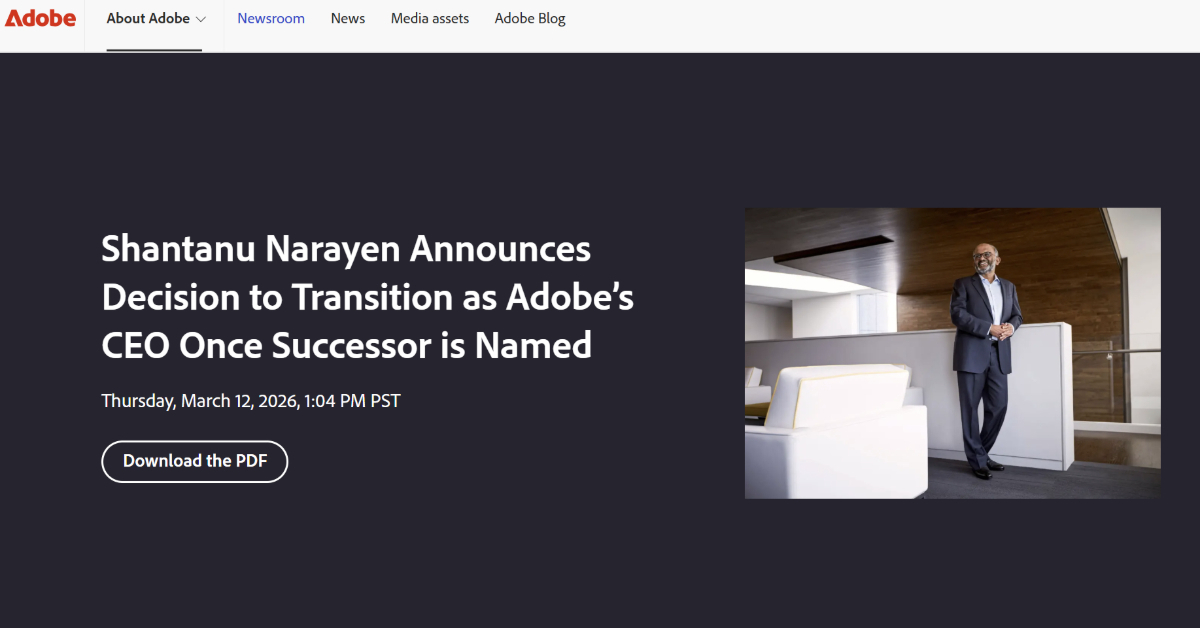
On March 12 (local time), Adobe announced that its long-serving CEO(シーイーオー) (shii ii oo), Shantanu Narayen (62), will step down after 18 years in the role, once a successor has been chosen.
Rather than a sudden departure, Narayen emphasized continuity. After stepping down, he will remain as chairman of the board and support a smooth leadership transition. A special committee, chaired by outside director Frank Calderoni, has been established to consider candidates from both inside and outside the company.
18 Years of Leadership and Growth
Narayen joined Adobe in 1998—28 years ago—and became CEO in 2007. Over the course of his 18-year tenure, his リーダーシップ (riidaa shippu, leadership) dramatically transformed the company.
Under his guidance:
- Employee numbers grew from around 3,000 to over 30,000.
- Revenue expanded from under $1 billion to more than $25 billion.
These figures highlight how Adobe evolved from a software company best known for creative tools like Photoshop into a global technology powerhouse.
In recent years, Narayen steered Adobe toward an AIファースト (ei ai faasuto, AI-first) era, building a foundation that positioned the company as an industry leader. In 2022, Adobe planned to acquire U.S.-based design platform Figma, but the deal was abandoned after concerns raised by regulatory authorities.
In Japanese, this is expressed using the grammar pattern 〜を受け、 meaning “in response to”:
- 各国の規制当局の懸念を受け、買収を断念した。 Kakkoku no kisei tōkyoku no kenen o uke, baishū o dannen shita. “In response to concerns from regulatory authorities, the acquisition was abandoned.”
“The Best Days Are Ahead”
In a message to employees, Narayen described his departure not as a farewell, but as “time for reflection.” He stressed that in the next era of creativity shaped by AI, Adobe is in an excellent position to lead.
He expressed strong confidence in the company’s future, saying that “Adobe’s best days are ahead.”
His contributions were widely praised. Microsoft CEO Satya Nadella commended him for building one of the world’s most important software companies and expanding opportunities for creators and entrepreneurs. Figma CEO Dylan Field described Narayen as thoughtful, kind, and uncompromising in pursuing Adobe’s ビジョン (bijon, long-term vision).
Strong Financial Results
On the same day, Adobe also announced its financial results for the first quarter of fiscal year 2026.
- Revenue increased 12% year-on-year to $6.4 billion, marking a record high for a first quarter.
- Net income was $1.89 billion on a GAAPベース (gaapu beesu, based on Generally Accepted Accounting Principles), or $2.49 billion on a non-GAAP basis.
One especially notable figure was ARR(エーアールアール) (ee aar aar, Annual Recurring Revenue) from AI-first products, which more than tripled compared to the previous year. Meanwhile, サブスクリプション (sabushukuripushon, subscription) revenue grew 13%, showing that expanding AI features are driving continued growth.
Cultural Context: Leadership Transitions in U.S. Tech
In major American technology companies, long-serving CEOs often play a central role in shaping corporate identity. An 18-year tenure is considered relatively long in Silicon Valley, where leadership changes can happen quickly.
It is also common for outgoing CEOs to remain as board chair to ensure stability. This approach reflects careful planning 〜に向けて (toward, in preparation for) the company’s next phase.
For example:
- 次期CEOの選定に向けて、特別委員会が設置された。 Jiki CEO no sentei ni mukete, tokubetsu iinkai ga setchi sareta. “A special committee was established toward selecting the next CEO.”
This phrasing shows forward-looking preparation—something highly valued in corporate Japan as well.
Learn Japanese from This Article
Key Vocabulary
| Japanese | Romaji | Meaning |
|---|---|---|
| CEO(シーイーオー) | shii ii oo | Chief Executive Officer |
| リーダーシップ | riidaa shippu | leadership |
| ビジョン | bijon | long-term vision |
| AIファースト | ei ai faasuto | AI-first strategy |
| サブスクリプション | sabushukuripushon | subscription (business model) |
| GAAPベース | gaapu beesu | based on GAAP accounting standards |
| ARR(エーアールアール) | ee aar aar | Annual Recurring Revenue |
| 退任する | tainin suru | to step down from a position |
| 後継者 | kōkeisha | successor |
Notice how many of these are written in katakana. Modern business Japanese frequently adapts English terms into Japanese pronunciation. Mastering katakana is essential for reading tech news.
Grammar Spotlight
1. 〜に向けて (ni mukete) — “toward; in preparation for”
Used when moving toward a goal or preparing for something.
Structure: Noun + に向けて
Example:
- 次期CEOの選定に向けて、委員会が設置された。 Jiki CEO no sentei ni mukete, iinkai ga setchi sareta. “A committee was established toward selecting the next CEO.”
2. 〜を受け、(o uke,) — “in response to; following”
Used in formal writing, especially news articles.
Structure: Noun + を受け、
Example:
- 規制当局の懸念を受け、計画は中止された。 Kisei tōkyoku no kenen o uke, keikaku wa chūshi sareta. “In response to regulatory concerns, the plan was canceled.”
You’ll see this pattern constantly in Japanese news.
Useful Expression
- 最高の日々はこれからやってくる。 Saikō no hibi wa kore kara yattekuru. “The best days are yet to come.”
This optimistic phrase is often used in speeches and corporate messaging.
Continue Learning
Working on your reading skills? Our Katakana Essentials: Adapting Global Words to Japanese lesson is a great next step.
Ready to dive deeper? Our lesson on Basic Vocabulary Building: Embracing Words Without Latin Ties will help you master these concepts.
Want to learn more about tech? Check out our lesson on Reading and Writing in Japanese II: Hiragana and Katakana.
これからもよろしくお願いします。 Kore kara mo yoroshiku onegaishimasu.