
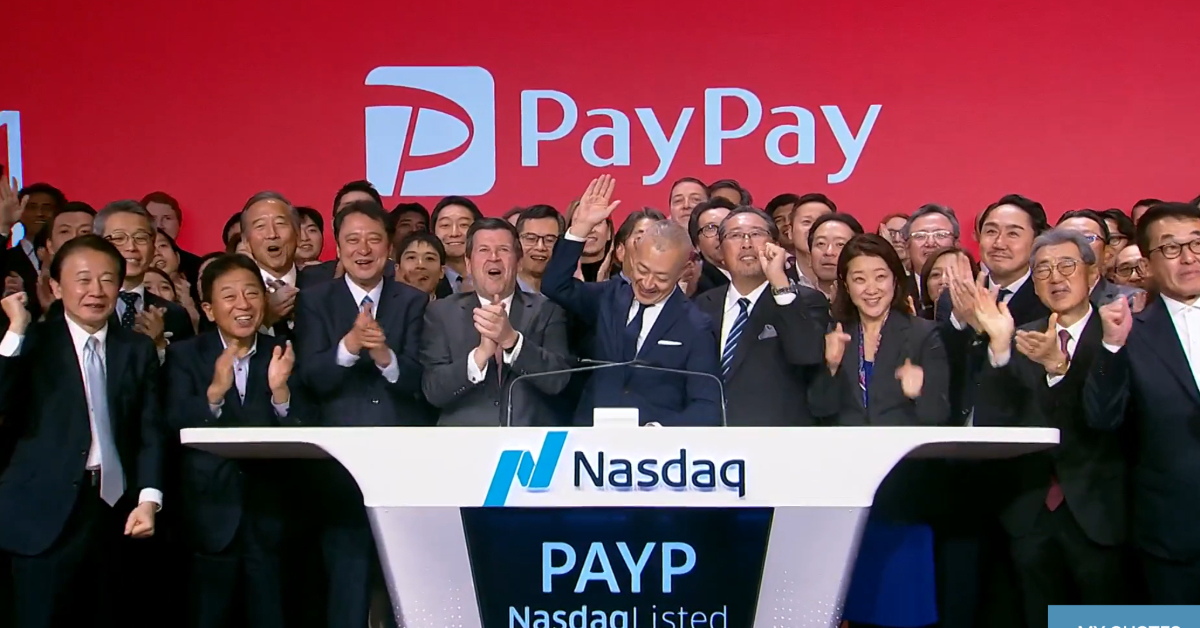
On March 12 (U.S. Eastern Time), PayPay was officially listed on the U.S. Nasdaq market, raising approximately 900 million dollars in its IPO. By the end of its first trading day, the Japanese cashless giant had reached a market capitalization of about 12.7 billion dollars—roughly 2 trillion yen.
PayPay Debuts on Nasdaq
PayPay, a major キャッシュレス (kyasshuresu) payment company under SoftBank Group, made its debut on ナスダック (nasudakku) on March 12.
The company’s IPO(アイピーオー) (aipīō) was priced at 16 dollars per share, with 54,987,214 shares offered to the public. Its ティッカーシンボル (tikkā shinboru), or ticker symbol, is PAYP. As a result of the listing, the company raised approximately 900 million dollars.
On the first day of trading, the stock opened at 19 dollars—nearly 20% higher than the IPO price. At that point, PayPay’s market capitalization reached about 12.7 billion dollars (around 2 trillion yen). The stock remained steady throughout the day and closed at 18 dollars and 16 cents.
A photo released by Nasdaq showed President and CEO Ichiro Nakayama ringing the opening bell, marking a symbolic moment for the company.
Why Nasdaq Instead of Tokyo?
With 73 million users in Japan, PayPay holds an overwhelming position in the domestic market. So why choose the U.S. market over the Tokyo Stock Exchange?
Behind this decision appears to be a strategy to gain higher evaluation in the American market, where many global ハイテク企業 (haiteku kigyō, high-tech companies) are listed. Nasdaq is particularly known as a hub for technology firms.
PayPay is using this listing as a stepping stone for expansion into the U.S. market. The company has announced plans to launch a スマホ決済 (sumaho kessai, smartphone payment) business in states such as California, in partnership with major クレジットカード (kurejitto kādo, credit card) company Visa.
Cultural Context: Japan’s Cashless Shift
Japan was once known as a cash-heavy society. However, over the past decade, キャッシュレス (kyasshuresu) payments have rapidly expanded. Services like PayPay became especially popular for small shops, restaurants, and everyday purchases.
With 73 million users—more than half of Japan’s population—PayPay has become almost synonymous with QR-code payments in Japan. Its move to Nasdaq reflects a broader ambition: not just to dominate domestically, but to compete globally in the fintech space.
Learn Japanese from This Article
Key Vocabulary
| Japanese | Romaji | Meaning |
|---|---|---|
| キャッシュレス | kyasshuresu | cashless (payment) |
| ナスダック | nasudakku | Nasdaq |
| IPO(アイピーオー) | aipīō | Initial Public Offering |
| ティッカーシンボル | tikkā shinboru | ticker symbol |
| ハイテク企業 | haiteku kigyō | high-tech company |
| スマホ決済 | sumaho kessai | smartphone payment |
| クレジットカード | kurejitto kādo | credit card |
| 時価総額 | jika sōgaku | market capitalization |
| 上場 | jōjō | stock listing |
Notice how many of these are written in katakana. Japanese often adapts global business and tech terms into its own sound system.
Grammar Spotlight
1. 〜に伴い
Meaning: “accompanying,” “as a result of,” “due to”
Structure: Noun + に伴い
Example from the article:
- 上場に伴い、約9億ドルを調達した。 Jōjō ni tomonai, yaku 9 oku doru o chōtatsu shita. “As a result of the listing, (the company) raised approximately 900 million dollars.”
More examples:
- 制度の変更に伴い、料金が変わります。 Seido no henkō ni tomonai, ryōkin ga kawarimasu. “Due to changes in the system, fees will change.”
This pattern is common in news writing and formal announcements.
2. 〜を目指している
Meaning: “aiming to,” “striving toward”
Structure: Noun + を目指している
Example from the article:
- 米国市場でのサービス展開を目指している。 Beikoku shijō de no sābisu tenkai o mezashite iru. “(The company) is aiming to expand services in the U.S. market.”
More examples:
- 医者を目指しています。 Isha o mezashite imasu. “I’m aiming to become a doctor.”
This expression is very useful when talking about goals—both personal and corporate.
Useful Expression
- 堅調な値動き (kenchō na nedōki) — “steady price movement”
You’ll often see this phrase in financial news when a stock performs stably.
Continue Learning
Working on your reading skills? Our Katakana Essentials: Adapting Global Words to Japanese lesson is a great next step.
To understand more about tech-related writing, explore our Reading and Writing in Japanese II: Hiragana and Katakana lesson.
Curious about broader vocabulary building? Check out Basic Vocabulary Building: Embracing Words Without Latin Ties.
PayPay’s Nasdaq debut marks a major milestone—not only for the company, but for Japan’s evolving fintech landscape. As you follow stories like this in Japanese, you’ll start recognizing patterns in business reporting, katakana vocabulary, and formal grammar structures used in real-world media.
これからもよろしくお願いします。 Kore kara mo yoroshiku onegaishimasu.