
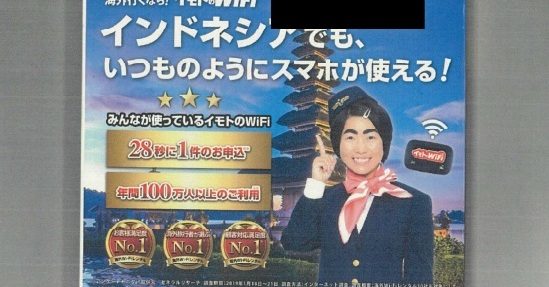
On March 12, Japan’s Consumer Affairs Agency ordered a payment of 172.62 million yen in 課徴金 (kachoukin, administrative fine) to the company behind the mobile router rental service “Imoto no WiFi.” The reason? Advertisements claiming it was “No.1” among overseas travelers were not based on objective research.
What Happened?
The Consumer Affairs Agency announced that, 景品表示法に基づき (keihin hyouji hou ni motozuki), or “based on the Act against Unjustifiable Premiums and Misleading Representations,” it had issued a surcharge payment order to XCom Global, a Tokyo-based company in Shibuya Ward.
The company operates a モバイルルーター (mobairu ruutaa, mobile router) レンタルサービス (rentaru saabisu, rental service) called “Imoto no WiFi.” These devices allow travelers to connect to Wi-Fi(ワイファイ) (wai-fai) abroad without relying on local SIM cards.
In guidebooks such as Chikyu no Arukikata Indonesia 2020–2021 and on its own Webサイト (webu saito, website), the company had advertised phrases like:
「お客様満足度 No.1 海外Wi-Fiレンタル」 Okyakusama manzokudo Nanbaa Wan kaigai Wi-Fi rentaru “Customer Satisfaction No.1 Overseas Wi-Fi Rental”
「海外旅行者が選ぶ No.1 海外Wi-Fiレンタル」 Kaigai ryokousha ga erabu Nanbaa Wan kaigai Wi-Fi rentaru “No.1 Overseas Wi-Fi Rental Chosen by Overseas Travelers”
「顧客対応満足度 No.1 海外Wi-Fiレンタル」 Kokyaku taiou manzokudo Nanbaa Wan kaigai Wi-Fi rentaru “Customer Support Satisfaction No.1 Overseas Wi-Fi Rental”
Here, No.1(ナンバーワン) (nanbaa wan) is commonly used in Japanese advertising to mean “number one” in some category.
However, according to the agency, the claims were not supported by 客観的 (kyakkanteki, objective) evidence.
What Was the Problem with the Survey?
XCom Global based its advertising on a third-party 調査 (chousa, survey or investigation). But the agency found serious issues with how that survey was conducted.
- Respondents were not asked whether they had actually used the company’s service or competing services.
- The questions only asked about impressions of websites.
- The advertisements did not accurately quote the actual survey results.
In other words, the survey did not objectively prove that the service was truly “No.1” in customer satisfaction or choice among overseas travelers.
The surcharge applies to the period from June 22, 2021, to June 21, 2024.
Why “No.1” Claims Matter in Japan
In Japan, advertising that highlights being “No.1” is extremely common. You’ll often see phrases like:
- 売上 No.1 (uriage Nanbaa Wan) – “Sales No.1”
- 満足度 No.1 (manzokudo Nanbaa Wan) – “Satisfaction No.1”
However, under the Act against Unjustifiable Premiums and Misleading Representations (景品表示法), companies must have clear and reasonable evidence to support such claims. If the evidence is weak or misleading, authorities can impose a 課徴金 (kachoukin), as in this case.
For language learners, this story is also a great example of how formal, legal Japanese is used in news reporting.
Learn Japanese from This Article
Key Vocabulary
| Japanese | Romaji | Meaning |
|---|---|---|
| 課徴金 | kachoukin | administrative fine; surcharge |
| モバイルルーター | mobairu ruutaa | mobile router |
| Wi-Fi(ワイファイ) | wai-fai | Wi-Fi; wireless internet |
| レンタルサービス | rentaru saabisu | rental service |
| Webサイト | webu saito | website |
| No.1(ナンバーワン) | nanbaa wan | number one |
| 客観的 | kyakkanteki | objective |
| 調査 | chousa | survey; investigation |
Notice how many of these are written in katakana. Words related to technology and marketing—like モバイルルーター and レンタルサービス—are often borrowed from English and adapted into Japanese pronunciation.
Grammar Spotlight
1. 〜に基づき/〜に基づく
Meaning: based on; in accordance with
- 景品表示法に基づき、課徴金納付命令を出した。 Keihin hyouji hou ni motozuki, kachoukin noufu meirei o dashita. “Based on the Act against Unjustifiable Premiums and Misleading Representations, a surcharge payment order was issued.”
You’ll see 〜に基づき in formal news and legal contexts. The dictionary form is 〜に基づく + noun:
- 調査に基づく結果 Chousa ni motozuku kekka “Results based on a survey”
This structure is common in official announcements.
2. 〜とうたう
Meaning: to advertise; to claim (especially in promotions)
- 「海外旅行者が選ぶNo.1」とうたう広告 “Kaigai ryokousha ga erabu Nanbaa Wan” to utau koukoku “An advertisement claiming ‘No.1 chosen by overseas travelers’”
The verb うたう originally means “to sing,” but in advertising and news contexts, it means “to promote as” or “to claim.”
Useful Expression
- 客観的な調査に基づかない Kyakkanteki na chousa ni motozukanai “Not based on objective research”
This phrase is helpful when discussing evidence, research, or even academic writing.
Continue Learning
Working on your reading skills? Our Katakana Essentials: Adapting Global Words to Japanese lesson is a great next step.
To understand more about tech, explore our Reading and Writing in Japanese II: Hiragana and Katakana lesson.
Curious about the Japanese used here? Our Basic Vocabulary Building: Embracing Words Without Latin Ties lesson covers this in depth.
Stories like this show you how Japanese is used in real legal and business contexts—not just in textbooks. By reading authentic news, you’re learning the language the way it’s actually written and spoken in Japan.
これからもよろしくお願いします。 Kore kara mo yoroshiku onegaishimasu.