
SEO Title: LINEヤフー Launches 3.11 Search Donation and Disaster Tool Meta Description: LINEヤフー will donate 10 yen per “3.11” search on March 11 and introduces a new disaster preparedness tool to help families prepare and share plans.
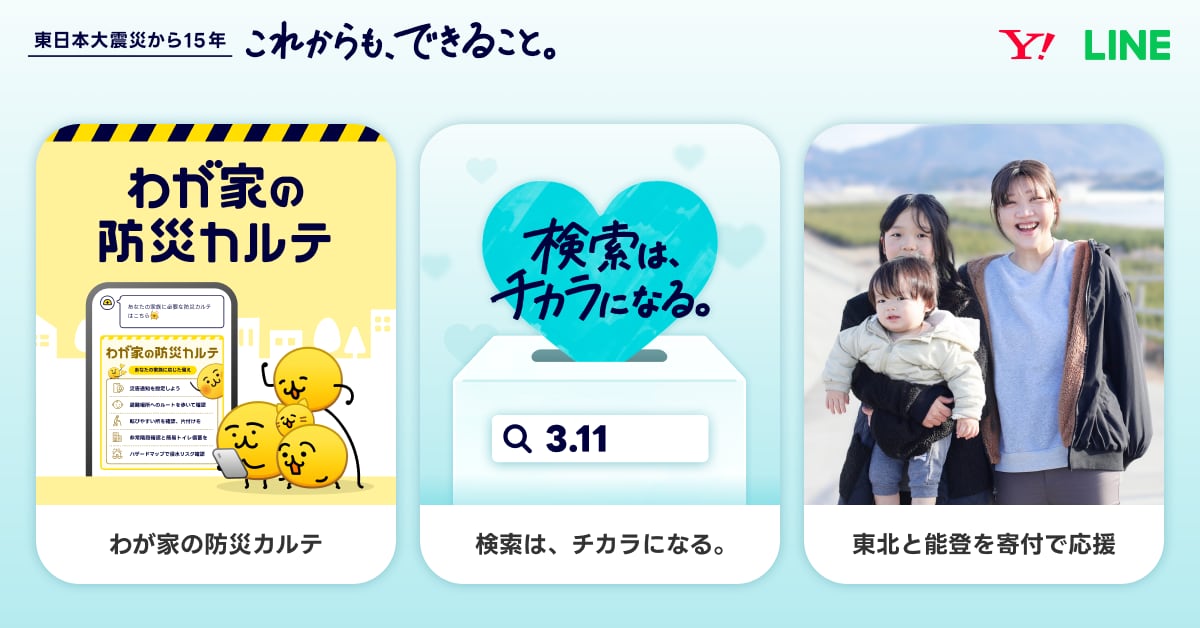
On March 9, LINEヤフー announced the launch of a special campaign site ahead of March 11, which marks 15 years since the Great East Japan Earthquake. The company will once again donate 10 yen for every user who searches “3.11” on March 11 through Yahoo! JAPAN or LINE.
The initiative combines remembrance, technology, and practical disaster preparedness — all through tools people already use every day.
Searching “3.11” Becomes a Donation
The special campaign site is called 特設サイト「3.11これからもできること」 (tokusetto saito “3.11 kore kara mo dekiru koto”), meaning “Special Site: What We Can Still Do After 3.11.”
On March 11, from 12:00 a.m. to 11:59 p.m., each user who searches 「3.11」 on Yahoo! JAPAN or LINE will trigger a 10-yen donation.
Here’s an important grammar point from the article:
- ユーザー一人につき10円を寄付する yūzā hitori ni tsuki jū-en o kifu suru “Donate 10 yen per user.”
The grammar 〜につき (ni tsuki) means “per” or “for each.”
Donations will go to areas affected by:
- The Great East Japan Earthquake
- The Noto Peninsula Earthquake and heavy rain disasters
The total donation amount is capped at 50 million yen.
This annual campaign shows how a simple online action can connect millions of people to a shared moment of remembrance and support.
A New Tool: “My Family’s Disaster Preparedness Chart”
This year, LINEヤフー is adding a new initiative: 「わが家の防災カルテ」 (waga ie no bōsai karute) — “My Family’s Disaster Preparedness Chart.”
The tool is available on the 特設サイト (tokusetto saito, special campaign website).
Users answer five questions in a チャット形式 (chatto keishiki, chat format). The questions ask about:
- Family structure
- Residential area
- Other basic information
Based on the answers, the site provides advice on:
- Checking your ハザードマップ (hazādo mappu, hazard map)
- Reviewing disaster notification settings
- Emergency supplies to prepare
- Practical steps you can take now
This personalized “disaster chart” also features a LINE-originated キャラクター (kyarakutā, character/mascot) called えもじの子(仮) (emoji no ko (kari)).
The completed chart can be saved as an image and 共有する (kyōyū suru, share) via LINE and other platforms with family members.
The goal? To encourage discussions about disaster preparedness across generations and help each household understand what preparations fit their specific situation.
Ask AI for Deeper Information
The campaign site also includes an 「AIにきいてみよう」コーナー (“ē ai ni kiite miyō” kōnā — “Let’s Ask AI” section).
In this コーナー (kōnā, website section), users can ask AI (ē ai, artificial intelligence) for more detailed related information.
Rather than offering only static advice, the campaign uses interactive tools — chat, AI, and shareable visuals — to make disaster preparedness more personal and accessible.
Cultural Context: Why March 11 Matters
March 11, 2011 — often referred to simply as 「3.11」 (san ten ichi ichi) — marks the Great East Japan Earthquake.
In Japan, dates like this can become symbolic shorthand. Just saying “3.11” immediately evokes the earthquake and tsunami that changed the country. Similar to how “9/11” functions in the United States, the numbers themselves carry emotional and historical weight.
Fifteen years later, companies like LINEヤフー continue annual initiatives 3月11日に向けて (san-gatsu jūichi-nichi ni mukete) — “toward March 11” or “in preparation for March 11.”
This brings us to another key grammar point.
Learn Japanese from This Article
Vocabulary
| Japanese | Romaji | Meaning |
|---|---|---|
| 特設サイト | tokusetto saito | special campaign website |
| チャット形式 | chatto keishiki | chat format |
| ハザードマップ | hazādo mappu | hazard map |
| AI | ē ai | artificial intelligence |
| キャラクター | kyarakutā | character; mascot |
| 共有する | kyōyū suru | to share |
| コーナー | kōnā | section (of a site or program) |
| 〜につき | ni tsuki | per; for each |
| 〜に向け | ni mukete | toward; in preparation for |
Notice how many of these words are written in katakana because they come from foreign languages (site, chat, hazard map, AI, character, corner). This is very natural in modern Japanese, especially in tech news.
Grammar Spotlight
1️⃣ 〜に向け(て) — Toward; In Preparation For
Structure: [Event / Date] + に向け(て)
Example from the article:
- 3月11日に向け、特設サイトを公開する。 San-gatsu jūichi-nichi ni mukete, tokusetto saito o kōkai suru. “They are launching a special site in preparation for March 11.”
More examples:
- 試験に向けて勉強する。 Shiken ni mukete benkyō suru. “I study toward (in preparation for) the exam.”
- 大会に向けて練習している。 Taikai ni mukete renshū shite iru. “I’m practicing for the tournament.”
This expression emphasizes preparation and direction toward a goal.
2️⃣ 〜につき — Per; For Each
Structure: [Counter + noun] + につき
Example:
- ユーザー一人につき10円を寄付する。 Yūzā hitori ni tsuki jū-en o kifu suru. “Donate 10 yen per user.”
More examples:
- お一人様につき一回まで。 O-hitori-sama ni tsuki ikkai made. “Limit one per person.”
- 1000円につき1ポイント。 Sen-en ni tsuki ippointo. “One point per 1,000 yen.”
You’ll often see this in formal announcements, campaigns, and store policies.
Useful Expression
- 今できること (ima dekiru koto) — “What we can do now”
This phrase appears in the campaign theme and is very common in Japanese during times of disaster or crisis. It focuses on practical, immediate action rather than abstract ideas.
Continue Learning
Working on your reading skills? Our Katakana Essentials: Adapting Global Words to Japanese lesson is a great next step.
Ready to dive deeper? Our lesson on Reading and Writing in Japanese II: Hiragana and Katakana will help you master these concepts.
For vocabulary expansion, check out Basic Vocabulary Building: Embracing Words Without Latin Ties.
Small actions — like typing 「3.11」 into a search bar — can become meaningful when millions participate together. And through tools like わが家の防災カルテ, technology becomes not just convenient, but protective.
これからもよろしくお願いします。 Kore kara mo yoroshiku onegaishimasu.