
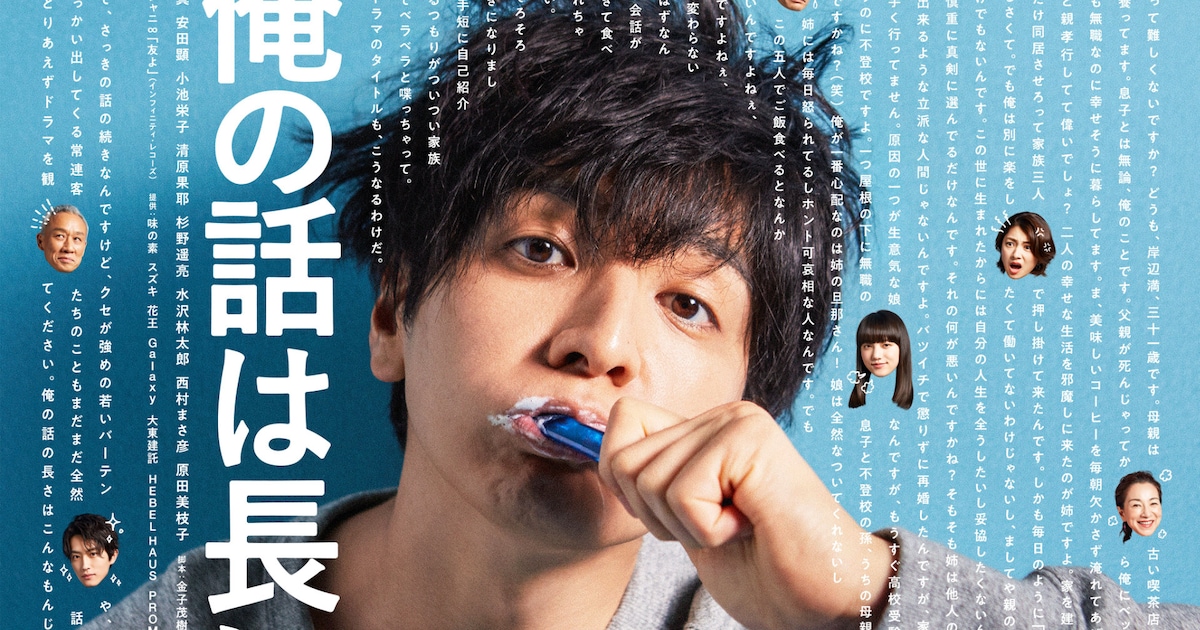
Toma Ikuta Stars as a NEET in "My Story is Long" Marathon Broadcast
If you’ve ever wanted to peek into the quirks and warmth of a Japanese family while picking up authentic language, you’re in for a treat. On January 31, 2026, the beloved 2019 drama 俺の話は長い (Ore no Hanashi wa Nagai, "My Story is Long") starring Toma Ikuta will air in a full 一挙放送 (ikkyo housou, marathon broadcast) on the CS channel Family Gekijo. This hilarious ホームコメディ (hoomu komedi, home comedy), along with its special sequel 俺の話は長い ~2025・春~ (Ore no Hanashi wa Nagai ~2025 Haru~, "My Story is Long ~2025 Spring~"), offers a perfect chance to dive into real Japanese family dynamics and witty dialogue. Let’s explore what makes this drama a must-watch for learners like you!
A Drama Full of Laughs and Family Chaos
First aired in 2019, 俺の話は長い (Ore no Hanashi wa Nagai) introduces us to Kishibe Mitsuru, a ニート (niito, NEET - Not in Education, Employment, or Training) who’s been jobless for six years after dropping out of university and failing at a business venture. Played by the talented Toma Ikuta, who takes on the 主演 (shuen, leading role), Mitsuru is a master of 屁理屈 (herikutsu, twisted logic or lame excuses), constantly leaving his family both frustrated and amused with his long-winded justifications. Whether he’s debating why he can’t get a job or why he deserves another chance, Mitsuru’s ability to 翻弄 (honrou, toy with or be at someone’s mercy) everyone around him is comedy gold.
The series centers on Mitsuru’s interactions with his family—his mother Fumie, sister Ayako, brother-in-law Koji, and niece Harumi—bringing to life the everyday chaos and love of a Japanese household. In the 2025 sequel, we see Mitsuru still struggling with 自立 (jiritsu, independence or self-reliance), trying to stand on his own after yet another short-lived job. Written by Kaneko Shigeki, known for hits like プロポーズ大作戦 (Puropoozu Daisakusen, "Proposal Operation"), this drama mixes humor with relatable struggles, making it a treasure trove for language learners wanting to hear natural, conversational Japanese.
Cultural Context: Understanding NEET and Family Dynamics
For many English speakers, a term like ニート (niito) might just mean “unemployed,” but in Japan, it’s loaded with cultural weight. Emerging in the early 2000s, it describes young adults who aren’t in school, work, or training, often living with and depending on family. This can create tension in a society that values hard work and societal contribution. Through Mitsuru, the drama humorously tackles these real issues, showing how family members navigate disappointment and support in subtle, often indirect ways—a hallmark of Japanese communication.
Then there’s 屁理屈 (herikutsu), the art of crafting elaborate excuses. While we all know someone who’s good at dodging responsibility, Mitsuru’s verbose rants highlight a uniquely Japanese flavor of humor. Watching his family’s reactions—often a mix of sighs and passive-aggressive comments—gives you insight into how personal conflicts are handled in Japan, where direct confrontation is usually avoided. As a learner, paying attention to these interactions teaches you not just language, but the “why” behind the words.
Learn Japanese from This Article
Ready to pick up some authentic Japanese from this drama? Here are key vocabulary words and grammar patterns to help you sound more like a native speaker. These are terms and structures you’ll hear in everyday conversations or family settings in Japan.
Key Vocabulary
| Japanese | Romaji | Meaning |
|---|---|---|
| ニート | niito | NEET (Not in Education, Employment, or Training) |
| 屁理屈 | herikutsu | twisted logic, lame excuse, quibble |
| 一挙放送 | ikkyo housou | marathon broadcast, airing all episodes at once |
| 主演 | shuen | leading role, starring role |
| 翻弄 | honrou | to be toyed with, to be at someone’s mercy |
| 自立 | jiritsu | independence, self-reliance |
| ホームコメディ | hoomu komedi | home comedy, family-oriented comedic drama |
Grammar Spotlight: 〜が主演を務める and 〜とともに
Let’s break down two useful grammar patterns that pop up when talking about dramas or relationships, both of which you’ll encounter in contexts like this news piece.
1. 〜が主演を務める (ga shuen o tsutomeru) - to play the leading role, to star in
- Structure: Subject + が + 主演を務める
- Meaning: Used to indicate who stars in or plays the leading role in a drama, movie, or play.
- Examples:
- 生田斗真が主演を務めるドラマはとても面白い。 (Ikuta Toma ga shuen o tsutomeru dorama wa totemo omoshiroi.) "The drama starring Toma Ikuta is very interesting."
- 彼女が主演を務める映画を見たい。 (Kanojo ga shuen o tsutomeru eiga o mitai.) "I want to see the movie she stars in."
- Usage Note: This is a formal way to describe someone’s role, often seen in news or reviews. It’s a great phrase to use when discussing actors or performances.
2. 〜とともに (to tomo ni) - together with, along with
- Structure: Noun + とともに
- Meaning: Indicates something or someone accompanying another, often used in formal or written contexts.
- Examples:
- 家族とともに新しい生活を始めた。 (Kazoku to tomo ni atarashii seikatsu o hajimeta.) "I started a new life together with my family."
- 続編とともに、元のドラマも放送される。 (Zokuhen to tomo ni, moto no dorama mo housou sareru.) "Along with the sequel, the original drama will also be broadcast."
- Usage Note: This phrase adds a sense of connection or simultaneity, often used in storytelling or formal speech to describe events or relationships.
Useful Expression
A handy phrase to pick up from family dynamics or dramas like this is もういい加減にして! (Mou iikagen ni shite!, "Enough already!" or "Cut it out!"). You’ll hear this when someone’s fed up with excuses (like Mitsuru’s 屁理屈). It’s casual and perfect for expressing frustration in a natural way.
Continue Learning
Want to build on what you’ve learned here? Check out these lessons to deepen your understanding of Japanese grammar and culture:
- Wa vs. Ga: Emphasizing Importance in Sentences: Ready to dive deeper? Our lesson on Wa vs. Ga: Emphasizing Importance in Sentences will help you master these concepts.
- Ni, De, and E: Mapping Directions and Locations: To understand more about に, explore our Ni, De, and E: Mapping Directions and Locations lesson.
- Greetings and Self-Introductions: Authentic Entry Phrases: Want to learn more about culture? Check out our lesson on Greetings and Self-Introductions: Authentic Entry Phrases.
これからもよろしくお願いします。 Kore kara mo yoroshiku onegaishimasu.