
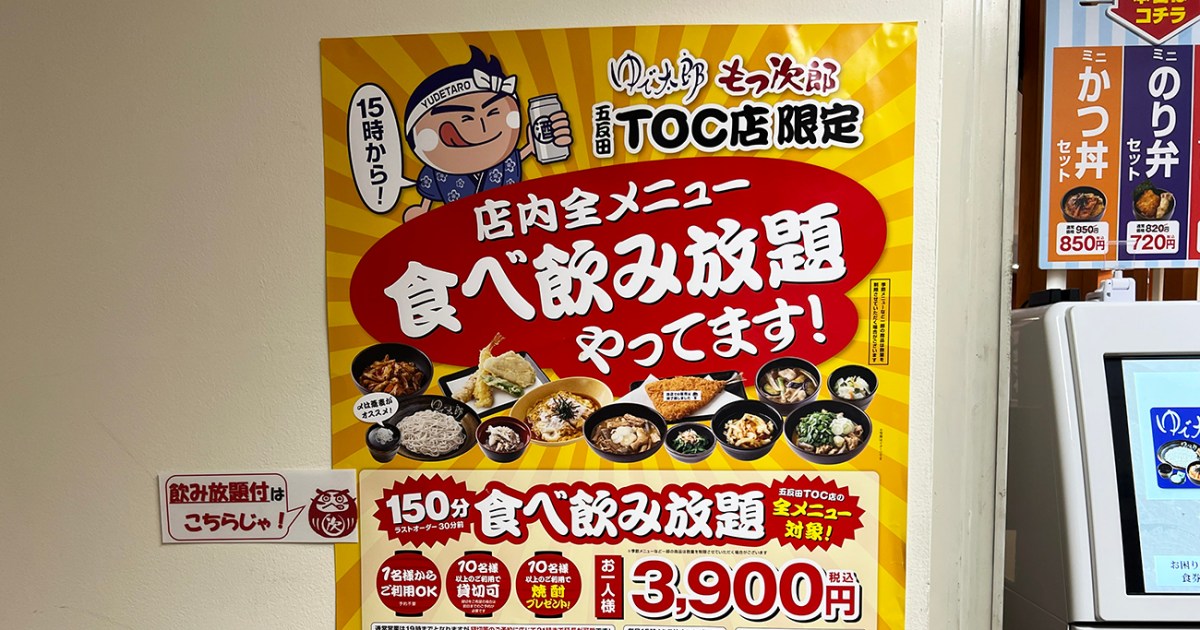
Yudetaro has exactly one 食べ放題 (tabehoudai, all-you-can-eat) location in all of Japan, and it is the Gotanda TOC branch in Tokyo. Rocket News writer Nakazawa visited that single shop to see whether the 2,700-yen plan was actually worth it, and finished with a total that came up 100 yen short. You can read the original report from Rocket News.
The branch is inside the basement of the Gotanda TOC Building, a large multi-use building south of JR Gotanda Station. According to the report, the building opened in 1970 and was said to be the largest private complex building in Japan and the biggest in the East at the time. The Yudetaro shop is on basement level 1, tucked behind the elevators in a layout the writer describes as maze-like enough to walk past once.
The only all-you-can-eat Yudetaro
As of November 13, 2026, posters on the wall showed two plans: an all-you-can-eat-and-drink course for 3,900 yen including tax, and an all-you-can-eat course for 2,700 yen including tax. The longer course lasts 150 minutes, while the food-only plan lasts 90 minutes.
The key detail was the受付時間, or reception time. Orders for the plan start at 3 p.m., and the shop’s 営業時間 (eigyou jikan, business hours) end at 7 p.m., so customers only have that four-hour window to begin. Nakazawa arrived at 5:40 p.m. and was still in time.
There was one more surprise: the 券売機 (kenbaiki, ticket vending machine) had no visible button for the all-you-can-eat plan. After asking a staff member, the writer learned that customers must order it directly. The staff then issued the ticket through what the writer jokingly described as a kind of hidden command on the machine.
How the ordering worked — and how full it got
At the table, staff brought over the rules, the menu, and an order sheet. The all-you-can-eat system is order-based, and each 注文 (chuumon, order) can include up to three items. One rule said some items have limits on the number of times they can be ordered, and the menu marked the seasonal kakiage topping as 数量限定 (suuryou gentei, limited quantity). A poster in the shop said that season’s kakiage was a “mostly shrimp” kakiage.
For the first round, Nakazawa went for cold yakumi soba, a mini nori bento, and motsuni. Ordering items separately made it possible to create a combination that does not exist as a set menu, and the writer also added motsuni from Motsujirou.
After eating that first round, the writer realized something important: one round already felt like enough. Yudetaro’s usual menu was available as all-you-can-eat, and being free from worrying about price felt great, but the food itself was filling enough that the original plan of eating three rounds disappeared quickly.
A second round still happened, though in a much smaller form. The seasonal kakiage was considered and then crossed out on the order sheet, and the second order became only tsukimi tororo soba. Even that felt substantial, and by the end the writer said finishing it was a close call.
Did the 2,700-yen plan pay off?
The meal ended after a little more than 30 minutes. Even so, the writer felt the plan had been fully 満喫 (mankitsu, enjoyed to the fullest). When the same items were totaled at normal menu prices, the result was:
- Mini nori bento: 480 yen
- Cold yakumi soba: 760 yen
- Tsukimi tororo soba: 760 yen
- Motsuni: 600 yen
That came to 2,600 yen, just under the 2,700-yen all-you-can-eat price.
The final impression was that the plan itself is not expensive. The challenge is that Yudetaro’s regular portions are already hearty and relatively low-priced, so reaching the break-even point is harder than it first appears. For people who already like Yudetaro, the Gotanda TOC 店舗 (tenpo, branch) may still be a fun stop.
Learn Japanese from This Article
Vocabulary
| Japanese | Romaji | Meaning |
|---|---|---|
| 食べ放題 | tabehoudai | all-you-can-eat |
| 店舗 | tenpo | store, shop location, branch |
| 営業時間 | eigyou jikan | business hours, opening hours |
| 券売機 | kenbaiki | ticket vending machine |
| 注文 | chuumon | order |
| 数量限定 | suuryou gentei | limited quantity |
| 満喫 | mankitsu | to fully enjoy, to make the most of |
Grammar Spotlight
〜ことにする
Used when someone decides to do something.
From the article: そんなゆで太郎らしさを感じたので食べ放題を体験してみることにした。 Sonna Yudetarou rashisa o kanjita node tabehoudai o taiken shite miru koto ni shita. “So I felt that bold Yudetaro spirit and decided to try the all-you-can-eat option.”
Example: 今日は早く帰ることにした。 Kyō wa hayaku kaeru koto ni shita. “I decided to go home early today.”
Example: 昼ご飯はそばにすることにした。 Hirugohan wa soba ni suru koto ni shita. “I decided to have soba for lunch.”
〜わけではない
Used to soften a statement: “it does not mean that…” or “it’s not necessarily the case that…”
From the article: とはいえ、2700円で全メニュー食べ放題という価格設定自体は決して高いわけではない。 To wa ie, nisen nanahyaku-en de zen menyū tabehoudai to iu kakaku settei jitai wa kesshite takai wake de wa nai. “That said, a price of 2,700 yen for all-you-can-eat across the full menu is not high in itself.”
Example: 安いわけではないが、量は多い。 Yasui wake de wa nai ga, ryō wa ōi. “It’s not exactly cheap, but the portion is large.”
Example: 有名な店だからといって、いつも空いていないわけではない。 Yūmei na mise da kara to itte, itsumo suite inai wake de wa nai. “Just because it’s a famous shop doesn’t mean it’s never crowded.”
Useful Expressions
元は取れるか Moto wa toreru ka “Can you get your money’s worth?”
1回のオーダーで3品まで Ikkai no ōdā de sanpin made “Up to three items per order”
ギリギリ Girigiri “Just barely” / “right on the edge”
Continue Learning
- Time and Dates: Tense-Free Expressions: Ready to dive deeper? Our lesson on Time and Dates: Tense-Free Expressions will help you master these concepts.
これからもよろしくお願いします。 Kore kara mo yoroshiku onegaishimasu.