
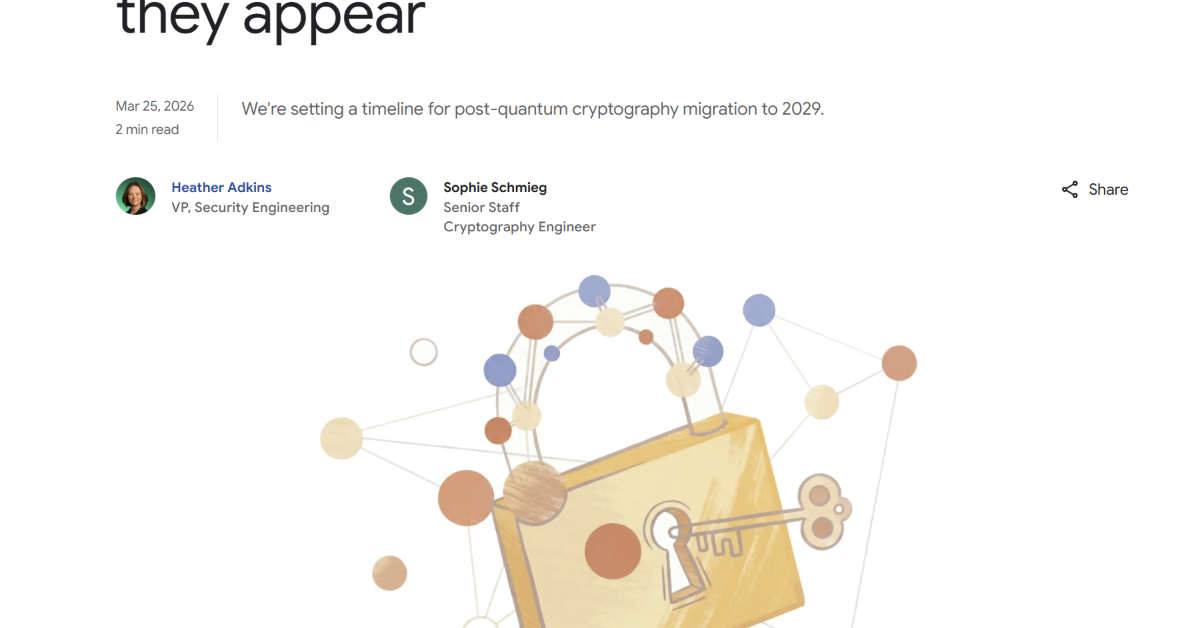
On March 25 (local time), Google announced that it is accelerating its transition ロードマップ (rōdomappu) to post-quantum cryptography, aiming to complete the shift by 2029. The rollout will begin with support in Android 17, marking a major step toward securing the future of the digital world.
Why Post-Quantum Cryptography Matters
Post-Quantum Cryptography, or 量子耐性暗号 (ryōshi taisei angō, PQC), refers to new encryption methods designed to resist attacks from future quantum computers. Today’s デジタル (dejitaru) society relies heavily on public-key cryptography and digital signatures to protect everything from bank transfers to corporate secrets.
In the article, this wide range is expressed with the grammar pattern:
- 銀行の送金から企業秘密に至るまで
- ginkō no sōkin kara kigyō himitsu ni itaru made
- “From bank transfers all the way to corporate secrets”
The phrase 〜に至るまで means “from A all the way to B,” emphasizing scope and breadth.
The concern is clear: if quantum computers become practical, they could potentially break today’s widely used encryption systems. That would threaten the “digital locks” protecting sensitive information across the globe.
Why 2029? Rapid Advances in Quantum Technology
Google explained that recent rapid progress in quantum computing ハードウェア (hādowea), quantum error correction, and resource estimation for quantum factoring has influenced its decision to move up the タイムライン (taimurain) to 2029.
Another major concern is what’s known as the “store-now-decrypt-later” attack. In this scenario, encrypted data is stolen today and stored, with the intention of decrypting it later once powerful quantum computers become available.
Google is also acting 〜を見据え (o misue) — “with an eye toward” — future threats to digital signatures. The company anticipates the day when cryptographically significant quantum computers emerge and pose a real danger to authentication services, which are a cornerstone of online security.
By setting an ambitious 2029 timeline, Google says it hopes to provide clarity and urgency not only within its own operations but across the entire industry’s digital transition.
Android 17: PQC Begins in the Mobile OS
Concrete measures are already underway. Google announced plans to introduce PQC support in its next mobile operating system, Android 17.
The company will begin testing enhanced PQC features in the ベータ版(β版) (bēta-ban) of Android 17, with full release planned in the official version.
Key initiatives include:
- Introducing the PQC digital signature アルゴリズム (arugorizumu) “ML-DSA” into Android Verified Boot, which verifies system integrity at startup.
- Supporting ML-DSA in the Android Keystore.
- Implementing ハイブリッド (haiburiddo) signatures in Google Play, combining traditional methods with PQC.
Through these steps, Google aims to replace the entire “chain of trust” — from OS startup to app distribution — with a quantum-resistant system.
Cultural Context: Japan and the Language of Tech
One interesting feature of this article is the heavy use of katakana words such as:
- ロードマップ (rōdomappu)
- ハードウェア (hādowea)
- アルゴリズム (arugorizumu)
- ハイブリッド (haiburiddo)
- タイムライン (taimurain)
In Japanese tech reporting, foreign-derived terms are commonly written in katakana and used naturally within sentences. Rather than translating everything into older Japanese vocabulary, modern tech language in Japan often mirrors global terminology.
For learners, this means that improving your katakana reading skills directly improves your ability to read real Japanese tech news.
Learn Japanese from This Article
Key Vocabulary
| Japanese | Romaji | Meaning |
|---|---|---|
| 量子耐性暗号 | ryōshi taisei angō | post-quantum cryptography |
| ロードマップ | rōdomappu | roadmap (development plan) |
| デジタル | dejitaru | digital |
| ハードウェア | hādowea | hardware |
| アルゴリズム | arugorizumu | algorithm |
| ハイブリッド | haiburiddo | hybrid |
| タイムライン | taimurain | timeline |
| ベータ版(β版) | bēta-ban | beta version |
| 整合性 | seigōsei | integrity, consistency |
| 信頼の連鎖 | shinrai no rensa | chain of trust |
Grammar Spotlight
1. 〜に至るまで
Meaning: From A all the way to B; covering a wide range
Structure: Noun + から + Noun + に至るまで
Example from the article:
- 銀行の送金から企業秘密に至るまで、多くの情報が守られている。 Ginkō no sōkin kara kigyō himitsu ni itaru made, ōku no jōhō ga mamorarete iru. From bank transfers all the way to corporate secrets, much information is protected.
This pattern emphasizes the breadth or extent of something.
2. 〜を見据え
Meaning: With an eye toward; anticipating
Structure: Noun + を見据え
Example inspired by the article:
- 将来の脅威を見据え、PQCへの移行を急ぐ。 Shōrai no kyōi o misue, PQC e no ikō o isogu. With an eye toward future threats, they are accelerating the transition to PQC.
This expression is often used in business, policy, and technology discussions about long-term planning.
Useful Expression
- 前倒しする(まえだおしする) maedaoshi suru — to move something forward (earlier than planned)
Example:
- 計画を前倒しする。 Keikaku o maedaoshi suru. To move a plan forward.
You’ll frequently hear this in corporate and tech news when companies accelerate their schedules.
Continue Learning
Working on your reading skills? Our Katakana Essentials: Adapting Global Words to Japanese lesson is a great next step.
Want to learn more about tech? Check out our lesson on Basic Vocabulary Building: Embracing Words Without Latin Ties.
To understand more about tech, explore our Reading and Writing in Japanese II: Hiragana and Katakana lesson.
Quantum computing may still feel futuristic, but the language around it is very much part of today’s Japanese. By learning how these terms and patterns work, you’re training yourself to read the kind of authentic material native speakers read every day.
これからもよろしくお願いします。 Kore kara mo yoroshiku onegaishimasu.