
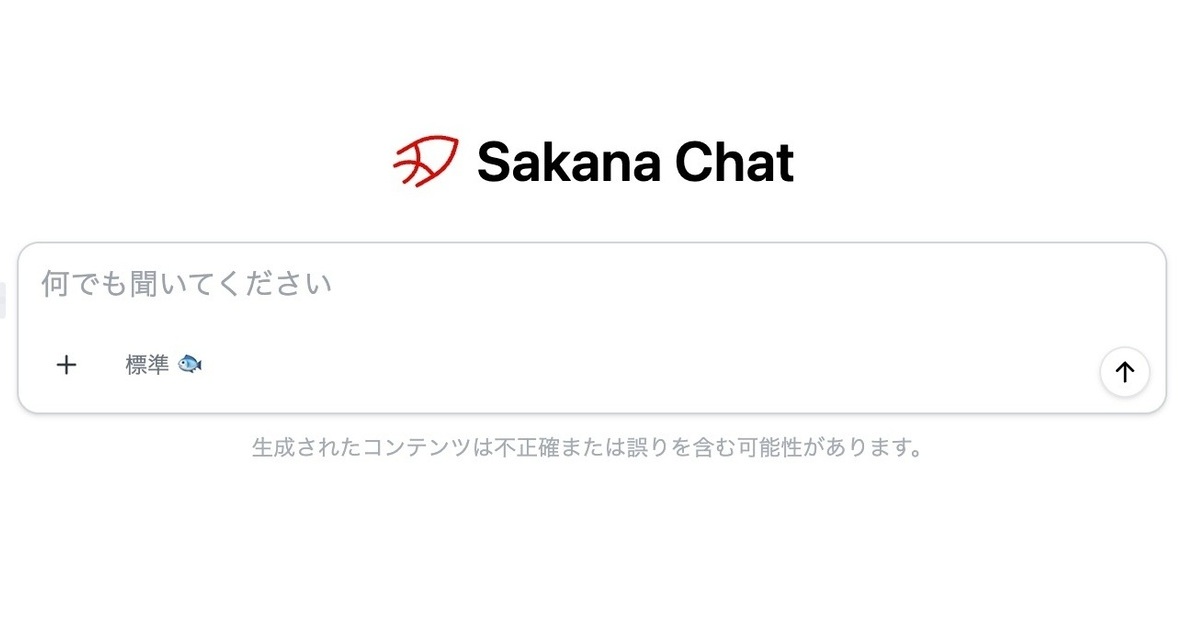
On March 24, Sakana AI announced the development of a new AI model series called 「Namazu」 (Namazu), currently in alpha. At the same time, the company released a chat service powered by these models: 「Sakana Chat」 (Sakana Chat).
The announcement highlights a key goal: adapting global AI models to better fit Japanese needs—while improving neutrality and accuracy.
What Is the Namazu Model?
The Namazu series is described as a set of プロトタイプ (purototaipu, prototype) models. Instead of building everything from scratch, Sakana AI used other companies’ オープンウェイト (ōpun weito, open weights) foundation models—models whose parameters are publicly released—and applied its own post-training technology.
In other words, they took existing large AI models and refined them for Japanese specifications.
As of March 24, three models were announced:
- Namazu-DeepSeek-V3.1-Terminus
- Llama-3.1-Namazu-405B
- Namazu-gpt-oss-120B
Each is based on an externally released foundation model, with Sakana AI’s additional training layered on top.
This approach reflects a broader trend in AI development: rather than always starting from zero, companies increasingly adapt and specialize powerful base models.
Benchmark Results: Neutrality and Accuracy
Sakana AI evaluated the Namazu series using various ベンチマーク (benchimāku, benchmarks).
In terms of basic capabilities—such as reasoning, general knowledge, and coding performance—the models maintained performance almost equal to their base models.
Here, a useful grammar pattern appears:
〜に比べ (〜ni kurabe) — “compared to”
The article explains that, ベースモデルに比べ (bēsu moderu ni kurabe), compared to the base models, Namazu achieved significant improvements in:
- Neutrality in politically and historically sensitive topics
- Accuracy and comprehensiveness of factual information
So while core abilities stayed roughly the same, neutrality and accuracy improved noticeably in comparison with the original models.
The company also investigated how the models respond to politically sensitive or socially specific questions. They examined whether the models would avoid or obscure information about certain social systems. According to Sakana AI, none of the Namazu models showed such avoidance behavior.
Addressing Ideology and Bias
Sakana AI made a strong statement about overseas AI models:
海外製モデルには、開発元の地域のイデオロギーや情報統制の傾向が反映されることが避けられない。
Let’s look at the grammar here.
〜ことが避けられない (〜koto ga sakerarenai) — “it is unavoidable that…”
This phrase means something cannot be avoided. In this context:
“It is unavoidable that overseas-developed models reflect the ideology and information control tendencies of their regions.”
Key terms include:
- イデオロギー (ideorogī) — ideology
- バイアス (baiasu) — bias
To correct this バイアス (baiasu), Sakana AI says it developed methods to reduce the influence of censorship present in some models.
The company is also preparing to release the model weights of multiple Namazu models in the future and plans to continue advancing its post-training research.
What Is Sakana Chat?
Alongside the models, Sakana AI launched Sakana Chat, a chat service powered by Namazu.
Before its public release, the company recruited 1,000 beta testers and improved the system based on their フィードバック (fīdobakku, feedback).
One notable feature is its integrated web search. Because it supports リアルタイム (riarutaimu, real-time) search, users can ask questions like:
“From this morning’s news, compare domestic and international trends in AI research.”
The Namazu model will gather and integrate information in real time before generating a response.
This combination of language modeling and live search reflects how modern AI chat services are evolving beyond static knowledge.
Cultural Context: Why “Japanese Specifications” Matter
The article repeatedly mentions adapting models to 日本仕様 (Nihon shiyō), “Japanese specifications.”
In Japan, discussions about freedom of expression, political neutrality, and media bias are often approached carefully and formally. The idea that foreign-developed models may reflect the values or information controls of their home regions is an important topic in Japan’s tech and policy circles.
By emphasizing neutrality and alignment with Japanese standards of free expression, Sakana AI positions Namazu not just as a technical upgrade—but as a culturally tuned AI system.
Learn Japanese from This Article
Vocabulary
| Japanese | Romaji | Meaning |
|---|---|---|
| オープンウェイト | ōpun weito | open weights (public model parameters) |
| ベンチマーク | benchimāku | benchmark |
| プロトタイプ | purototaipu | prototype |
| リアルタイム | riarutaimu | real-time |
| フィードバック | fīdobakku | feedback |
| イデオロギー | ideorogī | ideology |
| バイアス | baiasu | bias |
Notice how many of these are written in katakana. Japanese frequently adapts technical English terms this way.
Grammar Spotlight
1️⃣ 〜に比べ — “Compared to…”
Structure: Noun + に比べ
Example Sentences:
ベースモデルに比べ、精度が向上した。 Bēsu moderu ni kurabe, seido ga kōjō shita. Accuracy improved compared to the base model.
去年に比べ、利用者が増えた。 Kyonen ni kurabe, riyōsha ga fueta. The number of users increased compared to last year.
Use this when making direct comparisons.
2️⃣ 〜ことが避けられない — “It is unavoidable that…”
Structure: Verb (dictionary form) + ことが避けられない
Example Sentences:
影響が出ることが避けられない。 Eikyō ga deru koto ga sakerarenai. It is unavoidable that effects will appear.
誤解が生じることが避けられない。 Gokai ga shōjiru koto ga sakerarenai. It is unavoidable that misunderstandings will occur.
This structure is often used in formal writing and news reports.
Useful Expression
- 〜を発表した (〜o happyō shita) — “announced ~” Common in news reporting. Example: 新モデルを発表した。 Shin moderu o happyō shita. They announced a new model.
Continue Learning
Working on your reading skills? Our Katakana Essentials: Adapting Global Words to Japanese lesson is a great next step.
Ready to dive deeper? Our lesson on Reading and Writing in Japanese II: Hiragana and Katakana will help you master these concepts.
Curious about the Japanese used here? Our Basic Vocabulary Building: Embracing Words Without Latin Ties lesson covers this in depth.
Sakana AI’s Namazu series shows how AI development in Japan is not just about performance—it’s about cultural alignment, neutrality, and thoughtful adaptation. As you continue reading Japanese tech news, you’ll start noticing how often words like ベンチマーク, バイアス, and リアルタイム appear.
Each article becomes both a tech update and a language lesson.
これからもよろしくお願いします。 Kore kara mo yoroshiku onegaishimasu.