
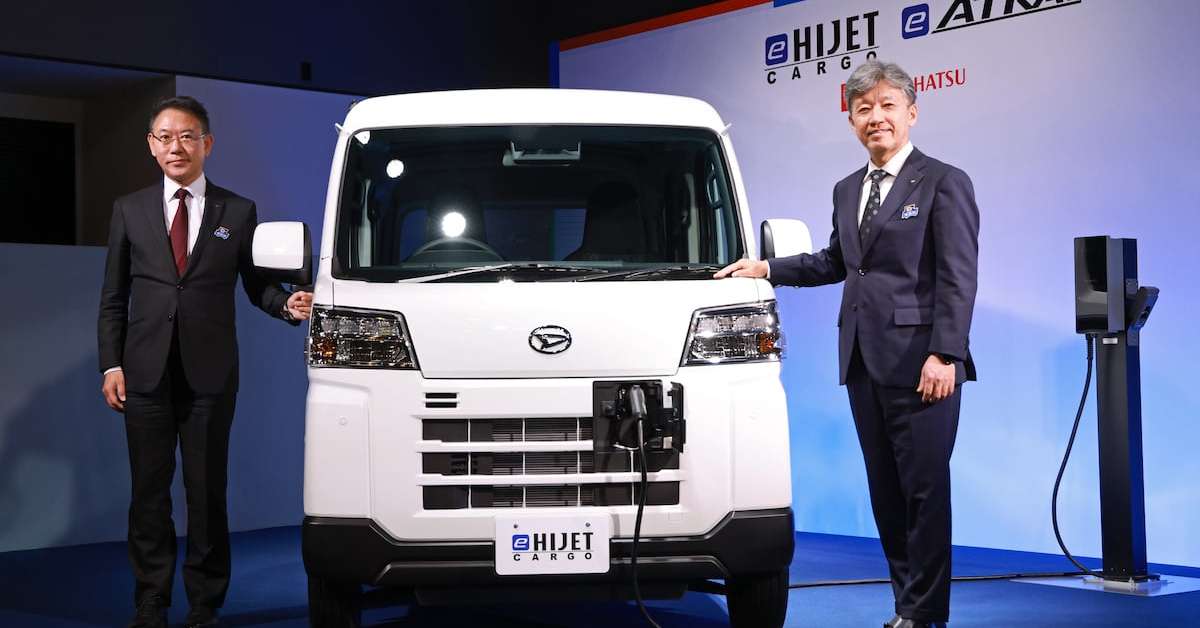
Daihatsu's Light EVs Spark a New Era in Japan’s Auto Race
If you’ve ever dreamed of navigating Japan’s narrow streets or diving into its cutting-edge tech scene, today’s news is your ticket to both. On February 2, 2026, Daihatsu Motor Co. rolled out its first mass-produced electric vehicles (EVs), stepping boldly into the light commercial vehicle market with the e-ハイゼット カーゴ (e-Haizetto Kāgo, e-HiJet Cargo) and e-アトレー (e-Atorē, e-Atrai). This isn’t just about cars—it’s a glimpse into Japan’s push for sustainability and innovation, and a perfect chance to learn authentic Japanese as it’s used in real-world contexts. Let’s break down the news, explore the cultural significance, and pick up some useful language along the way!
Daihatsu Enters the Light EV Competition
Daihatsu’s launch marks a pivotal moment in Japan’s automotive landscape. These two new models, designed for commercial use, boast an impressive cruising range of 257 km—top-tier for light commercial vans—and a cargo space that can fit up to 36 beer crates. Developed alongside industry giants Toyota and Suzuki, the EVs feature a sleek, high-capacity lithium-ion battery and even include an external power supply function as standard. Starting at 3,146,000 yen, they’re tailored to meet the rising demand for eco-friendly transport solutions in 日本 (nihon, Japan).
At the Tokyo launch event, Daihatsu’s president, Masahiro Inoue, highlighted the company’s vision. With half of their domestic sales coming from commercial vehicles, these EVs are a cornerstone in achieving カーボンニュートラル (kābon nyūtoraru, carbon neutrality), Japan’s ambitious goal of net-zero greenhouse gas emissions. But Daihatsu isn’t alone in this race. Suzuki is gearing up to release its own light commercial EV by March 2026, Honda’s N-VAN EV already holds a 20% share of its model’s sales, and Chinese giant 比亜迪 (Hiyadi, BYD) is set to enter the fray this summer. As Inoue put it, this is a battle among the “Big Three plus BYD,” and the stakes couldn’t be higher.
Why Light EVs Are a Big Deal in Japan
You might be wondering why light vehicles are getting so much buzz. Known as 軽自動車 (keijidōsha, light automobiles), these compact cars are a uniquely Japanese solution to urban and rural challenges. Their small size suits the country’s narrow roads and tight parking spaces, while their short-range usage aligns perfectly with EV battery capabilities. Plus, they offer zero emissions, quiet operation, and smooth driving—huge perks for delivery drivers and businesses. Even for everyday consumers, light EVs like Nissan’s サクラ (Sakura), with nearly 96,000 units sold by 2025, are proving popular.
Japan’s broader EV scene is also accelerating. From Toyota’s bZ4X to Nissan’s updated リーフ (Rīfu, Leaf), standard-sized EVs are gaining traction, supported by infrastructure like Toyota’s universal charging service TEEMO. For Japanese automakers, this isn’t just a trend—it’s a vital response to global sustainability demands, and it’s reshaping how people move through 日本 (nihon, Japan).
Cultural Context: The Heart of Keijidōsha in Japanese Life
To really understand this news, let’s dig into the cultural role of 軽自動車 (keijidōsha) in Japan. Born in the post-World War II era as an affordable transport option during economic recovery, these small vehicles—limited to 660cc engines and strict dimensions—now make up nearly 40% of cars on Japanese roads. They’re especially dominant in rural areas and cramped cities, embodying the Japanese value of 効率 (kōritsu, efficiency). For small businesses, 軽商用車 (kei shōyōsha, light commercial vehicles) are lifelines, so transitioning them to EVs balances practicality with environmental responsibility.
This shift also ties into Japan’s commitment to カーボンニュートラル (kābon nyūtoraru), a concept that’s more than a buzzword—it’s a reflection of societal harmony with nature, a value deeply rooted in Japanese culture. As you learn the language, noticing how innovation and tradition blend in everyday contexts like a delivery van offers a window into the Japanese mindset. It’s not just about tech; it’s about progress with purpose.
Learn Japanese from This Article
Ready to turn this ニュース (nyuusu, news) into a language-learning opportunity? Here at “Japanese from Japan,” we believe in learning the way native speakers do—through real-life contexts. Let’s break down some key vocabulary and a useful grammar pattern to help you talk about tech and innovation like a local.
Key Vocabulary
| Japanese | Romaji | Meaning |
|---|---|---|
| ニュース | nyuusu | news |
| 日本 | nihon | Japan |
| 軽自動車 | keijidōsha | light automobile |
| カーボンニュートラル | kābon nyūtoraru | carbon neutrality |
| 効率 | kōritsu | efficiency |
These words aren’t just useful for this article—they’re everyday terms you’ll hear across Japanese media, business, and casual chats. Start using ニュース (nyuusu) when discussing current events, or drop 効率 (kōritsu) when talking about practical solutions.
Grammar Spotlight: Using は (wa) for Topic Emphasis
One of the most fundamental particles in Japanese is は (wa), used to mark the topic of a sentence. Unlike English, where we rely on word order, Japanese uses は to clarify what you’re focusing on. It’s often taught as “as for…” in translations to show this nuance.
- Structure: [Topic] + は
- [Comment/Description]
- Example 1: 日本は技術が進んでいます。 (Nihon wa gijutsu ga susundeimasu.) – As for Japan, technology is advanced.
- Example 2: 軽自動車は効率がいいです。 (Keijidōsha wa kōritsu ga ii desu.) – As for light automobiles, they are efficient.
- Example 3: このニュースは面白いです。 (Kono nyuusu wa omoshiroi desu.) – As for this news, it is interesting.
When to Use: Use は to introduce or emphasize the main topic of discussion. It’s perfect for setting the stage in conversations about news or general observations, like discussing Japan’s EV trends. Notice how it shifts focus to the subject before adding details.
Useful Expression: 〜について (ni tsuite, “about/regarding”)
When diving into topics like EVs or sustainability, you’ll often want to say “about” or “regarding” a subject. The phrase 〜について (ni tsuite) is your go-to expression.
- Structure: [Topic] + について
- [Verb/Description]
- Example: カーボンニュートラルについて話しましょう。 (Kābon nyūtoraru ni tsuite hanashimashō.) – Let’s talk about carbon neutrality.
This phrase is incredibly versatile for discussions, whether you’re chatting about tech news or cultural trends in 日本 (nihon, Japan).
Continue Learning
Want to build on what you’ve learned here? Check out these lessons from “Japanese from Japan” to deepen your skills:
- Wa vs. Ga: Emphasizing Importance in Sentences: Want to learn more about は? Check out our lesson on Wa vs. Ga: Emphasizing Importance in Sentences.
- Basic Vocabulary Building: Embracing Words Without Latin Ties: Curious about the Japanese used here? Our Basic Vocabulary Building: Embracing Words Without Latin Ties lesson covers this in depth.
- Ni, De, and E: Mapping Directions and Locations: Ready to dive deeper? Our lesson on Ni, De, and E: Mapping Directions and Locations will help you master these concepts.
Learning Japanese isn’t just about words and grammar—it’s about connecting with the culture and context behind them. Keep exploring, and you’ll be speaking like a native in no time!
これからもよろしくお願いします。 Kore kara mo yoroshiku onegaishimasu.