

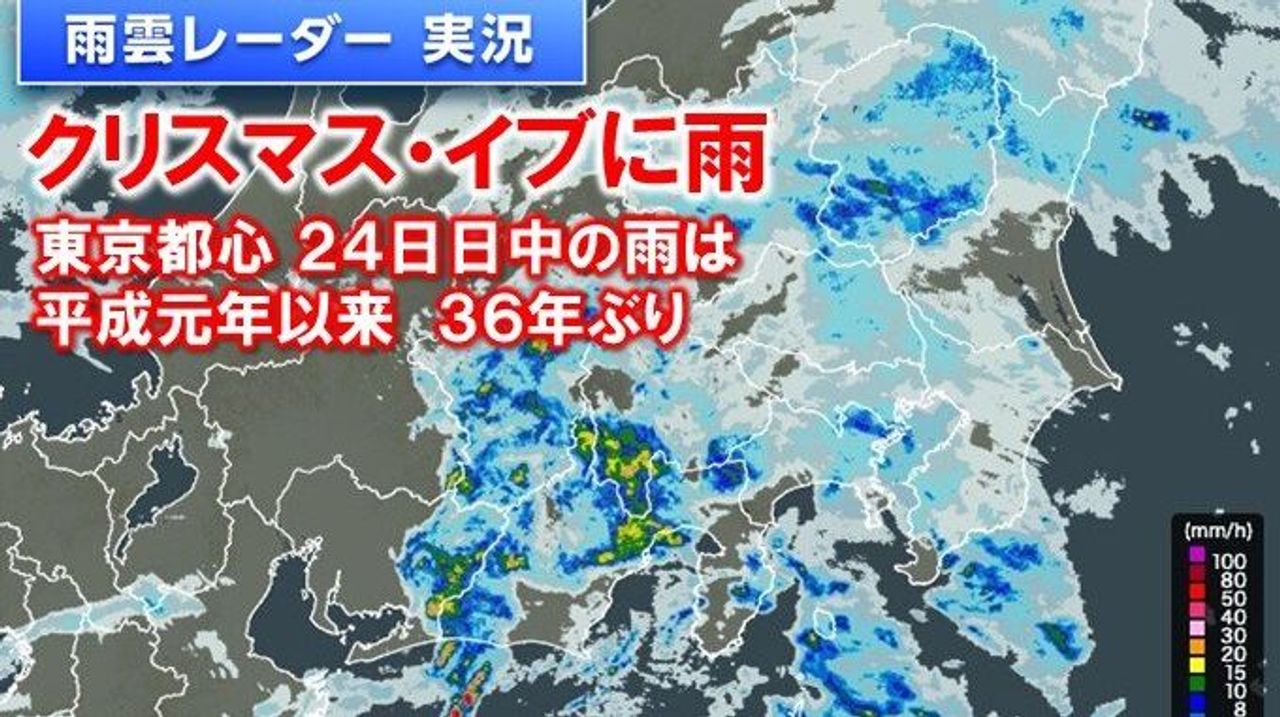
A Rainy Christmas Eve in Tokyo: A Rare Moment in History
Imagine strolling through the dazzling streets of Tokyo on Christmas Eve, surrounded by festive lights and holiday cheer, only to feel a gentle drizzle on your face. If you’ve ever pictured a perfect holiday moment in Japan, rain might not be part of it—but on December 24, 2001, it became a historic event. For the first time in over three decades, the Kanto region, including Tokyo’s bustling 都心 (toshin, city center), experienced measurable rain during the day on Christmas Eve. Let’s dive into this unique moment, explore its cultural significance, and pick up some authentic Japanese along the way.
A Drizzle of History in 2001
On that fateful Christmas Eve, rain began spreading across the Kanto region from the early morning. By 9 a.m., central Tokyo recorded a modest 0.5 millimeters of 雨 (ame, rain), marking a milestone that hadn’t occurred in 36 years. Since 1989—the start of the 平成 (Heisei) era, which spanned from 1989 to 2019—central Tokyo hadn’t seen measurable rain (0.5 mm or more) during the 日中 (nitchū, daytime) hours of 9 a.m. to 6 p.m. on クリスマス・イブ (Kurisumasu Ibu, Christmas Eve). What started as a light drizzle turned into a 本降り (honburi, steady rain), quietly etching this day into the records of weather 観測 (kansoku, observation or measurement). While rain might seem like a small inconvenience elsewhere, in Japan, it became a noteworthy piece of history.
The Cultural Lens: Christmas Eve in Japan
Christmas Eve in Japan isn’t just another holiday—it’s a cultural phenomenon with a unique twist. Unlike the family-focused celebrations common in the West, クリスマス・イブ (Kurisumasu Ibu) is often seen as a romantic occasion for couples or a joyful time with friends. Picture cozy dinners under twinkling illuminations or sharing a slice of クリスマスケーキ (Kurisumasu Keeki), the iconic strawberry sponge cake that’s practically mandatory for the season. When rain falls on such a day, especially in a vibrant hub like Tokyo’s 都心 (toshin), it shifts the mood. Outdoor plans might turn into intimate indoor dates, and the weather itself becomes part of the day’s story. In Japan, even small details like 雨 (ame) weave into the cultural narrative, shaping how holidays are experienced and remembered.
Learn Japanese from This Article
If you’ve ever wondered how to talk about weather or historical moments like this rainy Christmas Eve, let’s break down some key language points straight from the way Japanese is taught in Japan. Here, you’ll find vocabulary and grammar that native speakers use every day.
Key Vocabulary
| Japanese | Romaji | Meaning |
|---|---|---|
| 雨 | ame | rain |
| クリスマス・イブ | Kurisumasu Ibu | Christmas Eve |
| 都心 | toshin | city center, downtown |
| 観測 | kansoku | observation, measurement |
| 本降り | honburi | steady rain, downpour |
| 平成 | Heisei | Heisei era (1989-2019) |
| 日中 | nitchū | daytime, during the day |
These words aren’t just textbook terms—they’re the kind of language you’ll hear in everyday conversations or news reports in Japan. For instance, if you’re chatting about the weather, mentioning 本降り (honburi) instantly shows you understand the nuance of a real downpour.
Grammar Spotlight: 〜以来 (irai) and 〜以降 (igo)
To talk about events in relation to a specific time, like the rainy Christmas Eve of 2001, two useful grammar patterns are 〜以来 (irai, since a specific time or event) and 〜以降 (igo, after or since a point in time). These are commonly used in Japanese to mark historical or personal milestones, just as we’ve seen in this story.
〜以来 (irai): Since a Specific Time or Event
- Structure: Time/Event + 以来 (irai)
- Usage: Refers to something that hasn’t happened or has continued since a specific moment.
Examples:
- 1989年以来、クリスマス・イブに雨が降っていませんでした。 (1989-nen irai, Kurisumasu Ibu ni ame ga futteimasen deshita.) Since 1989, it hadn’t rained on Christmas Eve.
- 日本に来て以来、毎日日本語を勉強しています。 (Nihon ni kite irai, mainichi nihongo o benkyou shiteimasu.) Since coming to Japan, I’ve studied Japanese every day.
〜以降 (igo): After or Since a Point in Time
- Structure: Time/Event + 以降 (igo)
- Usage: Focuses on a period after a specific point, often with a sense of “from then on.”
Examples:
- 平成以降、東京のクリスマス・イブは雨が少なかったです。 (Heisei igo, Toukyou no Kurisumasu Ibu wa ame ga sukunakatta desu.) After the start of the Heisei era, there was little rain on Christmas Eve in Tokyo.
- 2020年以降、オンラインで勉強することが増えました。 (2020-nen igo, onrain de benkyou suru koto ga fuemashita.) Since 2020, studying online has increased.
These patterns are incredibly useful for discussing history, personal experiences, or even weather events like the one in 2001. They help you sound natural and precise, just like a native speaker.
Useful Expression: Weather Talk
A quick way to bring up the weather in casual conversation is to use 雨が降る (ame ga furu, it’s raining). For example:
- 今日、雨が降っていますね。 (Kyou, ame ga futteimasu ne.) It’s raining today, isn’t it?
This simple phrase can open up a conversation and is something you’ll hear all the time in Japan, especially on days like that historic Christmas Eve.
Closing Thoughts
Learning Japanese isn’t just about memorizing words or grammar—it’s about connecting with moments like a rainy クリスマス・イブ (Kurisumasu Ibu) in Tokyo and understanding how they fit into the bigger picture of Japanese life. Whether it’s a drizzle or a 本降り (honburi), every detail offers a chance to deepen your language skills and cultural insight. Keep exploring these authentic stories with us, and you’ll find yourself speaking Japanese the way it’s truly spoken in Japan.
これからもよろしくお願いします。 Kore kara mo yoroshiku onegaishimasu.