
On March 25, Netflix announced that 31.4 million people watched all 47 games of the 2026 ワールドベースボールクラシック (2026 Wārudo Bēsubōru Kurashikku, World Baseball Classic, or WBC) streamed exclusively in Japan. For Netflix, it was a historic milestone: its first full-scale sports ライブ配信 (raibu haishin, live streaming) project in the country.
Kazutaka Sakamoto, who oversees Japanese コンテンツ (kontentsu, content) at Netflix, said the company was able to successfully complete its first major live sports broadcast in Japan.
Record-Breaking Viewership
The 31.4 million figure includes both ライブ配信 (raibu haishin) and views of the アーカイブ (aakaibu, archived recordings) within 24 hours after each game ended. The total was calculated ビデオリサーチ独自の推計データを基に (bideo risāchi dokuji no suikei deeta o moto ni) — based on Video Research’s proprietary estimation データ (deeta, data).
It represents the total number of viewing contacts, including cases where one person watched on more than one デバイス (debaisu, device), such as a TV or smartphone.
The most-watched game was the March 8 evening matchup between Japan and Australia, drawing 17.9 million viewers. The live stream alone set a new record as Netflix Japan’s most-watched single title ever.
Close behind were:
- Japan vs. Korea: 17.86 million viewers
- Japan vs. Venezuela: 17.26 million viewers
Among non-Japan games, the トップ3 (toppu surii, top three) were:
- USA vs. Venezuela
- Australia vs. Korea
- USA vs. Canada
Interestingly, about 55% of users watched at least one game that did not involve Japan. Netflix believes that for many viewers, Samurai Japan (the nickname for Japan’s national team) served as a gateway, expanding interest to all 20 participating countries and regions.
Younger and More Female Viewers
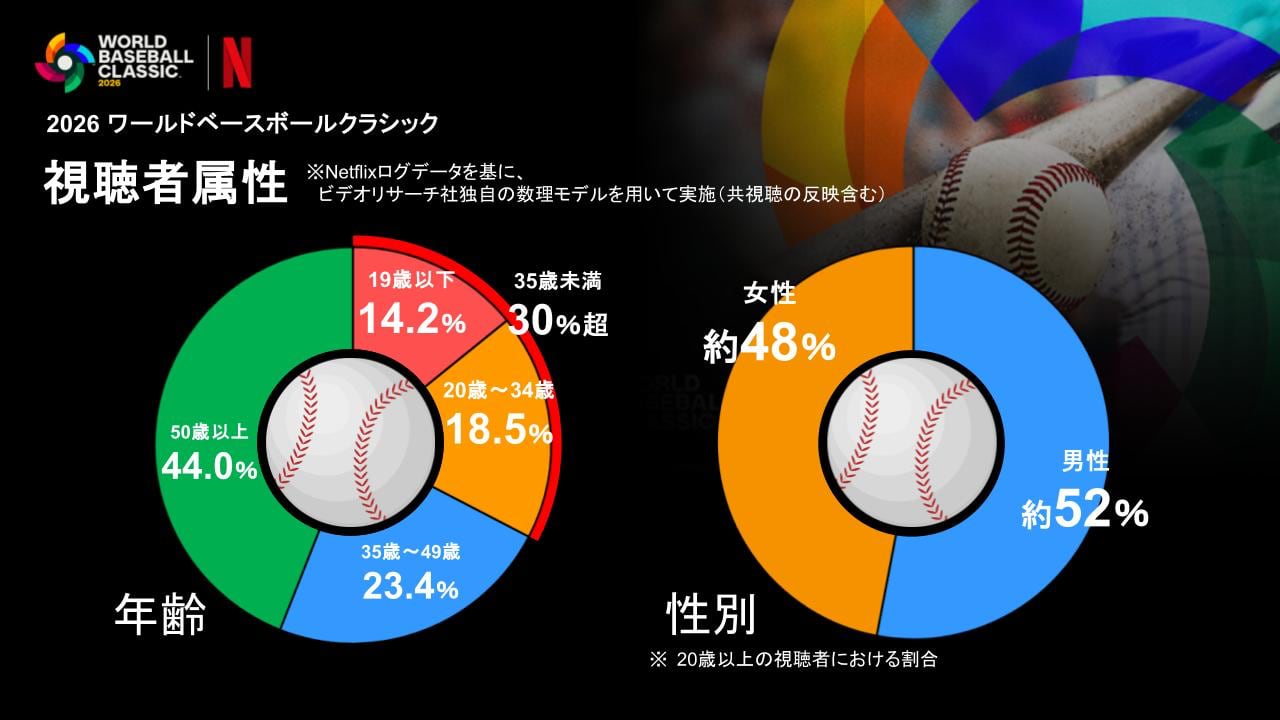
Using Netflix’s ログデータ (rogu deeta, log data) and a proprietary mathematical *モデル (moderu, model*) developed by Video Research, the company analyzed audience attributes such as age and gender.
The results showed clear trends:
- Over 30% of viewers were under 35.
- Approximately 48% were women.
According to Netflix, streaming the WBC significantly broadened Japan’s traditional baseball fan base, particularly by attracting younger viewers and women.
Controversy and Industry Impact
This year’s WBC also sparked debate. Because there was no terrestrial TV broadcast, some critics argued that elderly viewers were left behind. The decision stirred discussion about access and digital divides.
Another talking point was the relationship between traditional broadcasters and streaming platforms. Nippon TV handled the production of the broadcast footage, highlighting evolving cooperation between television networks and streaming companies.
For Japan’s media industry, this tournament may mark a turning point in how live sports are delivered and consumed.
Viewing Habits: How People Watched
For Japan games, the average viewing time per game was 147 minutes — more than two hours of sustained attention.
When it came to devices, about 85% of viewing occurred on televisions, showing that even for streaming services, the TV screen remains dominant for live sports in Japan.
Cultural Context: Baseball and National Identity
Baseball holds a special place in Japanese culture. International tournaments like the WBC are not just sporting events — they are moments of national unity. The term 侍ジャパン (Samurai Japan) evokes both modern athleticism and traditional warrior imagery.
The fact that over half of viewers also watched non-Japan games suggests something important: interest may be shifting from pure national loyalty to a broader appreciation of international competition.
At the same time, the criticism about the lack of terrestrial broadcasting reflects Japan’s aging population and ongoing conversations about digital accessibility.
Learn Japanese from This Article
Key Vocabulary
| Japanese | Romaji | Meaning |
|---|---|---|
| ライブ配信 | raibu haishin | live streaming |
| アーカイブ | aakaibu | archived recording |
| デバイス | debaisu | device |
| ログデータ | rogu deeta | log data |
| コンテンツ | kontentsu | content |
| モデル | moderu | (statistical) model |
| データ | deeta | data |
| トップ3 | toppu surii | top three |
Notice how many of these are loanwords written in katakana. Modern Japanese media and tech reporting relies heavily on English-derived vocabulary.
Grammar Spotlight
1. 〜を基に(して) — “based on”
Structure: Noun + を基に(して)
Example from the article: ビデオリサーチ独自の推計データを基に集計した。 Bideo risāchi dokuji no suikei deeta o moto ni shūkei shita. “The figures were calculated based on Video Research’s proprietary estimation data.”
More examples:
ログデータを基に分析した。 Rogu deeta o moto ni bunseki shita. “They analyzed it based on log data.”
アンケート結果を基にレポートを書いた。 Ankēto kekka o moto ni repōto o kaita. “I wrote the report based on the survey results.”
This pattern is common in formal writing, research, and news articles.
2. 〜における — “in” / “regarding” (formal)
Structure: Noun + における + Noun
Example: 日本における同社の単一タイトルとして史上最多 Nihon ni okeru dōsha no tan’itsu taitoru to shite shijō saita “The most ever for a single title in Japan for the company.”
More examples:
日本における野球の人気 Nihon ni okeru yakyū no ninki “The popularity of baseball in Japan”
若者におけるSNSの利用 Wakamono ni okeru SNS no riyō “SNS usage among young people”
You’ll often see this structure in formal reports and academic-style writing.
Useful Expression
物議を醸した Butsugi o kamoshita “Sparked controversy” / “Caused debate”
Example: 地上波放送がなかったことで物議を醸した。 Chijōha hōsō ga nakatta koto de butsugi o kamoshita. “It sparked controversy because there was no terrestrial broadcast.”
Continue Learning
To understand more about time-related expressions like dates and durations, explore our Time and Dates: Tense-Free Expressions
Streaming, sports, and statistics — this single news story gives you insight into modern Japanese media, digital culture, and formal written Japanese. Keep noticing patterns like 〜を基に and 〜における when you read Japanese news, and you’ll start understanding authentic articles the way they’re written in Japan.
これからもよろしくお願いします。 Kore kara mo yoroshiku onegaishimasu.